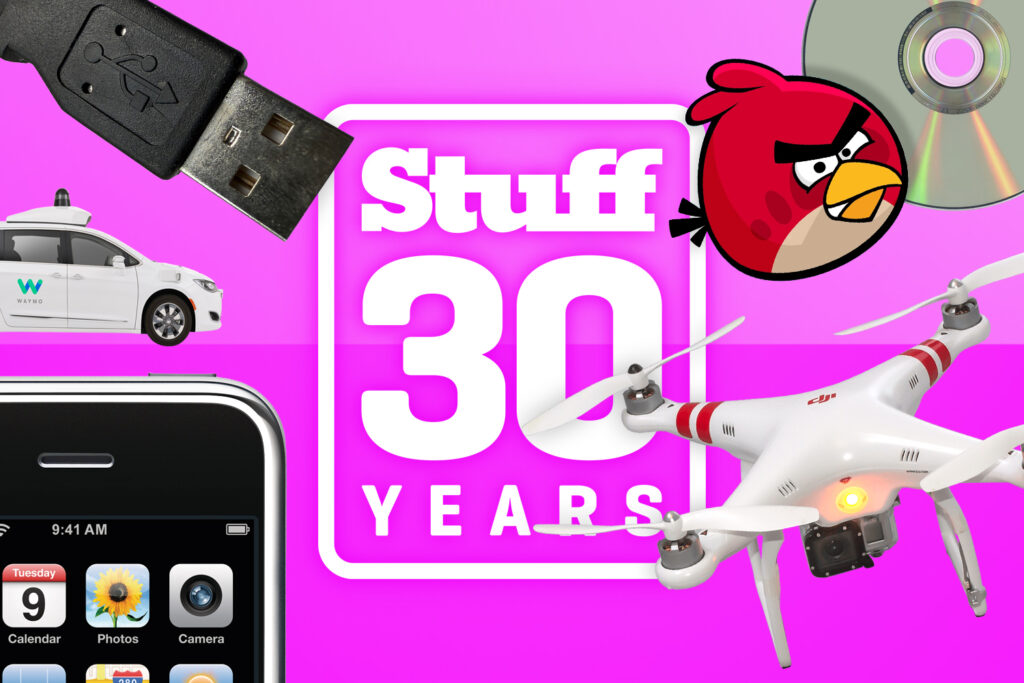
1996. Ewan McGregor goes swimming in a Scottish toilet, The Spice Girls launch Girl Power and a sheep gets cloned. Oh, and some other things happen too, like the mighty Stuff magazine making its debut. So now the mag’s in the year of its big three-oh, I thought it’d be fun to pick 30 key tech events from the past 30 years, including the launches of revolutionary smartphones, cars, gaming gear and more.
And, no, Will Smith dubiously saving the world by uploading a virus from an Apple PowerBook to an alien mothership isn’t one of them. Sorry, Hollywood.
DVD spins into view
Format wars rarely help anyone. Consumers have to make an expensive bet on which one will win. Ask anyone who went all-in on Betamax how that worked out for them. And for the successor to home video tapes, a massive scrap was brewing as various companies explored how to best replicate the success of CDs with video.
In one corner sat giants Philips and Sony. In the other, a raft of competitors. Then, on 3 May 1995, a technical group comprising Apple, Microsoft, IBM, Compaq and Hewlett-Packard proved that the press release is mightier than the sword. At least if that press release said there would be a boycott of both formats unless the warring factions put aside their differences.
A spec was duly hammered out and DVDs entered the wild the following year. They took time to catch on, but once you realised that, unlike a VHS player, your DVD drive wouldn’t eat your movie for lunch, it was impossible to go back to tapes.
USB gets connected

The clue is in the name: Universal Serial Bus. The aim was to standardise plugging things into computers, meaning you could connect a mouse to a PC or a Mac without swearing at dongles (or your lack thereof). Adoption wasn’t blazing fast but Apple, of all companies, gave USB a boost by ditching proprietary connectors and using it on the iMac.
As that machine took off, peripheral makers rushed to produce USB versions of their gear – usually with bits of translucent blue plastic attached. As the rest of the industry got on board, it soon became clear that USB was handy but slow. So the spec marched forward, although not always helpfully. Today, devices have ports that look identical but that can do wildly different things. Good luck telling them apart.
Tomb Raider strikes gold

To argue that gaming grew up in the mid–1990s is something of an overstatement. The way Lara Croft’s angular form was paraded across lad mags of the day didn’t exactly scream maturity. But Tomb Raider – especially on PlayStation – did represent a giant leap forward from the previous generation of gaming. At least if your ham-fisted efforts didn’t find Lara tumbling down a cliff to her untimely demise.
At the time, the game’s mix of exploration, puzzles, combat, tension and occasional dinosaur murder made it feel almost cinematic. It also provided a template for its generation of consoles to follow, proving games could be about atmosphere and adventure. Lara herself became a gaming icon, even if her cultural baggage sometimes threatened to overshadow the fact that Tomb Raider was genuinely pushing the medium forward.
Apple buys NeXT

It’s said Steve Jobs was surrounded by a reality distortion field. The same might be true of his backstory: the misunderstood genius, unjustly ejected from the company he founded, only to reinvent himself and return triumphant. As Steve Jobs in Exile shows, the truth is murkier. But there’s no debate that Jobs’s return to Apple saved the company and helped revolutionise multiple industries.
The catalyst was the Mac OS Jobs himself was partly responsible for. It was deeply flawed and, by 1996, horribly fragile. Apple’s attempts to replace it had gone nowhere, so then-CEO Gil Amelio looked to NeXT – Jobs’s other company, itself running on fumes after a series of poor decisions. However, operating system NeXTSTEP wasn’t one of them.
One $427 million purchase and board-sanctioned coup later, Jobs was in control of Apple and began transforming a beleaguered company 90 days from insolvency into the tech giant responsible for the iMac, Mac OS X (NeXTSTEP in a glossy Aqua coat), the iPod and the iPhone.
Bluetooth cuts the cord

During the 1990s, the tech world decided cables were the bane of everyone’s existence and started trying to eradicate them. Wireless standards made it possible to beam the internet across a building rather than tethering computers to modems. The following year, Bluetooth arrived – and was every bit as transformative.
Bluetooth had a slow start and took time to take hold. But by the 2000s, Bluetooth accessories – like the depicted Ericsson headset – were everywhere. Headphones no longer chained you to whatever was pumping audio into your ears. Bluetooth keyboards and mice freed your desk from cable spaghetti. And you could play on a console without having to sit infuriatingly close to the TV because some genius decided gamepad cables only needed to be half a nanometre long.
Now we’re on Bluetooth 6, with greater range, precision and efficiency. The downside? Hardly anyone’s impressed anymore. Bah.
BlackBerry begins

Research In Motion began life in the mid-1980s but really found its stride with a product line so instrumental that the company was eventually renamed after it. The BlackBerry 850 pager let business wonks party like it was 1999 – because it was. Their idea of a party, though, was having instant access to email everywhere.
Still, that was enough and the BlackBerry OS and RIM devices rapidly built on that foundation, adding SMS functionality, voice calls, colour displays and web browsing. By 2007’s BlackBerry Curve, advocates were convinced the world had hit peak smartphone – until the iPhone yomped in and stole BlackBerry’s thunder. Even then, BlackBerry clung on for years, buoyed by die-hard physical keyboard fans disgusted by the prospect of tapping out emails on a touchscreen.
Before its death rattle, the company did flirt with fully touchscreen devices and even Android. But keyboard lovers still got their hit with the Key2, which brought the 1990s kicking and screaming into 2018.
Napster sets sail

Napster was the result of an industry caught napping. Having grown fat and lazy selling consumers music on different formats over and over, industry execs failed to spot the digital revolution. MP3 files freed music from physical media and Napster provided a brilliantly simple way to download them.
The peer-to-peer network didn’t store anything, instead having you grab music from other people’s computers. You could chat while you waited, unearth the most obscure tracks, and revel in the gloriously chaotic free-for-all. Naturally, it couldn’t last. And, to be fair, it shouldn’t have, since artists lost income.
Predictably, the music industry hurled lawyers at Napster until it went bankrupt. Its assets were then passed between companies that flogged the brand to death as everything from a legit streaming service to its current incarnation as an “AI platform for creating and experiencing music in new ways”. You might say the latter at least echoes the original’s disruptive nature. The painfully corporate nature of the website would suggest otherwise.
PS2 takes over

Assuming it isn’t lying about sales numbers – and the company has ‘revised’ them at least once – Sony created the biggest-selling games console of all time. The original PlayStation may have reimagined gaming, but the PS2’s Japanese release on 4 March 2000 started a domino effect that was much more transformative.
Success happened because Sony got almost everything right. Launch titles like Ridge Racer V and Street Fighter EX3 showed the PS2’s clout and range. And if the launch titles weren’t to your taste, backwards compatibility meant your PlayStation collection got a stay of execution.
But the real act of genius was including DVD support while undercutting standalone players. If you fancied owning films on shiny disc rather than tapes prone to getting eaten, Sony left you with no excuse to not grab a console. That combination was so alluring that the PS2 didn’t just win its generation, but it gatecrashed the next one too, outselling its own successor for several years.
Wikipedia opens minds

Humans have long had a thing about writing down everything they know – early encyclopaedias date back over 2000 years. They were hefty tomes back then, but became even heftier over time, sprawling across dozens of volumes and thousands of pages. But even if you could afford a set, where would it go? And what would happen when it became outdated? Wikipedia aimed to solve those problems in one fell swoop.
The site was effectively Douglas Adams’s Hitchhiker’s Guide to the Galaxy minus the whimsy. On day one, it offered several thousand straight-laced articles and invited users to add more. Initially, it was a glorious mess. Today, Wikipedia is much tighter and more accurate, although regular battles ensue between contributors and editors arguing over what deserves inclusion.
Still, Wikipedia never lost sight of its mission to make knowledge freely available, and it’s now the world’s most visited website – aside from social media, search engines and messaging platforms. Citation required? Hey, look it up on Wikipedia!
iPod pockets music

The arrival of iTunes in 2001 heralded Apple’s major play for music, albeit initially with barely more regard for copyright than Napster. Invites to “rip, mix, burn” raised eyebrows among IP lawyers, unconvinced by Apple’s interpretation of format shifting as fair use. Still, the company got away with it – and then unleashed the iPod.
On 23 October 2001, Steve Jobs methodically demolished the competition and explained how the iPod alone got portable digital players right. It was as small as a deck of cards yet held a thousand songs. The scroll wheel made navigating huge libraries painless. And FireWire let you fill the thing in minutes rather than hours.
A Windows version followed, along with a slew of variations. And in 2003, Apple went properly legit, strong-arming the music industry into letting people buy individual album tracks on the iTunes Store. That was a major tech moment in itself, as media IP owners lost control over how music was packaged and sold. It wasn’t a mistake they’d make again.
Steam changes the game

Steam’s gestation was bumpy, but there’s no denying its 12 September 2003 debut upended PC gaming. Valve wanted automatic updates and stronger anti-piracy measures for its own games. No one else fancied building the system, so Valve did so itself.
The early years were plagued with server woes and compatibility headaches that dented Steam’s reputation. But convenience eventually won out. As broadband speeds improved, Steam slowly became where millions chose to buy PC games, no doubt buoyed by the regular sales, cloud saves and the ability to stream games to a range of devices.
Eventually, Steam decided that software wasn’t enough and started dabbling in hardware too. But it took until 2022 and the eye-poppingly affordable (at least until AI ramped up component prices and ruined everything) Steam Deck handheld before it had a genuine hit. Yet again, Valve had changed the very nature of PC gaming – something it now aims to do for a third time with its Steam Machine telly box.
Nintendo DS flips the script

The Nintendo DS was initially met with scepticism. Gaming types grumbled that a prototype at E3 2004 resembled a dual-screen Donkey Kong Game & Watch that you poked at with a stick. Nintendo didn’t appear overly confident either, talking up the platform’s unique nature but saying it would sit alongside existing hardware rather than replace it.
However, demand quickly outstripped supply, with the handheld’s immediacy clicking with the masses. Shrewd game releases like Nintendogs and Dr Kawashima’s Brain Training/Brain Age put the device into the hands of people who’d never usually touch a console. Nintendo eventually sold 150 million of the things.
It was such a good trick that Nintendo repeated it twice – with the Wii and its fantastic motion controls and then the take-anywhere Switch and its many intuitive ways to play. Those consoles faced plenty of scepticism too, suggesting those ‘in the know’ should learn that getting more people to play games means not assuming everyone else wants the exact same things they do.
YouTube goes live

The purported origins of YouTube are even less wholesome than Facebook’s, combining one founder’s frustration about not finding clips online of Janet Jackson’s Super Bowl ‘wardrobe malfunction’ and other founders urging women to upload videos of themselves to what was initially a video dating site. Fortunately, the first actual upload was more congenial – the family friendly ‘Me at the zoo’.
That took place on 23 April 2005. A year later, tens of thousands of videos across every subject you could imagine were being uploaded daily. That caught Google’s attention – and, surprisingly, retained it. YouTube thereby managed to avoid the Google graveyard, rising to dominate online video and supplant traditional telly.
Today, most streaming giants burn through billions making original content. YouTube mostly broadcasts everyone else’s efforts. It’s a smart strategy and means that far future Earth will probably house cockroaches, YouTube comments and a single short, forever playing on a loop, explaining how to fix an inkjet printer.
Android is born

Android predates Google. But on 11 July 2005, everything changed when the search giant paid a reported $50m for the little-known enigmatic company apparently working on smartphone software. It was a fantastic deal, positioning Google to ‘be Microsoft’ for mobile. But also, the Android team had vision and pace.
That proved vital when the iPhone arrived. Until then, the template had been BlackBerry phones. Android pivoted at speed, adding touchscreen support for devices like the depicted HTC Dream. Because Android could be licensed and customised, it quickly became the dominant mobile OS, swatting aside all competition bar iOS.
Since then, Android’s flexibility has seen it spread from phones into cameras, consoles and computers. And in 2026, it’ll make a major play for the desktop as the successor to Chromebook. So watch out, Windows.
Apple reinvents the phone

It’s easy to forget that keyboards once ruled the smartphone world. But Apple reasoned they shouldn’t hog space when you don’t need them, and turned the entire front of a device into a touchscreen.
That said, the first iPhone was expensive (from $499) and limited, lacking 3G and third-party apps. Nobody was convinced by Steve Jobs insisting web apps were a “sweet solution”.
What many failed to grasp was what removing the keyboard enabled. Arguments the iPhone wouldn’t appeal to business customers because it lacked a keyboard fell apart when you could have on-demand custom interfaces tailored for individual apps and languages.
The following year, Apple fixed the iPhone’s biggest flaws, adding 3G, slashing the price and launching the App Store. Inevitably, industry rivals faced the choice of holding their ground or getting out their photocopiers. Sensible ones chose the latter. Yet such was the iPhone’s allure that it went on to capture half the US market, a fifth of global smartphone sales and most of the profits.
Kindle rewrites reading

Amazon’s e-reader was far from the first, but it was arguably the first that mattered. Unveiled by Amazon’s CEO, Jeff ‘I have all the money’ Bezos, at a swanky New York hotel, the Kindle took aim at rivals and paper tomes alike.
In one sense, Kindle really did provide a glimpse of the future. It prized immediacy, letting you download books, news articles and Wikipedia entries over the air rather than laboriously loading them from a PC. You could even lob Office documents at yours via a personalised email address, if you fancied ruining your reading time with work.
Objectively, the device itself was otherwise akin to an escaped prototype. The design was ugly, the screen refreshed painfully slowly and the navigation system was awkward and bizarre. None of those things stopped the Kindle flying off Amazon’s warehouse shelves like a best-seller though. Its launch dragged digital books into the mainstream and gave Amazon the happiest of endings, given its later dominance of the space.
Minecraft is unearthed

The genius behind Minecraft was that it echoed Lego bricks, in that you could use the most basic pieces to craft the most magical of creations. 17 May 2009 was the key moment. Markus ‘Notch’ Persson posted an early version of his mining and building game to a forum. Immediately, excitement spread as players posted screenshots of their blocky constructions, including a 3D Mario made from brick, dirt and stone.
As players built within the game, its founder built up the game itself, adding multiplayer, enemies, Redstone to enable rudimentary ‘circuits’ and Creator mode that let people just be and build for fun.
Today, Minecraft is no scrappy indie. But millions will attest that – like Lego – while there are way more specialised pieces these days, it’s no less creative or fun.
Raspberry Pi goes public

The Raspberry Pi prototype resembled a USB stick with bits of nerdery glued on. Hardly TV magic, but the BBC’s Rory Cellan-Jones was intrigued enough to shoot an interview with Pi co-founder David Braben and upload it to YouTube.
The clip spread like wildfire. 8-bit-era veteran and Eliteco-creator Braben believed computing had lost its way, with layers of obfuscation increasingly locking people out – and that was assuming they could afford to buy hardware. The Pi, he hoped, would be cheap and open enough for everyone.
It was. The Pi kicked off a DIY computing revival, winning over enthusiasts of all ages with its low price ($35) and open nature. But the Pi Foundation didn’t stop there. A few years later, the Pi Zero arrived for just $5 – cheap enough to become a covermount for an issue of The MagPi magazine. In the 8-bit era, you’d occasionally get a cassette full of games taped to a front cover. Braben had helped upgrade that to an entire computer.
Angry Birds hits a billion

It was 52nd time lucky for Rovio when its Crush the Castle riff became a mega-hit. Just as well, because the studio was almost out of cash when it catapulted its feathered gang on to mobile. The game immediately took off, with its touch-friendly artillery action and absurdist violence clicking with folks who fancied gaming in spare moments but not carting a handheld around.
The event that wowed, though, was Rovio announcing in 2012 that Angry Birds downloads had hit a billion. Sure, this was cumulative, across the many sequels that existed by then, such as Angry Birds Space. But Rovio had proved that while it was one thing to dismiss mobile as not ‘proper’ gaming (as many did and still do), there was definitely proper money to be made.
Having conquered gaming, Angry Birds subsequently spread its wings elsewhere, notably on the big screen. Although whether this year’s third outing is a featherbrained idea or a real tweet remains to be seen.
Tesla Model S revs up

With the Tesla Roadster, the company Elon Musk totally, definitely, irrefutably co-founded (per a legal settlement) obliterated the idea that electric vehicles were slow, boring and only suited to short city trips. It excited the auto industry, but it was expensive and impractical.
On 22 June 2012, select customers got their hands on the Tesla Model S at the company’s Fremont factory. They came away impressed. So did everyone else. The car won a stack of awards and became one of the most consequential vehicles in decades.
It had great range and performance. And while it wasn’t cheap, it didn’t feel like an impossible fantasy to own one. Saying it was the moment EVs truly arrived might be hyperbole, but only just.
The Model S nailed luxury, accessibility and futurism, making its launch the obvious car ‘event’ for this list. Hard to believe the same company later unleashed the Cybertruck, not so much pointing towards tomorrow as bringing to life a low-poly car from a 1990s video game.
Voyager 1 goes beyond

In 1977, NASA launched space probe Voyager 1 to have a nose around the outer Solar System. It first sent back holiday snaps from Jupiter and then nipped to Saturn. Several years later, the probe shot the deeply humbling photo Pale Blue Dot, depicting the Earth as less than a single pixel as seen from over six billion kilometres from home. It then packed away its camera for good.
That decision was taken to preserve energy and resources – and presumably because endless shots of inky black weren’t of interest to NASA boffins. It also helped the probe to eke out an existence until 2012, whereupon it crossed into interstellar space and became the first human-made object to achieve that feat.
Astonishingly, Voyager 1 continues to gather data to this day. Not bad for a piece of tech originally designed to last a handful of years and that packs less computing grunt than an 8-bit micro, let alone the phone you carry around in your pocket.
DJI Phantom takes flight

For the longest time, drones were associated with war. As technology advanced, so did destructive capabilities, from drones attempting to dump incendiary balloons on a city during a mid-1800s skirmish to modern variants that are effectively semi-autonomous lethal aircraft without pilots inside. DJI’s first Phantom, though, took drones to the masses, without all that nasty killing business.
There were others on the market, but DJI echoed Apple in making a fully assembled product that was easy to use. The masterstroke was the optional GoPro mount, giving photographers and filmmakers access to sweeping shots that previously would have cost a small fortune rather than a relatively piffling few hundred bucks.
Having secured itself a hit, DJI rapidly improved its drones, adding better controls, longer battery life and enhanced obstacle sensing. Unfortunately, the same features that made them fantastic consumer gadgets also made them rather attractive to militaries. But that’s technology for you – build something useful and someone will eventually figure out how to weaponise it.
Alexa listens in

This one’s a dual event. On 6 November 2014, Amazon launched Alexa alongside – or perhaps it’s better to say inside – the first Amazon Echo. The Echo was a tube-like speaker that looked like it had arrived from the future. It had none of the friendliness of modern equivalents, with their fuzzy covers and cheerful vibes. That suited Alexa, which always came across as a little cold while it sat awaiting your command. And it was always listening, which felt a bit weird.
Fortunately, Alexa wasn’t the kind of tech to announce, “I’m sorry, Dave. I’m afraid I can’t do that” in a calm yet creepy voice. In fact, Amazon went out of its way to make Alexa extensible through ‘skills’ that let it work with third-party apps and services. Although, naturally, the system’s first love always remained Amazon itself. Still, at least Alexa didn’t refuse to open the doors if you had the sheer audacity to purchase something from a rival, thereby derailing its primary mission.
Pokémon Go… goes

Video games are often criticised for encouraging people to sit on their bums, staring at a glowing screen. Pokémon Go instead had you emerge, blinking, into the daylight, to lob virtual Poké Balls at virtual Pokémon overlaid on the real world.
If you were concerned about looking like a massive weirdo while frantically swiping your phone and whooping after successful captures, you needn’t have been. Despite middling reviews, Pokémon Go amassed millions of players within days of its 6 July 2016 debut and quickly spread worldwide.
Even issues with assigning key locations to the likes of graveyards didn’t dent the game’s popularity. That said, its wholesome image did more recently take a hit when it emerged captured location data may have been used to train delivery robots. Gotta catch ’em all!
Apple finds ‘courage’

Why did Apple remove the standard headphone port from the iPhone 7? According to exec Phil Schiller, it came down to one word: courage. Specifically, “the courage to move on [and] do something new that betters all of us”. A noble goal, although with a handy side effect: removing a port that had been a mainstay of audio kit for decades meant iPhone users suddenly needed something else. Enter: AirPods.
The rest of the industry mocked Apple. Schiller’s ‘courage’ became a meme. Android rivals ran ads pointing out that their devices still had the beloved port. Right until they didn’t. Within a couple of years, almost every major smartphone maker removed it too – along with any evidence of those wonderful ads explaining why Apple was wrong. Funny how quickly ‘courage’ caught on.
Phones get the bends

At some point, the industry realised something would have to give. As smartphone makers dreamed of screens growing to tablet dimensions, they faced an awkward truth: making such devices pocketable would require comedy trousers. So multiple companies hit upon a cunning solution: folding phones.
The Royole FlexPai was the first out of the gate. Its screen was on the outside, making for maximum scratch potential. When unfolded, the screen bump was annoyingly glaring. Also, the device felt cheap, laggy and buggy. Not ideal.
Fortunately, refined alternatives quickly followed, including the Samsung Galaxy Fold and Huawei Mate X. Manufacturers also dabbled in smartphones that folded in half, like a futuristic flip phone. The tiny snag with all these devices? They were very fragile and very expensive. They still are.
Waymo gets its driving permit

Although Waymo’s origins stretch back to the mid 2000s at Stanford, the team’s self-driving ambitions accelerated on joining Google. Many prototypes later, one of its cars famously took a blind man on an autonomous trip along a public road. Mildly terrifying for all concerned. The following year, the company became Waymo and testing began in earnest.
The key breakthrough came in October 2018, but it wasn’t a car. It was California granting Waymo a permit to operate without safety drivers – handy, given that having someone poised to take control at any moment undermined the whole point.
Having ditched driving instructors and gained licences, Waymo cars now roam a growing number of cities. There’s no stopping them. Well, apart from in May 2026, when a horde of Waymo cars mysteriously congregated in an Atlanta suburb and ground to a halt. Waymo blamed a software glitch. Let’s hope that’s true and the cars weren’t quietly plotting removing all humans from existence rather than just taxi drivers.
Starlink takes off

A couple of years before ‘we’ve got Lex Luthor at home’ became the world’s richest person (on paper), his company was busy hurling satellites into orbit. Following a limited test run the year before, 60 Starlink satellites abruptly found themselves in space, beaming internet back to beta testers on Earth, who revelled in surprisingly fast speeds wherever they happened to roam.
Elon Musk wasn’t done. Seemingly seeking domination of skies and internet alike, his network grew to more than 10,000 satellites. Quite whether it was wise to place so much power in the hands of an increasingly erratic, terminally online individual remains to be seen. Let’s hope the satellites don’t one day start firing Neuralinks into our brains from orbit, forcing us to love Musk or, worse, start posting on X again.
Windows Phone killed

Having dominated the desktop, Microsoft assumed it’d get to do the same on mobile. But by the time it stopped messing about with the widely disliked Windows Mobile, based on Windows CE, it was too late. Android owned most of the market, while Apple ate up the profits. There was no room for Windows.
Which is a pity. Not because Microsoft deserved any, but because Windows Phone tried something different, with a futuristic interface based around live tiles. Alas, it had no future itself.
Microsoft broke device and app compatibility between Windows Phone 7 and 8. Devs drifted away and the platform limped on until 2017, when Microsoft admitted it was no longer a ‘focus’. It was finally put out of its misery on 14 January 2020, leaving a duopoly in its wake.
ChatGPT prompts panic

Even ChatGPT will admit it wasn’t the first large language model (LLM) when you ask it. But it was the first that went mainstream. Systems like it had long been explored and used by researchers, but ChatGPT’s 30 November 2022 release made the technology accessible to pretty much everyone through the simplest of interfaces.
Within two months, it had reached over 100 million users. Today, that number is around ten times higher. Which you’d think would be a great success story for developer OpenAI, but – to borrow a phrase – it’s complicated.
ChatGPT gained a reputation for inaccuracy. What the AI industry calls ‘hallucinations’ are actually confidently delivered errors, because LLMs are essentially prediction engines like auto-complete, but trained on vast chunks of the internet, which means they get ‘lucky’ more than most.
More recently, ChatGPT has been embroiled in controversy over copyright infringement, allegedly providing harmful advice, burning through resources and triggering an AI arms race. Still, at least you can now write emails slightly faster.
Read the full article here