

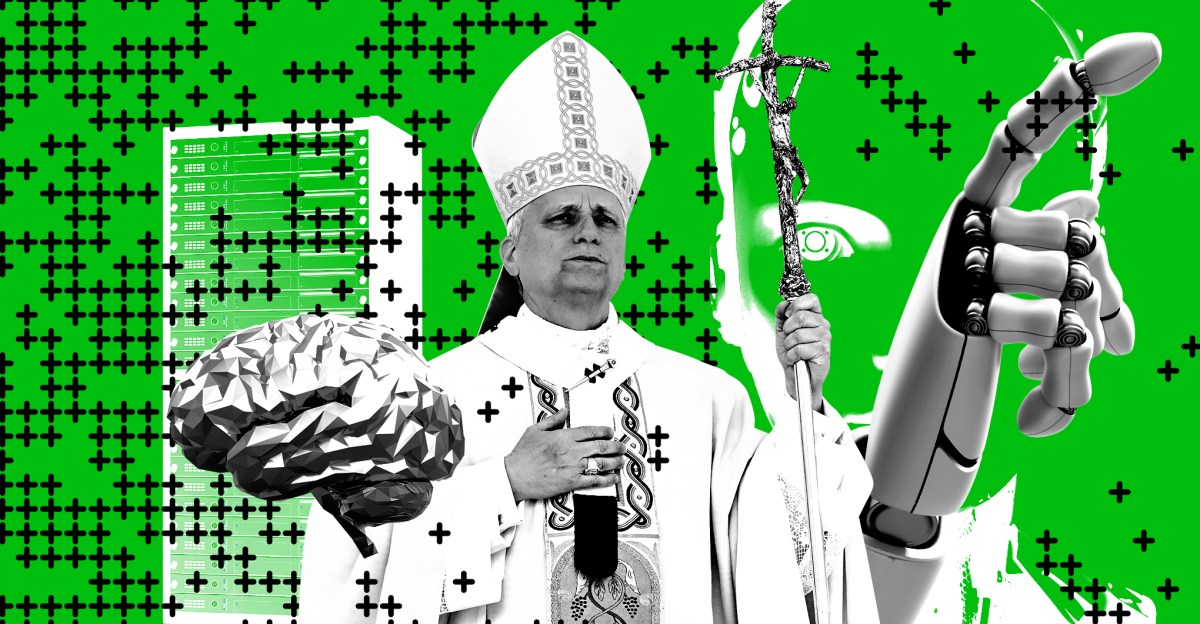
Pope Leo XIV probably isn’t the first person you picture when conversation turns to Artificial General Intelligence doomsday scenarios. But last month, AGI researcher John-Clark Levin found himself inside the Vatican on a mission to put those concerns in front of the pope.
Levin hasn’t been acting alone. In the past year, he has been quietly assembling a loose network of roughly three dozen academics, scientists, policy researchers, and priests — a group he half-jokingly calls the “AI Avengers” — who meet virtually to strategize how to get the Vatican thinking more seriously about AI’s more extreme possibilities.
His main worry is that the pope will take too long to realize the risks of artificial general intelligence (AGI), a goal pursued by some of the world’s biggest tech companies like OpenAI, Microsoft, Google, and Meta. “If you wait for perfect certainty, it’s going to be too late to act to stave off the very severe danger that appears to be just several years away,” he tells The Verge.
The Vatican’s AI moment
AGI is, to put it mildly, a divisive idea. There is no consensus on what AGI is or when it may arrive, even among the communities that fully buy into it. At its core, it usually refers to AI that matches or exceeds human performance across all measurable cognitive domains. It’s in the details where things get messy. Depending on your definition — and there are many — AGI might already be here, is just around the corner, or may never arrive. The expected impacts of AGI are equally diverse, ranging from enormous economic abundance and unprecedented scientific and medical breakthroughs to widespread inequality, geopolitical unrest, and catastrophic threats like nuclear wars and pandemics.
For those who care about these risks, reducing them is a top priority that will require buy-in across industry, government, and civil society worldwide. Unsurprisingly, a lot of lobbying has focused on China and the US — where most frontier AI labs are based and many experts believe AGI would be most likely to emerge — but the Vatican is becoming an increasingly important stop on the lobbying circuit too.
While the Vatican is clearly not a major world power when it comes to its tiny size, military, and economy, it wields a tremendous amount of soft power. As the head of the Catholic Church, the pope’s moral and spiritual authority cuts across borders, industries, and ideologies and shapes global opinion. Directly, there are 1.4 billion Catholics and a vast network of religious, diplomatic, and cultural institutions worldwide and history suggests this influence reaches far beyond the Church too. This, alongside its almost-unique position as a neutral entity in global affairs, gives the Vatican almost unparalleled connections and convening power that could prove decisive in mediating discussions on AGI, particularly given the tensions and arms-race dynamic between China and the US.
There are also some special things about Leo when it comes to AI that could prove particularly useful in shaping global AI discussions. He’s American — a papal first — which could make it easier for him to engage with many of the frontier AI labs racing to develop AGI, which are overwhelmingly US based. He’s also got a degree in mathematics and, reportedly is relatively tech savvy — also something of a papal novelty — meaning he would be more comfortable than most on addressing the more technical aspects of AI too.
Putting AGI on the agenda
Nobody is expecting Pope Leo to referee the AGI debate or even to pick a side. As one might expect for a centuries-old institution, the Vatican is not normally a swift actor on new technologies and will typically launch lengthy consultations with outside experts before beginning to develop its position. The ask for the Vatican is simpler: acknowledge AGI as a possibility, consider it seriously, launch a consultation, and scrutinize the risks and benefits on its own terms. That’s the message Levin has been trying to get in front of Leo for months.
“There’s clearly a wellspring of interest in this, even among the clergy.”
For his part, Leo — and the Catholic Church in general — hasn’t exactly shied away from AI. Quite the opposite. It’s hardly a secret that the Vatican wants a seat at the table on AI. Pope Francis, Leo’s immediate predecessor, frequently spoke about AI’s impact on society. He also spearheaded the Rome Call for AI Ethics, a voluntary framework signed by tech giants including Microsoft, IBM, and Cisco. Less deliberately, Francis triggered a global debate over deepfakes and misinformation when AI-generated images of him modelling a stylish white puffer jacket went viral. For that, he is better known by the moniker “Balenciaga Pope.”
Leo has gone a step further and made AI a defining issue of his papacy. It inspired his papal name — he sees similarities between AI’s challenges today and those the industrial revolution posed in the days of Leo XIII — and his speeches, media engagements, and official statements are littered with comments about the risks AI poses to “human dignity, justice and labour.” These aren’t footnotes or minor events, either: Leo mentioned the risks and “immense potential” of AI numerous times in the first few days of his papacy, including during his first formal addresses to cardinals and the media.
He’s also convening experts and is clearly paying attention to relevant conferences and gatherings on AI. According to several Vatican observers The Verge spoke to, it is something of an open secret that he is preparing an AI-focused encyclical, an influential document Father Michael Baggot, a professor at the Pontifical Athenaeum Regina Apostolorum in Rome, says is “one of the chief means of teaching on contemporary issues” today. In many ways, the document will take up the mantle of Pope Leo XIII’s encyclical Rerum Novarum, which addressed the upheaval of the industrial revolution and laid the foundation for modern Catholic social teaching.
Notably absent is any talk of AGI, or even an acknowledgement of its central position in many heated arguments wracking policy and tech circles debating the future of AI. Levin, a research lead at Kurzweil Technologies, the research lab of famed computer scientist and Google futurist Ray Kurzweil, felt that needed to change. He tells The Verge he just wants the Vatican to accept AGI as something that’s possible and plausibly coming soon, in essence taking it seriously enough to investigate the implications now rather than waiting for scientific certainty to coalesce. Concretely, that would look like a formal scientific consultation on AGI specifically, collecting insights from experts around the world to inform the pope’s thinking, likely under the auspices of the Pontifical Academy of Sciences or the Pontifical Academy of Social Sciences. Pope Francis did a similar thing with climate change. “We’re not trying to suggest theological innovations,” Levin says, just trying to give the pope the information and support needed to make an informed decision.
Silicon Valley has a handy slang term for convincing someone AGI is a genuine and plausibly imminent possibility: AGI pilling. To Levin, then, his “first challenge is to ‘AGI pill’ the Vatican.”
The tricky thing is getting the pope and those around him to think about AGI as more than just a sub-issue of AI. Thinking about AGI is not just thinking about AI, but more so, it’s a different thing entirely, Levin explains. “That’s not the right way to think about AGI.” He says it would be like thinking about the impact of the Industrial Revolution by only looking at only the spinning jenny, the textile machine that allowed workers to spin multiple threads at once — important, but not the full picture and lacking the kind of deep transformation expected.
“Even if he [Pope Leo] is bowled over by whatever I say, and says, yes, we need to act on this, it would be a long runway to actually begin and carry out that scientific consultation.”
Also tricky is infiltrating Vatican circles to even speak with people about AGI. The task would be daunting for even the most experienced lobbyist. The Holy See is a complex mix of a royal court, political center, and religious nexus, and navigating it requires a very different approach to lobbying in Washington, London, or Brussels. Success also requires bridging the worlds of Catholicism and AI safety, two communities not known for their overlap. “The number could probably fit in an elevator,” Levin estimates.
Of all the people in that imaginary elevator, Levin seems particularly well equipped for the mission. He’s a veteran in the AI safety movement, having thought about the ramifications of superintelligent AI at Kurzweil Technologies and other institutions long before ChatGPT arrived on the scene. He’s also connected and engaged in Catholic spheres. Levin says Leo — then Robert Prevost — visited his high school in California twice when he was younger in his role as head of the Augustinian order. Several local priests are apparently still on texting terms with him, he adds.
The act of figuring out the mood on AI in the Vatican is not too dissimilar from good old-fashioned detective work, Levin says. “It sort of has the feeling of going around Rome like an old 1950s gumshoe, pigeonholing priests in gelaterias, grabbing them by the cassock, and saying, ‘all right, give it to me straight, Padre, how does it really work around here?’” he says. “That’s just a massive difference from DC.”
Hyperbole aside, Levin says figuring out the levers of power in the Vatican is a frustratingly slow process. Even though we are months into Leo’s papacy, Levin says it’s still not clear who the pontiff’s most trusted advisers on AI are. Others in Catholic AI circles shared that sentiment. That pace fits uncomfortably with the urgency that Levin and others concerned about the risks of AGI feel. The technology is moving fast — some in the field believe it will be achieved in the next few years — giving an increasingly narrow window in which to act. Levin says he wants to get the Vatican thinking about AGI on its own, before Big Tech convinces it to adopt its own laxer approach to the technology (despite its vocal assurances to the contrary). Levin claims Big Tech companies have been flooding into the Vatican to try and sway the pope on their own priorities for AI and AGI. The secretive nature of Vatican meetings makes this kind of claim hard to verify, but given Big Tech’s lobbying on the matter elsewhere, well-documented channels between the Vatican and tech executives under Pope Francis — which news reports suggest are alive and well under Leo — and the overall importance of the AGI narrative in companies’ talking points, it certainly seems credible.
Shortly after Robert Prevost became Leo XIV, Levin flew to Rome for a conference on AI ethics at the Pontifical Academy of Sciences. There, he met people with similar views on getting the Vatican engaged with AGI. On his return, he started pulling together the “AI Avengers” to virtually workshop ways to get the Vatican’s attention, inform priests about the technology and science, and support the Holy See as it (hopefully) works to formulate a position on AI that takes AGI seriously.
“No one I’ve spoken to about AGI has flat out said, ‘that’s impossible, you’re a heretic, get away from me.’”
Levin returned to Rome in November for the Builders AI Forum, a community whose website says is “dedicated to supporting the development of AI products that serve the Church’s mission.” It’s one of the few places where “conversation [about AI] gets the most concrete,” says Taylor Black, a director of AI and venture ecosystems at Microsoft and the inaugural director at the Catholic University of America’s new AI institute. Most AI talk in Rome is very “high level,” he explains, typically covering familiar Catholic themes like human flourishing and dignity rather than more concrete issues. Another exception to that is the Humanity 2.0 project — a self-described “human flourishing accelerator” — though Black says that “really turned into” Builders.
Though he didn’t participate directly, Leo followed the conference closely. “We did notify him of the work and we made clear that he would be welcome to pop in whenever he found a moment in his schedule,” Baggot says, adding that the pontiff is “aware of our work and encourages us in that work.” To that end, Leo even sent a brief missive to Builders participants. In it, he urged them to ensure AI serves human dignity and the common good and “reflects the Creator’s design.”
Still no mention of AGI, though. Builders’ roster of workshops focused on more tangible topics like healthcare, education, and robotics, so Levin arranged a pair of AGI-themed side events to keep AGI momentum building. One was a dinner and the other a discussion seminar exploring the implications of AGI. Interest was surprisingly high, Levin says, adding that the dinner venue couldn’t accommodate the number of people interested in coming. “I was very pleased… there’s clearly a wellspring of interest in this, even among the clergy, which I wasn’t quite expecting.” Moving forward, Levin says the challenge will be funneling that enthusiasm into concrete action and support as the Vatican begins its “sense making around AGI.”
That unexpected enthusiasm finally gave Levin the break he’d been chasing for months: a chance to make his case to Pope Leo directly. One of the participants at the AGI seminar had an invite to a group audience with Pope Leo later that week and had an unused plus-one. He offered it to Levin.
Levin spoke in an excited tone when he called me late at night from Puglia less than four hours before he was due to travel to Rome for his papal audience. “I expect I’ll only have a brief personal encounter with him, but that will hopefully be an opportunity to pass on a message about the work we hope that the Vatican will undertake with regard to AGI science and the encyclical that is in the works,” he says. The challenge is to be direct and memorable in the short time you get with the Holy Father. “Everyone says, ‘Oh, my mother in law is from Chicago,’ or ‘go White Sox,’ something like that, and you want your message to be something that will hopefully stick in his mind.”
Levin says he’s taking a one-page letter “conveying the bare bones” of his message. He wouldn’t share the full text, but did summarize it for The Verge: it commends Leo for what he’s done about AI so far, urges the Vatican to launch a formal scientific consultation on AGI specifically, not just as a sub-issue of AI, and offers support from the AGI community to help the Vatican make sense of everything.
In the end, Levin wasn’t able to get his direct moment with Pope Leo. As often happens in places like the Vatican, two groups were merged and moved into a larger room, changing the protocol of the encounter and removing the chance for brief, but substantive, personal interaction. He sounded a little deflated telling me this. “But I did hand deliver a letter about AGI.” Per diplomatic protocol, this was handed to one of the pope’s secretaries, not the pontiff himself. Given the high volume of mail the pontiff receives, Levin says he doesn’t have high hopes of getting a reply beyond a form response. “But you never know.”
Levin doesn’t see his brief encounter with the pope as the end of his mission to get the Vatican serious on AGI. Far from it. “Even if he [Pope Leo] is bowled over by whatever I say, and says, yes, we need to act on this, it would be a long runway to actually begin and carry out that scientific consultation,” he explains. “I understand there’s a long way to go.”
While Leo still hasn’t spoken on AGI directly, Levin’s experience suggests the Vatican may be more open to the idea of AGI than anyone expected — and far more open to discussing it than its reputation would imply. “Everyone I’ve talked to directly at the Vatican about this has been quite receptive to my message,” he says. “No one I’ve spoken to about AGI has flat out said, ‘that’s impossible, you’re a heretic, get away from me.’”
Read the full article here
