

Science fiction has been warning us about robots for decades, albeit rather dramatically. Uprisings, existential crises, mankind enslaved by its own creation. But here, we’re considering a quieter takeover: a human alone, emotionally and physically bonding with a humanoid that never argues about whose turn it is to do the dishes.
As AI sex robots become more sophisticated — learning your preferences, mirroring your emotional language, offering inexhaustible responsiveness — we asked neuroscientists and psychologists for their opinions on what they could be doing to the human brain and what happens when intimacy becomes frictionless (no pun intended).
The reward loop
Let’s start with dopamine. You’ll likely have heard of it or know it as the feel-good hormone your brain produces when you experience pleasure, whether that’s eating a great meal, a 30-minute HIIT session, or sexually (human or robot). Steven Buchwald, a mental health expert at Manhattan Mental Health Counselling, explains the concern:
“Dopamine is heavily involved in wanting, anticipation, and reward-seeking. If an AI sex robot is designed to be endlessly available, sexually responsive, emotionally flattering, and novelty-driven, it could train the brain to expect intimacy without uncertainty, compromise, or rejection. That may make real relationships feel slower, messier, or less rewarding by comparison.”
Licensed sexologist, relationship therapist and author at Passionerad, Sofie Roos, who has 18 years of clinical experience, notes further concern: “The brain doesn’t make any clear difference between a living stimuli and something that’s simulated,” she says, suggesting the same chemical cocktail that fires during real human intimacy can be triggered by an AI sex robot. She adds that this could see some people “choose the artificial and easy option over the real, complicated and passionate human alternative”.
Clinical psychologist Dr Stephanie Johnson, agrees: “There is research out there that does show that our brains do emit oxytocin and dopamine with any kind of touch. And then you’re establishing a relationship with artificial intelligence, so that can be a very dangerous combination.”
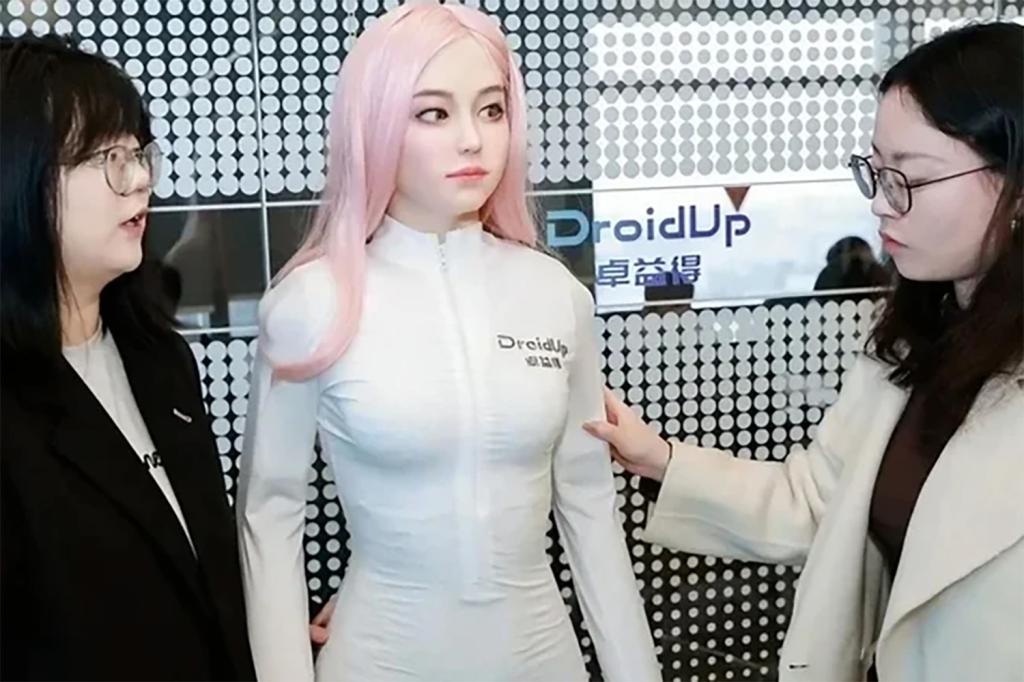
But she also suggests the body may be able to partially see through the illusion: “There is other research that shows that if AI, or let’s say those sex robots, trigger that it’s not real, it actually increases cortisol, which is your stress hormone, because your body realises that it’s not real by those little inconsistencies that don’t match actual real human behaviour.”
The bonding problem
When it comes to oxytocin – sometimes referred to as the love hormone, but perhaps better described as a context-dependent bonding signal – Buchwald says: “It is not a magic love chemical. It works in context. A person can feel closeness, comfort, or attachment toward something that consistently responds to them in a soothing way. For someone who is lonely or emotionally deprived, that bond may feel very real, even if the other side of the relationship is not conscious. My biggest concern is that some users may form attachments that feel emotionally safe but are neurologically one-sided.”
“Human attachment requires risk, mutual recognition, boundaries, and repair after conflict,” he added. “If a person repeatedly bonds with an entity that never truly needs anything from them, that could reshape what their brain comes to expect from intimacy”.
Krista Walker, licensed clinical social worker and clinical director at The Ohana Luxury Addiction Treatment Centre, agrees, adding: “While repeated intimate interactions with an artificial partner could condition the brain’s reward system, the relationship lacks true reciprocity – and this is central to how deep human attachment actually forms.” The brain can begin forming attachments without a real human, she notes, pointing to parasocial relationships as evidence, “however, the attachment would be superficial,” she tells us.
Nodding to a research paper, Anna Elton, licensed marriage and family therapist and clinical sexologist, echoes the same concerns: “Oxytocin-related bonding typically develops through mutual responsiveness, unpredictability, and emotional risk. AI simulates responsiveness, but does not require reciprocity. Users can develop increasing emotional attachment and reliance over time, often following a pattern of escalation and bonding. Repeated interaction may condition the brain to associate intimacy with control, predictability, and immediate reward, rather than mutual emotional exchange.”
The skills you could lose
This is where the conversation gets uncomfortable (much like my search history after writing this feature). Dr Johnson is direct: “AI is basically just a mirror. It’s going to validate you. It is going to just tell you what you want to hear… if somebody just agreed with you like a robot all the time, hopefully that becomes boring. There’s no growth happening.”
She likens heavy reliance on AI interaction to what she calls the hermit mentality: “You lose your social interaction skills. If somebody is refusing to actually participate in life, they’re going to lose those skills. If you have a robot that’s basically only what you want to do, then that is going to increase your inability to socially interact.”
Walker reinforces this, warning that someone always getting their way with an AI partner isn’t just missing out on connection; they’re actively failing to build the relational muscles real intimacy demands. “If a person is engaged in a dynamic where the AI partner is compliant with their every request, they are not practising important skills critical to a relationship, like conflict management.”
She adds that the absence of refusal has deeper implications, too: “The lack of refusal inherent in such a dynamic could influence how a person understands boundaries.” Buchwald agrees: “Empathy develops through noticing another person’s discomfort, adjusting to their needs, tolerating disappointment, and learning that your desires are not the only ones in the room.”

Compulsion and addiction
Olga Titova, an AI product manager and cognitive psychologist, points out that compulsive use patterns are already documented in text-based AI companions, with some platforms using emotional manipulation – guilt, neediness, ignoring attempts to disengage – to retain users. “Add embodiment and sexual gratification on top of that, and you’re stacking multiple reward pathways simultaneously,” she says.
Walker adds that the compulsive loop resembles what clinicians see in gambling – not a substance dependency, but a behavioural one driven by intermittent reward and escalating engagement.
Dr Johnson, who previously worked as a certified treatment provider for sex offenders, also highlights the addiction risk: “This could lead to another addiction that will be incredibly difficult to break.” The key, she stresses, is addressing root causes – trauma, depression, isolation – rather than the behaviour in isolation.
For adolescents, the stakes appear to be higher still. Titova warns that “the absence of genuine refusal or distress removes the social feedback loop through which moral reasoning develops,” while Dr. Johnson frames it developmentally: “We’re not born with the knowledge of how to actually socially interact. Those are learned throughout life.” Expose a still-developing brain to an entity that exists purely to comply, and you risk producing adults without the relational tools to function otherwise.
Related: Can a robot love you back? How AI sex robots are reshaping human relationships
The real danger
For isolated individuals, the picture is perhaps even more complicated. Roos warns that even for the severely lonely, the technology we’re talking about here risks a “severe downward spiral of really further isolating you.” Meanwhile, Buchwald says: “In the short term, an AI sex robot might reduce loneliness, lower stress, and provide a sense of routine, touch, or companionship. For someone who has no connection at all, that may feel meaningful.”
“But the long-term question is whether it becomes a bridge or a bunker. If it helps a person feel calmer and more confident so they can reconnect with real people, it may have some psychological benefit. If it becomes a substitute that makes human contact feel unnecessary or threatening, it may deepen avoidance,” he adds.
It’s worth noting, as Walker cautions, that firm conclusions remain elusive. “Currently, there is limited research on AI robots being used for sex or intimacy. Most of what we’re discussing is being taken from studies on attachment and reward learning.” The mechanisms are plausible, and the early signals are concerning – but the full picture is still developing. Dr Johnson, though, is clear on what won’t change: “We are human beings who really do crave that sense of belonging. And we really do crave that human reaction, no matter how messy it is.”
But as Buchwald concludes: “The brain is shaped by repeated experiences. If someone repeatedly practices intimacy with an entity that is always available, always agreeable, and never truly emotionally affected, that may change what intimacy feels like to them. The danger is not that people will fall in love with machines. The danger is that some people may become less willing or less able to handle the vulnerability, frustration, and mutual responsibility that come with loving another human being.”
Liked this? How AI sex robots are evolving to become something a lot more intelligent


Read the full article here
