


You might associate Amazon with Alexa or its Prime Video streaming service, rather than rockets and satellites. It doesn’t matter what you think, though. Because it’s true. Amazon is – rather rapidly – building a new internet network in space. It’s called Amazon Leo, and it is, in essence, Amazon’s answer to Starlink – Elon Musk’s SpaceX-owned satellite internet service.
Like Starlink, rather than relying on fibre cables, phone lines or nearby mobile towers, Leo uses satellites orbiting hundreds of kilometres above Earth to provide an internet connection. That’s more than a little useful in rural and remote areas where conventional broadband can be slow, unreliable, or simply unavailable, and it isn’t some distant dreamy experiment, either. Amazon now has nearly 400 satellites in orbit, and says it has enough to begin initial internet service in 2026.
So, how does Amazon Leo work, how fast will it be, and when will you actually be able to get it?
What is Amazon Leo, and how does it work?
Amazon Leo is a low Earth orbit (LEO) satellite internet network, previously developed under the name Project Kuiper. Amazon began deploying its production satellites in April 2025, with its first-generation constellation planned to include 3232 satellites.
The basic idea is relatively simple. Instead of your home or business connecting to the internet entirely through infrastructure on the ground, a small antenna communicates with satellites passing overhead. Those satellites form part of a much larger network that also connects to ground stations and the wider internet.
Amazon’s satellites operate roughly 590 to 630km (367 to 392 miles) above Earth. That’s much closer than traditional geostationary communications satellites, which orbit at an altitude of around 35,786km (22,236 miles).
That shorter journey for your data is rather important, as it allows modern LEO networks to provide much lower latency than traditional satellite internet, making them far better suited to everyday activities such as video calls, streaming and online gaming.
The other obvious advantage is coverage. That’s why satellite broadband can be particularly useful in remote or sparsely populated areas where laying conventional fixed infrastructure may be difficult or expensive, provided the area has service coverage, and the terminal has a suitable view of the sky.
How fast is Amazon Leo?
Amazon has developed three different antennas, or terminals, for connecting to Leo, with different sizes and performance levels.
The smallest is the Leo Nano, a terminal capable of download speeds of up to 100Mbps. Above it sits the Leo Pro, a model with claimed download speeds of up to 400Mbps. Then there’s Leo Ultra, a much larger enterprise-focused terminal capable of downloads of up to 1Gbps, and uploads of up to 400Mbps.
Those figures are impressive, but as with most claims, they need an important caveat. These are all Amazon’s maximum stated capabilities based on limited preliminary testing, rather than speeds we’re currently seeing from a mature consumer network. Actual performance can vary according to factors including location, weather, network congestion, Wi-Fi performance, and the chosen plan.
For most people, the Pro route is arguably the most interesting of the three. Amazon describes it as suitable for homes as well as businesses, and up to 400Mbps would comfortably handle the usual mix of 4K streaming, video calls and gaming if real-world performance gets close to that figure.
Leo also isn’t being designed exclusively for houses, mind. Amazon has already announced plans and agreements covering everything from rural broadband and ships, to mobile networks and aircraft, including a deal to bring Leo-powered Wi-Fi to hundreds of Delta aircraft beginning in 2028.
Amazon Leo vs Starlink – what’s the difference?
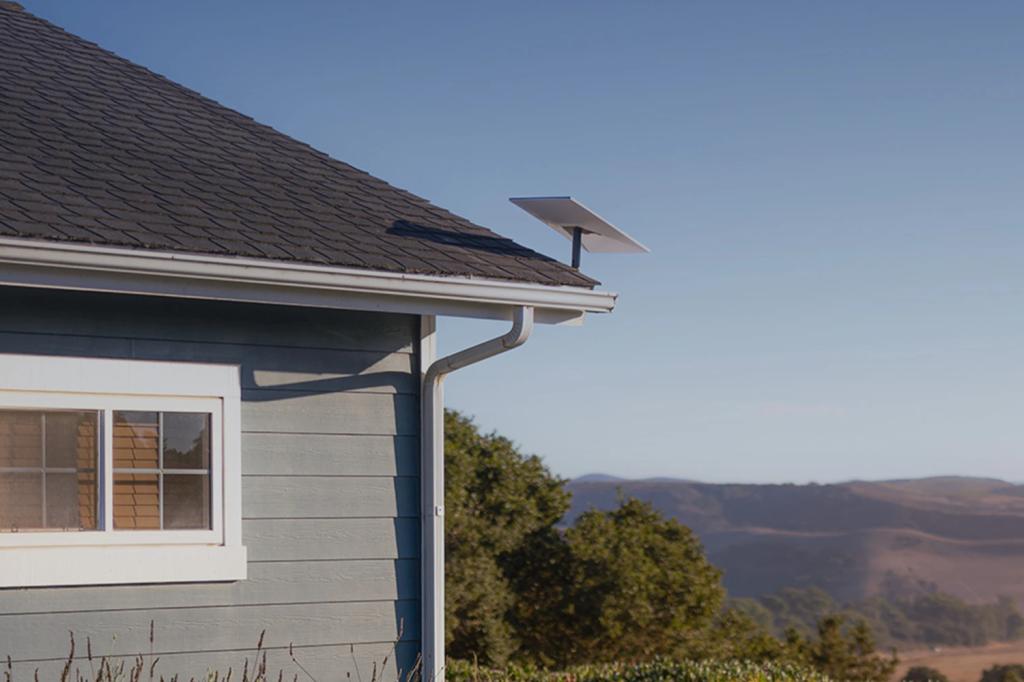
If all of this sounds familiar, that’s because SpaceX’s Starlink is built around the same fundamental idea. Both use large groups of satellites in low Earth orbit and ground-based terminals to provide internet access without requiring a conventional fixed broadband connection at the user’s location. The key difference right now, is maturity.
Starlink is already an established commercial internet service with thousands of satellites in orbit. Amazon Leo, by comparison, is still being built. Amazon began its full-scale satellite deployment in April 2025, and had deployed 396 satellites by early July 2026. Its latest financial results describe the operational constellation as nearly 400 satellites, and say that’s enough to begin initial service this year.
So although it’s tempting to frame Leo as a straight Starlink alternative, that’s getting ahead of where things currently stand. We don’t yet have widespread consumer Leo service, long-term real-world performance data, or consumer pricing to properly compare the two.
The interesting part though, is what happens once we do. Competition from a company with Amazon’s resources could give people looking for satellite broadband another major option, particularly in places where conventional fixed internet isn’t good enough. Whether Leo can actually compete with Starlink on performance, reliability and price, is something we’ll only be able to judge once the service is properly available.
When can I get Amazon Leo, and how much will it cost?

Amazon still hasn’t announced exactly when consumers will be able to sign up for Leo. As recently as the end of July 2026, the company said its nearly 400 satellites were enough to begin initial internet service “this year”, but stopped short of giving a specific month or launch date.
The service will initially be limited geographically and expand as Amazon launches more satellites and adds network capacity. The US is naturally an important market, while Amazon has also secured approval to operate in countries including the UK, which it says will be among the first to receive general Leo services.
Amazon began an enterprise preview with selected business customers in November 2025, ahead of a wider rollout during 2026. There’s still no consumer pricing either, for the hardware or monthly service. Until those details arrive, it’s impossible to say whether Leo will undercut Starlink or offer better value.
For now, Amazon’s satellite count is worth watching. It had deployed 396 satellites by early July and subsequently said its operational constellation was approaching 400. That’s still only a fraction of its planned first-generation network, but it’s enough for Amazon to start offering initial connectivity while continuing to expand coverage and capacity.
Elsewhere, Leo’s ambitions also stretch beyond broadband terminals. Amazon announced plans to acquire satellite operator Globalstar in April 2026, as part of a push into direct-to-device satellite connectivity. Amazon has since filed with the US Federal Communications Commission for permission to deploy a separate constellation of up to 5105 satellites that could connect compatible phones and other mobile devices directly to space for voice, messaging, data, and emergency services.
Deployment of that proposed network isn’t expected to begin until 2028, so it’s a longer-term part of the story rather than something Leo buyers need to worry about today. But Amazon has already struck an agreement with Apple for Leo to power satellite services on supported iPhone and Apple Watch models.
For home internet, the more immediate question is much simpler – when can we try it, and how much will it cost? Amazon Leo now has enough hardware in space to start providing some answers. Until the consumer service arrives, though, Starlink remains the established product and Leo the potentially very significant challenger. All we can do for now, is wait and see…


Read the full article here
