Close Menu
Gadget Guide News
  • Home
  • News
  • Features
  • Reviews
  • Best Stuff
  • Buying Guides
  • Deals
  • More Articles

Subscribe to Updates

Get the latest tech news and updates directly to your inbox.

Trending

Classic-TKL Underscore Edition review: dressed to kill (in beige)

August 10, 2026

Best Mac apps in 2026 from the App Store and beyond

August 10, 2026

Ford’s new AI assistant can check your fuel levels and tire pressure

August 10, 2026
Facebook X (Twitter) Instagram
Gadget Guide News
Subscribe
  • Home
  • News
  • Features
  • Reviews
  • Best Stuff
  • Buying Guides
  • Deals
  • More Articles
Gadget Guide News
  • Best Stuff
  • Buying Guides
  • Reviews
  • Deals
  • Features
Home»Features»A spectacular solar eclipse is coming on 12 August – here’s when, where, and how to watch it
Features

A spectacular solar eclipse is coming on 12 August – here’s when, where, and how to watch it

News RoomBy News RoomAugust 10, 2026016 Mins Read
Share Facebook Twitter Pinterest Copy Link LinkedIn Tumblr Email Telegram WhatsApp
Follow Us
Google News Flipboard
Share
Facebook Twitter LinkedIn Pinterest Email Copy Link

I don’t know about you, but I am tired of all the endless phone doomscrolling. I don’t think my brain can take another catastrophic climate change, endangered animal, or increased retirement age fact either. My brain, as the kids say, is cooked. All this, and more, is why I’m rather looking forward to the solar eclipse on 12 August.

For me, it’s a chance to step back from the chaos. For a brief moment, I’ll feel significant, insignificant, alone, and together, all at once. My son will join me, staring in amazement, and so will you, here on this pale blue dot, in whichever postcode of the universe we happen to find ourselves. Oh, and I won’t be thinking about AI for a single nanosecond during it either.

With that said, here’s everything you need to know about the solar eclipse on 12 August 2026. Enjoy!

Where can you see the solar eclipse?

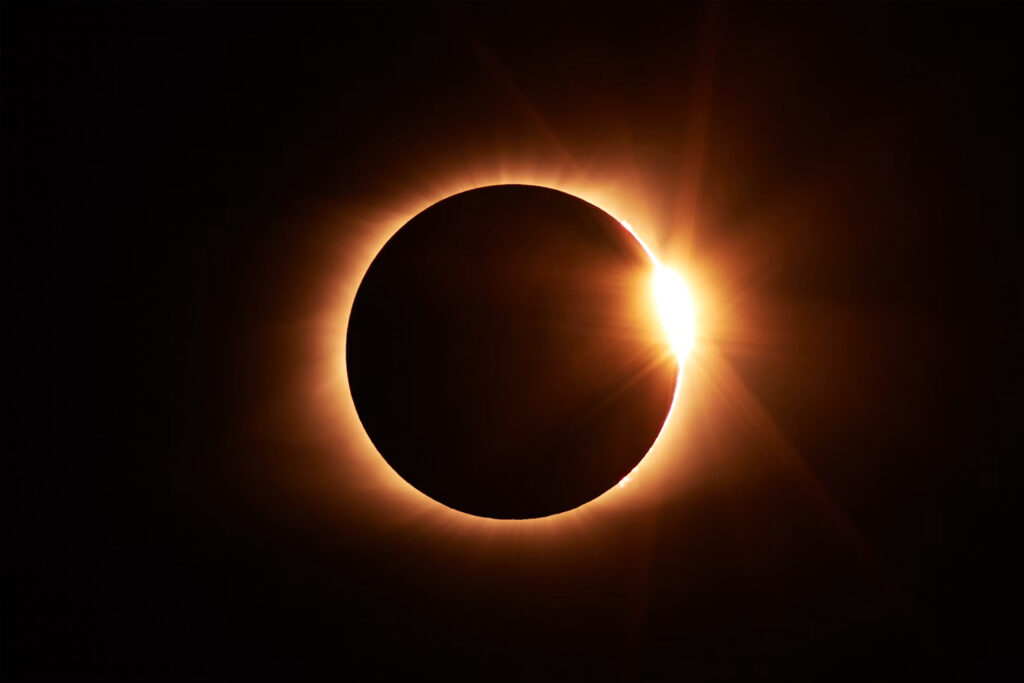
The solar eclipse will take place on Wednesday 12 August 2026, as the Moon passes between Earth and the Sun. Exactly what it looks like will depend on where you’re watching from. A narrow path across Greenland, Iceland, Spain and a small part of Portugal will experience a total solar eclipse, during which the Moon completely covers the Sun. The UK, parts of the US and many other areas across the Northern Hemisphere will instead see a partial eclipse.

That might sound like a consolation prize, but the UK, for example, is still in for its most impressive solar eclipse since 1999. Around 88–97 per cent of the Sun will be covered across the country, depending on your location and provided the weather plays nicely.

Elsewhere, the eclipse will be visible in some form across much of Europe, parts of North America, north-western Africa and the Arctic.

A full, total eclipse will only be visible from the narrow path crossed by the Moon’s central shadow. According to NASA’s eclipse map, that path passes over a remote part of northern Russia before crossing Greenland, western Iceland, northern Spain and a tiny corner of Portugal.

Outside that path, the eclipse will be partial. The Moon will cover some of the Sun, but the remaining portion will stay intensely bright. Even 99 per cent coverage doesn’t produce the darkness or visible solar corona associated with a total eclipse.

Where to watch the solar eclipse in the UK

The entire UK will see a deep partial solar eclipse, with roughly up to 97 per cent of the Sun obscured depending on location. It will be the greatest coverage visible from the country since the total eclipse of August 1999. Huzzah!

As for the exact times, they vary by location. In London, the eclipse begins at 6.17pm, reaches its maximum at 7.12pm and ends at 8.06pm – at least, acording to Skyscanner.

Because the Sun will be relatively low, your best option is somewhere with an unobstructed view towards the west. A west-facing beach, hill or large open park should work well. There’s little point travelling hundreds of miles for another percentage point of coverage, though. As the Royal Astronomical Society points out, finding clear skies will be more important than choosing the location with the highest theoretical coverage.

Where to watch the solar eclipse in the US

Unfortunately, the eclipse will not be total anywhere in the US, and the partial eclipse will be far less dramatic than the one visible from, say, the UK.

It will be visible from Alaska and parts of the northern and eastern US, mind, with coverage generally increasing as you travel north-east. NASA describes the US visibility area as extending from Alaska to North Carolina, although the amount of Sun covered varies considerably within that region.

New York City, for example, will see around 9 per cent of the Sun covered, with the maximum eclipse occurring at approximately 1.54pm EDT. Northern New England will get a more noticeable partial eclipse, while large areas farther south and west won’t see it at all.

You can enter your nearest town or city into Timeanddate’s eclipse calculator to check whether the eclipse will be visible and find the precise local timings, if you like.

Where will the eclipse be total?

The full total solar eclipse will be visible from parts of Greenland, western Iceland, northern Spain and a very small part of north-western Portugal, as well as a remote area of northern Russia.

Reykjavík also lies inside the path of totality, as do several locations across northern Spain. These include parts of Asturias, Cantabria, Castile and León, Aragon, Catalonia and the Balearic Islands.

Totality will last for a maximum of around two minutes and 18 seconds, although its length depends on the observer’s exact position. In Spain, it happens late in the evening with the Sun sitting very low above the western horizon. Iceland will see totality earlier, with the Sun higher in the sky, but its weather is considerably less predictable.

Most of mainland Europe will see a partial eclipse instead. Coverage will be particularly high in countries close to the path, including France, Ireland, Italy and areas of Portugal outside the totality zone.

How to watch the solar eclipse online

If the eclipse isn’t visible where you live – or clouds get in the way – NASA will broadcast it through NASA Live. Its coverage is due to begin at 1.15pm EDT, which is 6.15pm BST.

Time and Date will also host a livestream, with teams and partner feeds in Spain, Iceland, Europe and North America. UK viewers can also watch dedicated coverage from the Royal Observatory Greenwich, which kicks off at 6.10pm.

How to watch the solar eclipse safely

Never look directly at a partial solar eclipse without proper eye protection. Regular sunglasses aren’t safe, regardless of how dark they appear.

Instead, use eclipse glasses or a handheld solar viewer that complies with the ISO 12312-2 safety standard. A pinhole projector is another safe option because it allows you to observe an image of the eclipse without looking directly at the Sun. Search online for “eclipse cereal box viewer” and enjoy!

As for cameras, binoculars and telescopes, they all need purpose-made solar filters fitted securely over their front lenses. And it should go without saying, but definitely don’t look through magnifying equipment while wearing eclipse glasses, as the concentrated sunlight can damage the glasses and cause severe eye injuries.

Eclipse glasses can also only be removed during totality, when the Sun is completely covered – and only by people standing inside the path of totality. That means anyone watching from the UK or US, for example, must keep proper eye protection on throughout. Other than that, stay safe, and enjoy!

google preferred source

Apple News

Read the full article here

Follow on Google News Follow on Flipboard
Share. Facebook Twitter Pinterest LinkedIn Tumblr Email Copy Link
News Room
  • Website

Related Posts

Best Mac apps in 2026 from the App Store and beyond

August 10, 2026

The lessons Apple should learn from Samsung’s wide Galaxy Z Fold8 before it launches the foldable iPhone

August 10, 2026

I replaced my vacuum with Dyson’s all-new V10 Konical with its remarkable auto-empty Dok – here are 7 things you need to know 

August 10, 2026
Add A Comment
Leave A Reply Cancel Reply

Top Articles

Apple CarPlay Ultra compatibility list: every car that has, and is getting, Apple’s next-gen UI

June 12, 2026

What to expect from Apple’s September event: iPhone Fold, iPhone 18 Pro, Apple Watch Ultra 4 and more

July 4, 2026

You can now try Apple’s all-new Siri AI yourself on your iPhone, iPad or Mac – here’s how

July 13, 2026
Latest Reviews

Is this $450 laptop from an unknown brand too good to be true?

News RoomAugust 8, 2026

Nitecore’s latest power bank is the lightest and most compact yet

News RoomAugust 8, 2026

The best instant cameras for 2026

News RoomAugust 7, 2026

Subscribe to Updates

Get the latest tech news and updates directly to your inbox.

Demo
Most Popular

Best flip phones in 2026: top clamshell foldables for every budget 

June 11, 2026

Apple CarPlay Ultra compatibility list: every car that has, and is getting, Apple’s next-gen UI

June 12, 2026

What to expect from Apple’s September event: iPhone Fold, iPhone 18 Pro, Apple Watch Ultra 4 and more

July 4, 2026
Our Picks

TAG Heuer revives my favourite Formula 1 colourway – going orange for the Dutch Grand Prix

August 10, 2026

A spectacular solar eclipse is coming on 12 August – here’s when, where, and how to watch it

August 10, 2026

The lessons Apple should learn from Samsung’s wide Galaxy Z Fold8 before it launches the foldable iPhone

August 10, 2026

Subscribe to Updates

Get the latest tech news and updates directly to your inbox.

Facebook X (Twitter) Instagram Pinterest
  • Home
  • Privacy Policy
  • Terms of use
  • For Advertisers
  • Contact
2026 © Prices.com LLC. All Rights Reserved.

Type above and press Enter to search. Press Esc to cancel.