

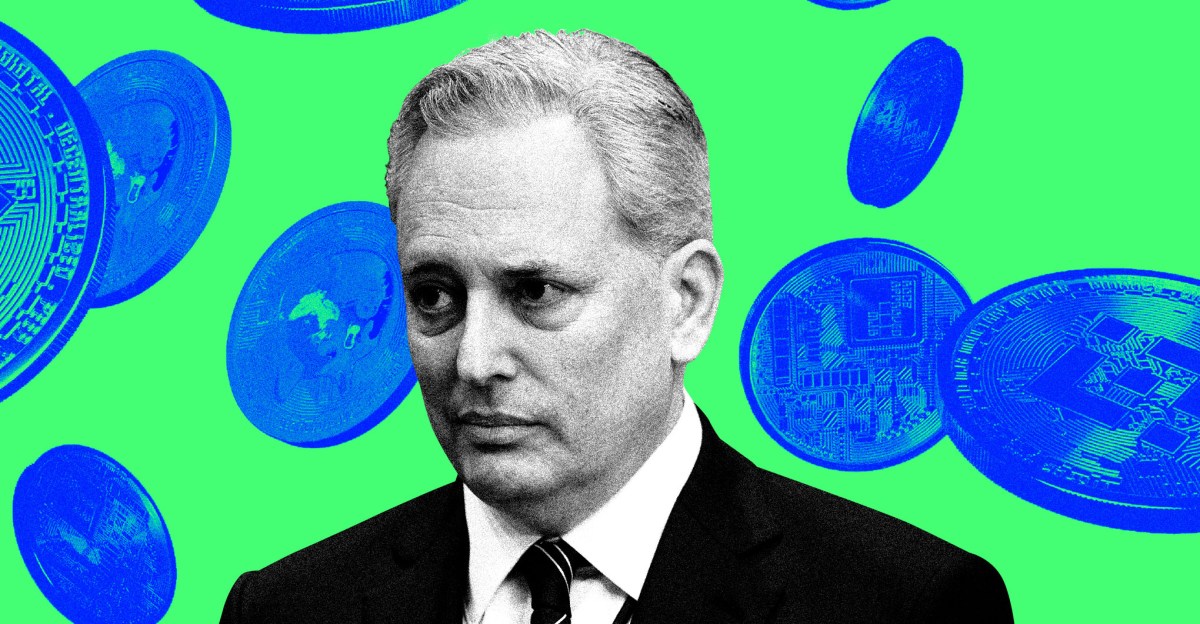
David Sacks, the venture capitalist and tech billionaire who’d become Silicon Valley’s primary advocate inside the White House and a key architect of its aggressive AI policy initiatives, revealed on Thursday that he was no longer a special government employee — and therefore no longer President Donald Trump’s Special Advisor on AI and Crypto.
Sacks’ official status as an SGE allowed him to work simultaneously in the private sector and for the government, but for no more than 130 days, raising questions about why he was still in the job more than a year after his appointment. But in an interview with Bloomberg Television discussing the White House’s recent legislative proposal for an AI framework, Sacks revealed that he had now “used up that time,” and would now focus his energy on co-chairing the President’s Council of Advisors on Science and Technology (PCAST).
Earlier this week, the White House had announced several new appointments to the advisory council, including other tech executives like Mark Zuckerberg, Marc Andreessen, Jensen Huang, and Sergey Brin. Michael Kratsios, the head of the White House’s Office of Science and Technology Policy, will also be co-chair.
“I think moving forward as co-chair of PCAST, I can now make recommendations on not just AI, but on an expanded range of technology topics,” he told interviewer Ed Ludlow. When asked, Sacks clarified that his role would not involve coordinating with the government of federal agencies: “It’s intended to be advice to the president and to the White House, to the executive offices of the president. So, yeah, we’re going to study issues, make recommendations. And that’s the main goal of that, is advice.” (The White House did not immediately return a request for comment.)
As AI and crypto czar, Sacks, who had held a major Silicon Valley fundraiser for Trump in 2024, had direct access to the Oval Office and wielded immense power in shaping the White House’s technology policy. But his aggressive approach to policymaking inadvertently he steered the Trump administration into several unpopular political battles. His attempt to implement a blanket ban on AI state laws, both in Congress and then by executive order, alienated Republican governors and MAGA populists instead, and made several other potential policy wins politically toxic. “He failed to get preemption. He pressed the White House into a culture war against its own voters. He kept it from getting simple wins like child safety. He has been a political disaster,” Michael Toscano, the executive director for the conservative Institute for Family Studies, told The Verge. “He is perhaps singularly responsible for the White House losing its populist bona fides.”
Last week, however, he did something arguably worse by Trumpworld standards: he publicly criticized the president, saying on his podcast All In that the president needed to find an “off-ramp” from his war with Iran.
During his second administration, Trump has frequently demoted his most controversial or embarrassing appointees in lieu of firing them. Last year, Mike Waltz was removed as National Security Advisor for his role in Signal-gate and reassigned as U.N. Ambassador. Recently, Kristi Noem, the former Secretary of Homeland Security who oversaw ICE’s violent occupation of Minneapolis which led to the death of two protesters, was reassigned as special envoy to an initiative called the “Shield of the Americas”.
Read the full article here
