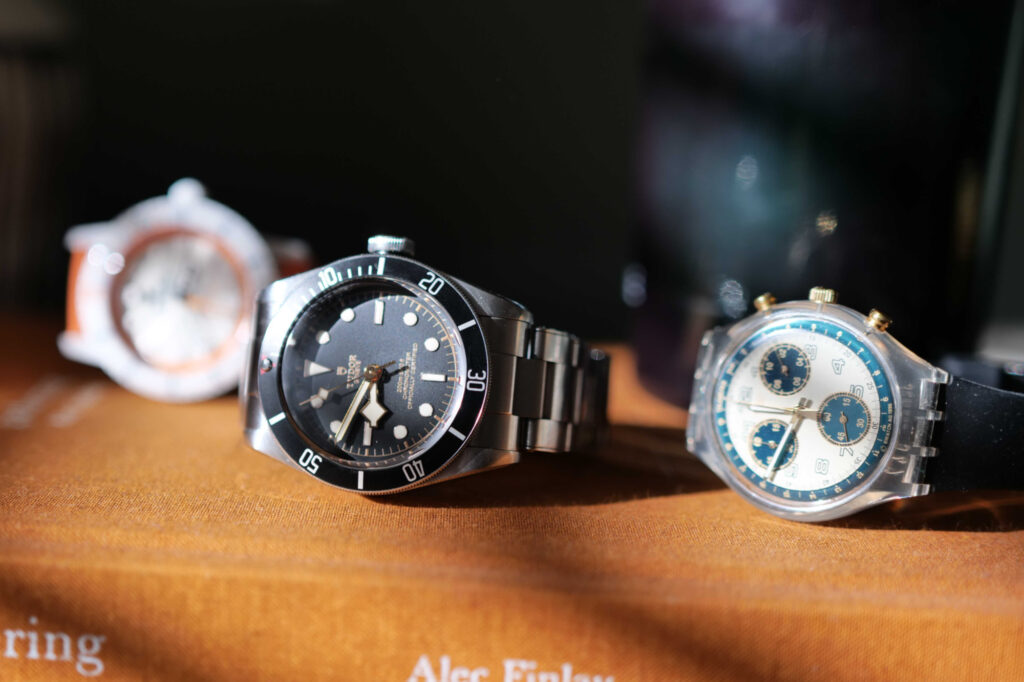
There’s a joke that does the rounds in watch circles: the correct number of watches to own is n+1, where n is however many you currently have. It’s funny because it’s true, and it’s also completely useless as actual advice.
I get asked this a lot. Usually by someone who’s just bought their first “proper” watch, felt that little dopamine hit, and is now wondering whether that’s the end of the story or the beginning of a very expensive habit (hint, it’s always the later).
So let’s actually try to answer it, rather than just quoting the meme back at them.
The one-watch argument
There’s a compelling case for owning exactly one watch. It forces a decision: something versatile enough for the office, dinner, the beach and everything in between. A steel sports watch with a bit of dressiness to it, or a simple time-only piece on a leather strap that goes with anything.
You wear it every day, you know it intimately, and you never have that faintly ridiculous experience of standing in front of a watch box wondering which one “matches” your mood and/or outfit.
I own more than one watch, so take this with a pinch of salt, but I don’t think the one-watch life is a compromise. Plenty of people wear the same watch every single day and couldn’t care less about anything else.
If your interest in watches is purely functional, one is not just enough.
Starting a watch collection
The trouble is that “purely functional” rarely goes hand-in-hand with an actual mechanical watch (if you wanted that, you’d probably just buy a smartwatch).
Once you understand what’s happening inside the case, discover more brands and designs, or realise that one watch can’t possibly cover every scenario in your life, the watch collecting bug takes hold and then it becomes less about telling the time. That’s usually where a second watch creeps in.
The most sensible reason to own more than one is that different watches genuinely do different jobs. A dive watch can survive being knocked about and doesn’t mind a bit of water. Something dressier for big occasions. Maybe something with a complication you find genuinely useful, like a GMT if you travel a lot.
This is the “two or three, each earning its place” collection, and honestly, it’s where most sensible people land. Three watches covering three real use cases isn’t excessive, it’s just having the right tool for the job (at least, that’s what we tell ourselves). It’s really the same as owning more than one pair of shoes.

When it stops being about need
Beyond that, you’re not really adding watches because you need them anymore. You’re adding them because you love the mechanics, or the history, or the craft, or simply because a particular watch means something to you.
I’d put my own collection of Swatch chronographs from the ’90s in this category. I don’t wear them because I lack other watches capable of telling the time. I wear them because they’re from the decade I was born, I love the size, and their design. That’s not a functional decision, and there’s nothing wrong with that, provided you’re honest with yourself about what’s actually driving it.
This is really the crux of the question. Once you’re past the two or three watches that cover genuine bases, “how many should I own” stops being a practical question and becomes a personal one.
Some people are perfectly happy with a considered collection of four or five watches. Others end up with drawers full of watches and no clear system at all, buying on impulse, chasing whatever’s hyped that month. Neither is wrong, but only one of them tends to leave you satisfied with what you’ve actually got.

The only rule that actually matters
If I had to give one genuine piece of advice, it’s this: every watch in your collection should be there for a reason you could explain in a single sentence.
This is my everyday watch. This is the one I take diving. This one belonged to my grandfather. This one is just a beautiful piece of engineering I just really admired.
If you can’t articulate why a watch earns its place in the box, it’s probably there because of marketing, hype or a moment of weakness, and that’s the version of collecting that ends in regret and a drawer of watches you never wear.
So, how many should you own? However many you can justify without hesitating. For some people that’s one. For me, right now, it’s a bit more than that.
Liked this? 7 reasons we still need mechanical watches in the age of the Apple Watch
Read the full article here