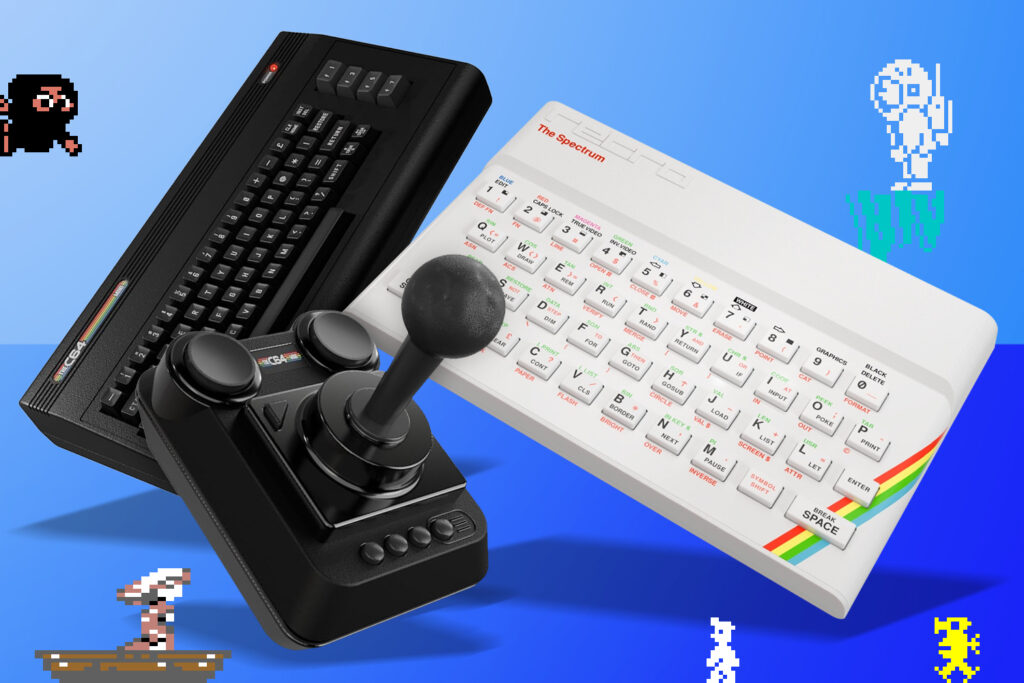
I’m a cynic when it comes to special editions. Hey, folks! Buy this thing you already own, but in a new colour! Just no. But also, I am weak. So when the chance arose to pit remakes of two 8-bit classics against each other, how could I refuse? Besides, this was a chance to settle that decades-old argument once and for all: which really is better, the ZX Spectrum or the Commodore 64?
(I’m 100% certain there’s no way picking a favourite here will cause me any trouble among fans of either system!)
Back in black
I started with TheC64 Mini Black. Unlike previous takes on Commodore’s breadbin, this one’s dressed like a ninja. But since it’s a ‘Mini’, the keyboard’s just for show. If you want to play Zork, you’ll need to plug in a USB keyboard.
Fortunately, that’s easy enough via the USB ports, which also accommodate the bundled joystick (also black) and a USB stick for adding your own games. And you’ll probably want to, because chances are that you won’t recognise most of the included ones.
Before you grumble, though, that’s kind of the point. Rather than include a handful of ancient C64 classics and annoy everyone because their favourites aren’t present, this edition goes for 25 modern titles.
Some, like the Lode Runner-ish Shadow Switcher, look like they’ve beamed in from 1984. Others, such as A Pig Quest, Yeti Mountain and Sam’s Journey really show off what Commodore’s micro was capable of. It’s a fab selection overall – and the unit’s RRP is less than buying all the games separately online, which seems like a solid deal.


I was also delighted to discover that playing the games wasn’t a fairly miserable experience. Unlike on the original Mini, the joystick is no longer borderline terrible – it’s actually good, even if the big fire buttons are overly twitchy. The lack of built-in button mapping is annoying, though, even if the manual explains how to create override files. Not that you should have to – hacking together text files to make games work better feels a little bit too retro to me.
The joy of sticks
Want a TL;DR for remapping controls? Open a text editor, add the following line –
J:2:JU,JD,JL,JR,JF,SP,JU,JF,JF,1,2,3,JF,F3,F4
– save the file as thec64-default.cjm and bung it in the folder that houses your games on your USB stick. This setup maps the right-hand fire button to space (sometimes used as a second fire button in C64 games) and the left-hand triangle button to up, thereby dealing with that cardinal sin of 8-bit micro games: up to jump.
A bit of all white
The original Speccy was a natty black number. People joked about the rubber keys, but, man, I’ve always loved this quirky example of British design. It looked – still looks – far nicer than the boring beige boxes that came out of the US. But this limited edition goes all white as a tribute to the one millionth ZX Spectrum. It’s odd, but it works.
The full-size keyboard looks great and feels close to the original. Which is handy because, by default, The Spectrum expects you to use it for playing games. Even for PC gamers, the notion of using the entire computer as a controller might feel weird, but, hey, welcome to the 1980s.
Still, once you get the hang of it, you’ll have a fighting chance of taking on stone cold classics like Head Over Heels, Manic Miner and Skool Daze, which rub shoulders with more recent titles like Alien Girl and the fantastic TCQ – a concoction that feels like Mondrian was hurled forward in time and told to make a tough-as-nails 8-bit puzzle platformer.


But none of that is different from last time. The hardware and games are the same. The ‘special’ stuff is what else is in the box: a tiny, blank USB stick; a 32-page A5 copy of Crash magazine that may rub your nostalgia nubbin but is no substitute for instructions; and a joystick. The joystick matches its black counterpart, but games aren’t well configured for it.
On The Spectrum, you can at least map controls for added games (and tweak various other settings, such as tape loading speed, to avoid endless hours of tape-load screeching). But the software oddly assumes you’re using a gamepad from the tiny Amiga remake rather than the joystick that’s bundled in the box. Sigh.
And the winner is…

Neither of these tributes is fully authentic, but both should satisfy fans looking for a quick nostalgia hit. The lack of proper game instructions is baffling, though, since that renders some titles impenetrable without additional research. On the plus side, save states give you a fighting chance of bludgeoning your way through these sometimes brutally difficult games.
But which is better? Am I a Spec-chum or yelling Commo-MOAR? Weeeell… I was a C64 lad back in the day, but over the years have grown to appreciate the sheer ingenuity behind Spectrum games. And when I reviewed the previous versions of these tribute acts, The Spectrum triumphed over TheC64 Mini, due to it being more authentic and not relying on a duff controller. In short, it was more fun.
This time round, much as I like The Spectrum, the C64 (sorry, TheC64) takes the win. The revamped games selection makes it the better buy, even if you own the original. Plus, everyone looks good in black.
Review units were supplied by Plaion. Find out more about TheC64 Mini Black and The Spectrum Special Edition. TheC64 Mini Black’s RRP is $119.99/£89.99, although it can currently be found at a significant discount. The Spectrum White Edition is UK-only at £129, but I’m sure enterprising folks in the US will find places to buy one or – if they’re far more sensible – the original.
Read the full article here