

New OLED gaming monitors from top companies coming out this year should look clearer and crisper. LG Display and Samsung Display, which typically provide the actual panels used in gaming monitors, are finally lining up the colors of their subpixels in vertical RGB stripes — remember when we used to worry about Pentile OLED displays? — which means, among other improvements, the panels should have easier-to-read text.
You can see for yourself how Asus and MSI are touting changes to their upcoming monitors with Stripe RGB technology — for Asus, with the ROG Swift OLED PG27UCWM, ROG Swift OLED PG34WCDN, and ROG Strix OLED XG34WCDMS, and for MSI, with the MEG X and MPG 341CQR QD-OLED X36:
Both LG Display and Samsung Display aim to improve text clarity issues that have plagued ultrawide OLED panels in particular. Samsung Display announced earlier this month that it has started mass production of “the world’s first 34-inch 360Hz QD-OLED panel” with what it calls a “V-Stripe” RGB pixel structure. The V is a bit of a misnomer of how the structure is shaped; it indicates that the subpixels are in a vertical orientation, not in a V. The structure “improves the clarity of text edges, making it ideal for users engaged in text-intensive tasks such as document editing, coding, or content creation,” Samsung Display says.
Samsung Display has already been “supplying the panels to seven global monitor manufacturers including ASUS, MSI, and Gigabyte since December 2025.”
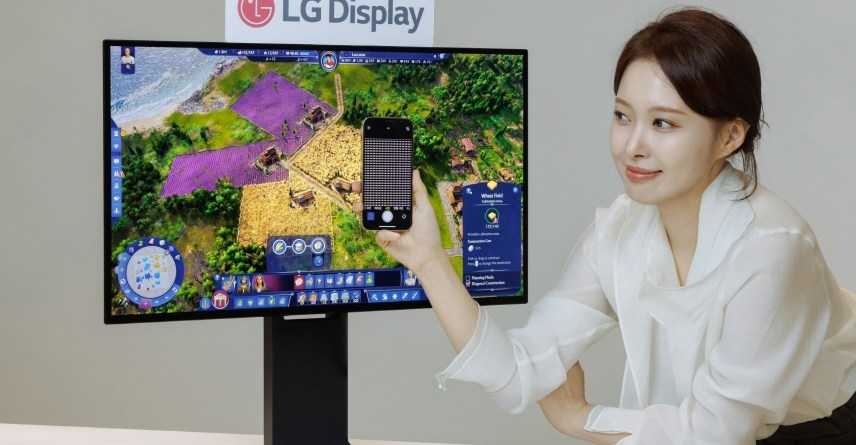
As for LG Display, it announced last month it would be debuting “the world’s first 27-inch 4K OLED panel for monitors featuring an RGB stripe structure and a 240Hz refresh rate” at CES in Las Vegas. While LG Display was previously known for “WOLED,” where its TVs and gaming monitors typically have an extra white subpixel, or orienting RGB pixels in a triangular pattern, the company says the RGB stripe panels are “optimized for operating systems such as Windows and for font-rendering engines, ensuring excellent text readability and high color accuracy” as well as for providing “optimal performance” in FPS games.
Perhaps confusingly, “RGB stripe” isn’t the only new RGB screen tech from LG Display at CES. It’s also touting “Primary RGB Tandem 2.0,” which it calls “an advanced version of LG Display’s proprietary Primary RGB Tandem technology, which generates light by stacking the three primary colors of light (red, green, and blue) in independent layers.”
As we discussed last year, Tandem OLED (and Primary RGB Tandem OLED specifically) are about dramatically increasing the brightness of OLED panels, which has been one of their few weaknesses over competing screen tech. Samsung Display’s QD-OLED panels use quantum dots to increase their panel brightness, whereas LG Display is now betting on these stacks. Asus says its PG27UCWM is both an RGB stripe panel and a Tandem OLED panel, though it’s not clear if it uses version 2.0.
For gaming monitors, LG Display is promising that Primary RGB Tandem 2.0 will enable “monitor displays that achieve a peak brightness of up to 1,500 nits,” and up to 4,500 nits for OLED TVs using the tech. We were impressed by the 1.0 version of Primary RGB Tandem in the LG G5 TV, and we’ll be checking out 2.0 at CES.
Read the full article here
