

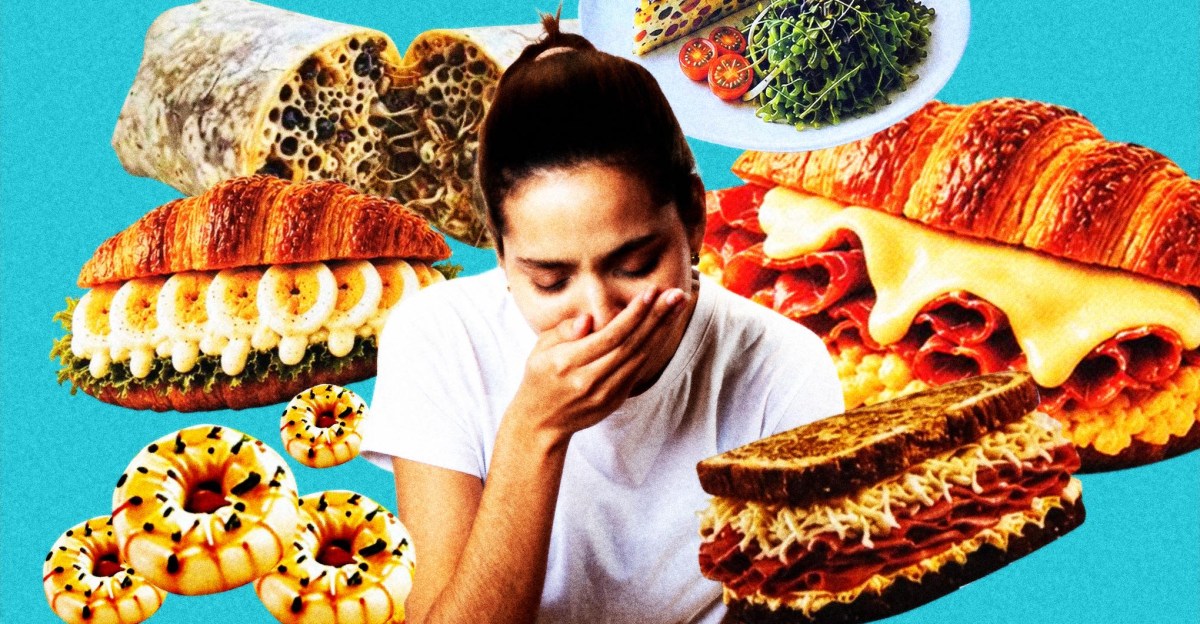
There is a torrent of unappetizing slop coming from restaurants, cafes, and brands that are increasingly turning to AI to generate images promoting their food. The resulting horror show includes donut shrimp, Reubens from the deep, wormlike noodles, and noodle-like pastries and stringy chicken. There’s also construction material masquerading as ice cream, ice cream masquerading as brains, and other masonry-adjacent cuisine. I don’t even know how to begin describing this monstrous attempt of a burger, and the less said about the trypophobic burrito from hell, grubs and all, the better. There are lumps. And holes. So many holes.
“Diffusion models are notoriously weak at generating thin, continuous, terminating structures.”
We don’t usually know why anyone would use AI slop to sell something intended to look appetizing, particularly when the food is presumably right there to photograph. But we do know a bit about why AI is so adept at producing such exquisitely nauseating images.
There are many reasons why this AI food is so wrong, from the technical nuances of how AI systems generate images and the materials used to train them to the psychological baggage humans perceive the images through. Frequently the problem starts from the very outset. Many of the leading image generators produce images using diffusion. Put simply, diffusion models start with an image of pure noise — something like a screenful of static — and gradually remove noise little by little in order to create the requested visual. “This means that initially coarse structures are recovered first with fine texture details” coming at the end, explained Chris Russell, a professor of AI, government, and policy at the University of Oxford and an expert in computer vision.
Russell said that in many of these unsettling food images things have already gone wrong by the time those finer details are added. The model might get the basic structure of an object wrong at an earlier stage, then lump vivid texture details on top of that structure. “This is the same kind of failure as you see when a person is generated with six fingers instead of five,” Russell said. (This could explain the donut shrimp too.)
The model might get the basic structure of an object wrong at an earlier stage, then lump vivid texture details on top of that structure.
Even when the underlying structure is solid, finer details can go awry in their own ways, said Giovanbattista Califano, a behavioral scientist who studies responses to AI-generated imagery at the University of Naples Federico II in Italy. “Diffusion models are notoriously weak at generating thin, continuous, terminating structures,” he said. “Noodles, strands, and tendrils are exactly the kind of geometry that trips this up, so you get spaghetti-like artifacts bleeding into places with no anatomical or culinary logic.” In other words, once a model starts generating something like this, it can struggle to figure out where it should stop or what it should be attached to. Other repeating textures like bubbles and seeds are similarly hard for diffusion models to contain within sensible boundaries, he added, meaning they often spill into areas they should not be in. That helps explain why so many AI food images are so relentlessly noodly, unsettlingly patterned, and riddled with the kind of clustered holes that can trigger trypophobia.
It doesn’t help that AI has no idea what a sandwich actually is. Or a noodle. Or a burrito. It has no understanding of the objects it’s creating or the physical world they inhabit. It has learned, broadly, what these things tend to look like on a statistical level, but not why they look that way or how they’re supposed to behave. “AI image generation reproduces looks without proper knowledge about the world,” explained Roland Meyer, a professor for digital cultures and arts at the University of Zurich in Switzerland. The result is an approximation of food divorced from any understanding of the thing itself.
That lack of understanding can lead to some stomach-churning aesthetic interpretations by humans who view the images, said Michael Cook, a senior lecturer in computer science at King’s College London. Hence the ice cream that resembles cracked concrete, or burgers seemingly fashioned from rocks. AI models have no understanding of why food should not look like other non-food images in that way. “These textures might look totally normal if used in an architectural context,” Cook explained. “But they become wrong when we imagine it as edible food.”
The images used to train these models can compound the problem. “Because we know so little about the training processes of these systems, we don’t really know what mix of content they’re receiving, or what associations they’re making,” Cook said.
Food photography is often highly stylized, full of sharp contrasts, intense colors, glossy lighting, and exaggerated shapes. Sometimes the “food” being photographed isn’t even food. Meyer said AI models can pick up on these surface qualities and visual conventions, but reproduces them without understanding the context behind them. “In other words, AI image generation perfectly imitates the look of photography, but not its professional aesthetic strategies,” Meyer said. “That is ultimately what makes them so unsettling.”
It doesn’t help that AI has no idea what a sandwich actually is. Or a noodle. Or a burrito.
Style aside, there’s another problem with learning about the world from trawling the internet: things can get weird fast. Simon Colton, a professor of computational creativity, games and artificial intelligence at Queen Mary University of London, said there may be relatively few images of ordinary red apples, for example. “Who would want to post an image of a boring apple on the web?” Stranger images, meanwhile, could find big audiences on social media platforms like Reddit, or spread widely as memes. Bizarre internet lore and brain rot means an AI model can have a weird set of associations around food and what it should look like.
Cook said it is well known that AI systems are now also being trained on AI-generated material. A lot of popular AI material involves food, Cook said, recalling a trend for AI-generated videos of people jumping in or on piles of food. Beyond the sometimes surreal nature of the material itself, research suggests that training AI models on the outputs of other models can cause a kind of “model collapse,” a consequence of which can be a kind of visual degeneration and a growing sameness between images.
How images are created and used can make matters even worse. Prompts — both those written by users and the system-level instructions companies use to guide their models — may not always yield the best results. They may be vague, such as just asking for a sandwich, or contain language like “be precise” that makes sense for text, but doesn’t make much sense for generating images. Low-resolution images can also be blown up well beyond their intended size, magnifying every unsettling imperfection that may have otherwise escaped notice or creating a void a model is left to fill in, often imperfectly.
Bizarre internet lore and brain rot means an AI model can have a weird set of associations around food and what it should look like.
All of this pushes many AI-generated food images deep into the uncanny valley. And, unfortunately for us, humans are painfully well-equipped to notice when food looks wrong. Scientists believe disgust evolved partly as a means of protecting us from parasites, pathogens, toxins, and other potential threats, making us particularly attuned to when something may be unsafe to eat. Califano said this makes the uncanny valley for food even more visceral than the one we experience with not-quite-humans.
AI-generated food has an unnerving ability to hit many of those triggers at once. Strange, noodly tendrils resemble worms or parasites, clusters of holes suggest infestations, and off colors and texture signal contamination or spoilage. AI generated food looks wrong because, on a primal level, it feels wrong. It might resemble food, but our brains know better. It is slop, and we recoil accordingly.
Read the full article here
