






The current EV market is flush with variety. I’ve driven single-motor economy-minded machines, dual-motor EVs with all-wheel drive, tri-motor vehicles that dial up the performance stakes, and even wild quad-motor performance cars, like the Rimac Nevera.
But this is the first time I’ve ever driven a five-motor EV, one with the agility and speed to turn a 360 even more smoothly than an electric G-Wagon. It also makes quick work of terrible turf.
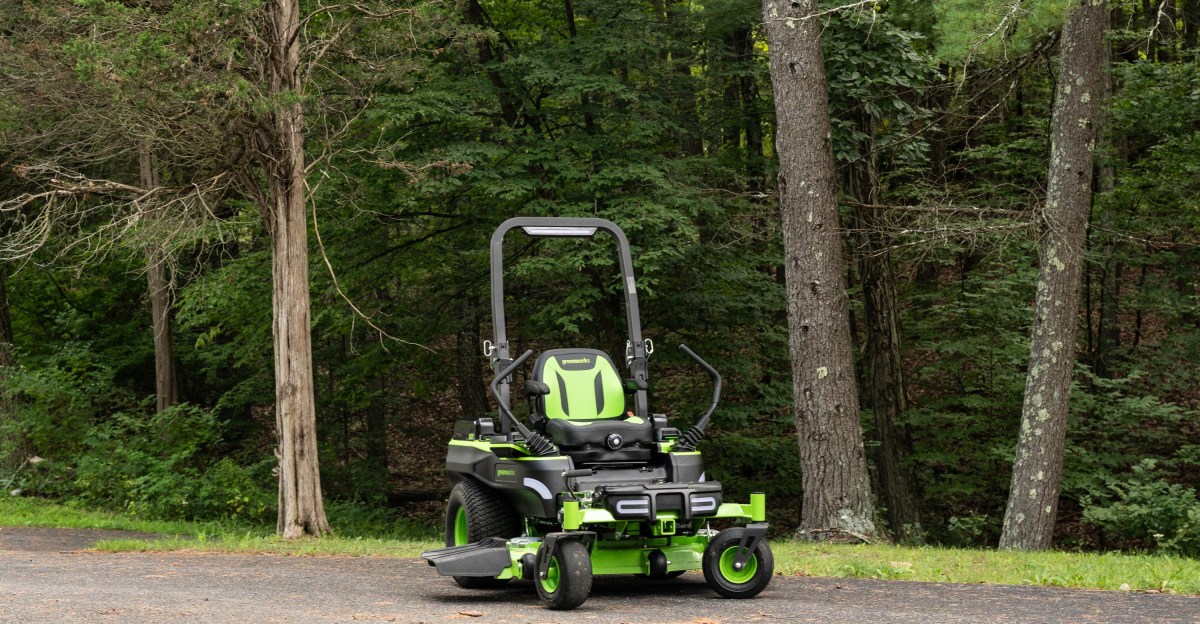
This is, of course, a lawn mower, and it only uses two of those motors to drive the wheels. The other three turn a trio of blades that cut a 54-inch-wide swath in a single pass. It also promises four acres on a charge and is positioned as the ultimate mowing machine. For $8,799, it had better be.
For a company that spent much of its life building white-label tools for other brands, Changzhou, China-based Greenworks has quickly leaped to the forefront of battery-powered products for those trying to phase out internal combustion in every facet of their lives. Opening a manufacturing facility in Tennessee in 2023 certainly helped elevate its domestic cred.
The company offers a wide portfolio of products from power tools to go-karts energized by a dizzying array of often incompatible battery technologies. The 80-volt architecture within the MaximusZ mower here is the company’s latest, with Greenworks offering various packs of various sizes. This mower uses four smaller 6.0Ah and two large, 17-pound 16Ah packs to offer a combined battery capacity of 56Ah. That, Greenworks says, is enough to do four acres on a single charge.
Charging duties are handled by a disappointingly proprietary charger. I greatly wish Greenworks engineered this thing to work with a standard SAE J1772 plug, or even NACS, but it is quick at least, with Greenworks estimating a full charge at 3.5 hours.
At nearly $9,000, the MaximusZ’s cost may seem extreme, but in this space it’s actually competitive. With a maximum speed of 8mph and 41 horsepower on tap, it’s comparable to something like a Stihl RZ 552, which retails for $9,499. It even out-powers some professional-grade machines, like a $18,899 Toro 6000 Series. But is it truly comparable?
It has a few key advantages, the biggest of course being its relative lack of noise and vibration. Not burning gas is an increasingly big deal, too, as is a lack of carburetors to clean and oils to change. Finally, the MaximusZ features a little dumper bed on the back and even a tow hitch.
All those reasons are why I decided to bring one home, but before I could start flaying the fescue, I had to pick a mowing height. That’s easy in the MaximusZ. A pedal on the right lifts the entire mower deck, while a grid defines its height in quarter-inch increments. Step on the pedal, put the pin in the right hole, then take your foot off the pedal, and you’re good to go. It’s almost crude in its simplicity, but it works well.
Next was figuring out the controls. Twist the key and the mower takes about eight seconds to boot up. That’s just long enough to be annoying. Above the key there’s a dim, 4.0-inch LCD that picks up a new scratch every time you look at it too hard. Squint, though, and you can see the current state of charge, maximum mower speed, maximum blade speed, and total runtime.
The buttons under the display let you toggle the blade and mower speeds or enter a menu to change a scant few settings. That 1.5 acres of mowable land I have is split up across a half-dozen small patches, plus a larger pasture, which means I had ample opportunity to test both the MaximusZ’s agility and its stability. I started in the slowest mode until I got the hang of things, which caps you at roughly half the thing’s maximum cutting speed of 8mph.
You steer the mower with the two handles. Push them apart from each other, and the mower goes into a sort of park mode. Pull them inward, and the motors are engaged. Each handle controls the corresponding motor on that side, so pushing the right handle all the way forward has the mower turning to the left. Pull the left handle toward you at the same time, and it’ll spin on its own axis. Quite abruptly, if you’re not smooth.
While I wove and wobbled my way through the first few laps of my pasture, it didn’t take long to get the hang of things. I also quickly realized that the handles weren’t aligned. To go straight ahead, I need to hold the right handle about an inch behind the left. There is, obnoxiously, no way to recalibrate for this, but I eventually got used to it.
As I got more confident, I started to dial up the speed, and within a few laps I had the handles pushed all the way forward. I then stepped up from the mower’s slowest setting to the middle, and eventually the fastest.
Mowing at the fastest speed is not the best way to get a perfectly clean cut, but if you, like me, are more interested in getting it done than having it perfect, you can cover a lot of ground quickly.
In smaller areas, that tight turning radius makes for a surprisingly nimble machine, but you do have to be careful about grip. Try to make a too-tight turn, and the MaximusZ tends to light up the inside tire, quickly tearing up the grass and making it look like I was doing donuts out in our pasture.
The biggest challenge, though, is inclines. Officially, the MaximusZ can only be operated at grades of up to 15 degrees. This is a common rating for this type of mower, which many will find limiting. I have succeeded in summiting steeper slopes than that, but grip is the limitation here. With only the rear wheels doing both the driving and the steering for this 767-pound machine, it’s easy to overpower the tires.
Running out of grip could mean a crash, and while I imagine it’d take quite a bit to roll this thing over, having a sturdy tubular steel rollover protection structure (ROPS) overhead is definitely reassuring. The MaximusZ has plenty of other niceties, too, like a 2-inch hitch at the front that’s ready for a tow ball, and a smaller hitch at the back with 300-pound towing capacity.
The tiny tailgate at the back, though, is its most interesting feature. At 18 inches deep and 28 inches wide, you won’t exactly be hauling a season’s worth of mulch, but 200 pounds of capacity means decent capability. I’ve been using it to haul wood in from the various piles I’ve made over my property from downed trees.
There’s even something Greenworks calls an ETO, the electric takeoff, a play on the power takeoff or PTO on most tractors that can drive anything from hay balers to snowblowers. Greenworks only has a few accessories for this so far, but hopefully it will release more in the future. A chipper would be perfect.
All this makes it a surprisingly good utility vehicle, far more practical for day-to-day chore use than the other, competitive mowers. They may cover more ground on a tank of gas, but they’re typically only good for cutting grass.
The seat is comfortable and has a built-in, adjustable damper system. That, though, is the only suspension on the machine, making this a rough ride over tree roots and the like. There are integrated USB-A and USB-C ports, a slot for your smartphone, and two cupholders.
And what about noise? I measured 85dB at maximum blade speed, significantly lower than the 90 to 100dB of a commercial-grade mower. That may not sound like much, but a 10dB increase equates to a 10x increase in acoustic force. While you can safely listen to 85dB for eight hours without concern, at 95dB, you can damage your hearing in just 60 minutes.
I still wear earplugs to be safe, but I appreciate the relative quiet and lack of harsh vibrations. When the blades are stopped and I’m zipping up and down the driveway, it’s silent and smooth.
At its fastest speed, with the blades on maximum, I can mow my entire property in slightly over one hour. I’ve now done that three times, each time consuming roughly 75 percent of the mower’s battery capacity.
Doing the math, that means two acres could be possible at maximum speed. That’s short of the promised four acres, but again, I have a lot of small, oddly shaped patches to mow, and I’m doing it at top speed. Were I mowing at lower speeds, and if I had a single, large pasture, three acres seems like a safe bet without pausing for a recharge or battery swap. That advertised figure of four, though, feels optimistic.
The mower has an annoying tendency to drain the four smaller batteries before tapping into the bigger packs. I fear the extra charging cycles these smaller packs face mean they’ll wear out more quickly than if the larger packs were depleted first.
And as far as charging goes, Greenworks’ estimate of 3.5 hours seem fair. Mine has always been done in well less than three.
Again, though, there’s some bad news here. The charger has a loud onboard fan that runs constantly so long as the mower is plugged in, even when fully charged. So I always have to make a point of unplugging the thing after it finishes.
While it doesn’t quite deliver on the range, the MaximusZ manages enough capability that I’m not suffering any buyer’s remorse yet. The poor display, the uneven controls, and the unfortunate battery discharge priority are negatives, but none are deal-breakers.
The biggest challenge is, of course, the cost. Greenworks markets the MaximusZ as something that not only replaces a high-end zero-turn mower, but also serves as a mini utility vehicle around your property. Its functionality there is limited compared to a full-size UTV vehicle, but given you can easily spend $15,000 on one of those, that helps skew the value equation in this mower’s favor.
My main question now is reliability, but only time will tell whether I’ll need to tap into its four-year warranty. If you’re considering one of these yourself, the best advice I can give is to not pay full price. Greenworks constantly has big discounts. Wait a little while and you’ll save thousands, which might bring the price down to a point where it’s worth the splurge.
Photography by Tim Stevens / The Verge
Read the full article here


