

With crushing inevitability, the UK government is to ban social media access for the under-16s. Having previously announced a ban on smartphones in schools, I half expect to soon hear that British children will be banned from the internet entirely. Or from using anything that has more technology inside than the average stick.
I don’t support the ban. I think the policy is incoherent, illogical and illiberal. Moreover, I don’t think it will work. Worse, it will cause what politicians will later label “unintended consequences” – despite said consequences being evident. We know that because countries like Australia have gone down the same road.
There, debates erupted over what should and shouldn’t be included. Children quickly found ways around restrictions. Adults grumbled about verifying their age on services they used daily. And many young people – including those who are homebound and/or LGBTQ+ – found themselves suddenly isolated.
Yet the British government appears determined to repeat the experiment, basking in the glow of supportive headlines, and oblivious to looming pitfalls.
X marks the rot
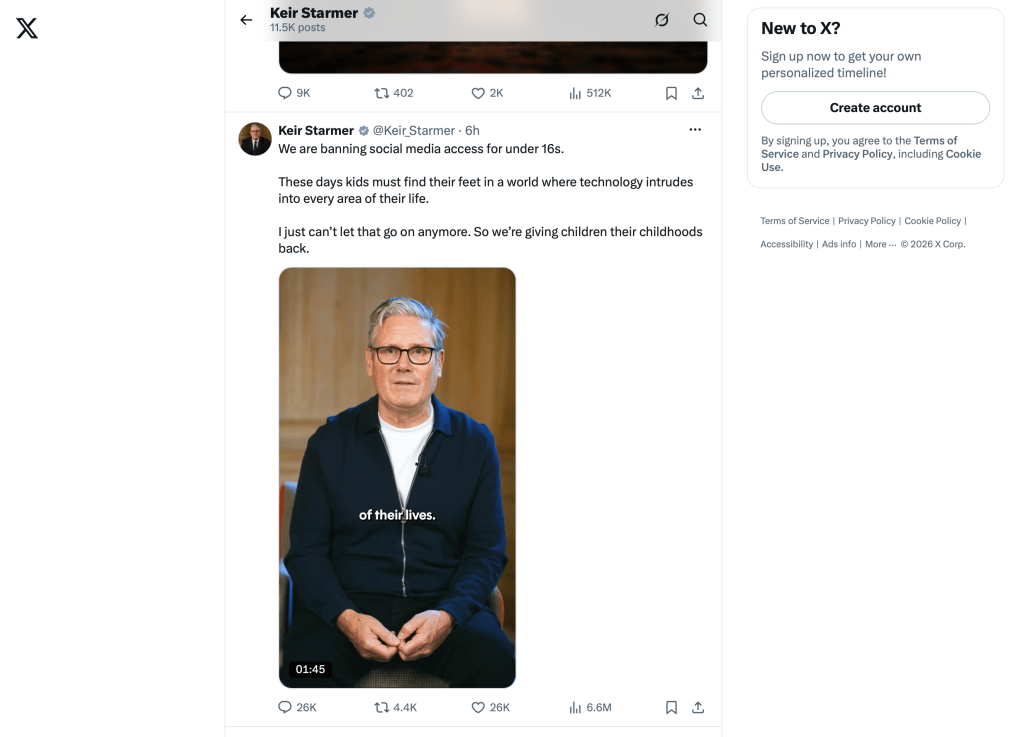
In explaining that children need protection from online harms, UK Prime Minister Keir Starmer posted a video on CSAM generator, far-right pogrom organisation tool and sometimes social media site X. He said he wants children to be safe and happy – the rest is up to them. Apart from social media access, obviously. Because that intrudes into their lives, leaving them “addicted” and “trapped in a cycle of endless scrolling [that] can harm their mental health”.
He suggested resistance to his government’s plans will come from “the most powerful companies in the world”. Like X, the aforementioned hellhole he chose to post his video on, because the government itself appears addicted to toxic social media platforms.
Still, he was not wrong in claiming the plans have support. NSPCC CEO Chris Sherwood fired out a press release with alarming speed, calling the ban a “win for children” and urging the government to “go further, be bolder and make sure there is real accountability across all online platforms, gaming services, and AI chatbots”.
Depending on your point of view, Sherwood’s comments are chilling or well reasoned. Going further might mean overreach. But his point about accountability is useful, because there are widespread problems with social media. Yet this ban won’t solve them.
Hashtag danger zone
There’s all kinds of wrongness in UK government social media policy. A key one is equating social media ills with harm to children alone. Adults are becoming addicted to and being manipulated and radicalised by social media. You could demand platforms act more like broadcasters and publishers, and also ban infinite scrolling and algorithmic feeds.
Instead, perennially online adults with a shocking lack of self-awareness gulp down endless garbage while arguing phones and the internet are rotting children’s brains. Meanwhile, Starmer equates social media with “sending sexually explicit messages”. Which makes me wonder whether he’ll next demand children be banned from messaging apps too, and what exactly ministers think social media is.
Which leads to another problem: what is social media anyway? What will and won’t be banned? Is YouTube social media? WhatsApp? Snapchat? Discord? Legislation can’t adopt Apple’s App Store “we’ll know it when we see it” approach. Yet by separating online spaces into distinct camps, you risk blocking access to services that help young people while allowing harms to continue elsewhere.
In harm’s way
In replacing education with prohibition, my fear is a ban will cause damage that will only become apparent when it’s too late. Age-gating will normalise adults proving their age to visit websites. Passports will be uploaded to access Facebook, and photos gulped down by AI systems, followed by inevitable data breaches.
As noted on Bluesky by activist Tristan Grayford, communities will be torn apart. They noted the UK government has “moved faster to destroy the online communities of teenagers than it has to limit the power of a foreign white supremacist to launch race riots in the UK’s cities and spread child pornography online”. In minority spaces, Grayford added, bans can be especially dangerous: “Keir Starmer has never spoken to an LGBTQ+ or neurodivergent child in a small community who only found people like them online, people who understood them and made them feel like they weren’t alone.”
Beyond that, I find it incredible that the UK government is about to create a cliff edge where teens will simultaneously be able to access social media and vote, having had no experience of the latter and with scant understanding of how algorithms work.
Education, education, education

I’m not an idiot. I know social media can cause harm. I’m not suggesting we do nothing. But bans lack nuance, care and basic logic. They are a headline, not a solution. By treating social media like a drug, that may even make it more alluring. And additional proposals for an under-18s curfew merely highlight the absurdity of where we’re at. Vote at 16? Sure. Get a job? Fine. Join the army? OK. Use YouTube after midnight? ABSOLUTELY NOT!
Fortunately, some sane voices remain. Professor Julia Davidson OBE, Professor of Criminal Justice and Cybercrime and Director of the Institute for Connected Communities, said: “While age restrictions may help reduce exposure to some harms, they should not be viewed as a standalone solution. Protecting young people online requires regulation, education, parental support and safer platform design.” And Dr Ruby Farr, Associate Director of the Institute for Connected Communities, added: “The challenge is not simply whether children should be on social media, but how we create safer online environments where they can learn, connect and thrive.”
I agree. We need education and parental guidance. Platforms must be held to account. Governments need to recognise their own failings, stop using toxic platforms, and regulate rather than just scream THINK OF THE CHILDREN for a quick win.
But no. Cliff edge it is.


Read the full article here
