






Introduction
Incredibly, the BYD Ti7 already sells at a rate of 15,000 units a month in China. Over there, it lives under the slightly-less-snappy-than-BYD banner of FangChengBao; the UK is set to get essentially the same car I’ve just driven, but with BYD badging later in 2026. It’ll come with a four-wheel drive, plug-in powertrain complete with impressive EV only range of up to 79 miles, a premium seven seat interior and, naturally, a small mountain of top tech.
I think it could do really well for buyers looking for value but with a big, bold persona that looks like a serious rival to the Land Rover Defender. While pricing is yet to be confirmed, it is likely to fall in the £50,000 or lower ballpark, which makes it a bit of a steal compared to a basic Land Rover Defender or Discovery, which before adding in options can take one of those to well over the £70,000 mark and upwards.
I know people might get a bit sniffy about that, in much the same way that folks like to talk down the ubiquitous Jaecoo 7, but it’s hard to knock what’s on offer here. The BYD Ti7 will be a firm rival to the likes of the Hyundai Sante Fe and Kia Sorento too, so it’ll be interesting to see how this high-rise SUV fares when it lands on these shores later in the year. Here’s what I thought of it during a recent drive on the roads around BYD’s sprawling central headquarters.
The styling
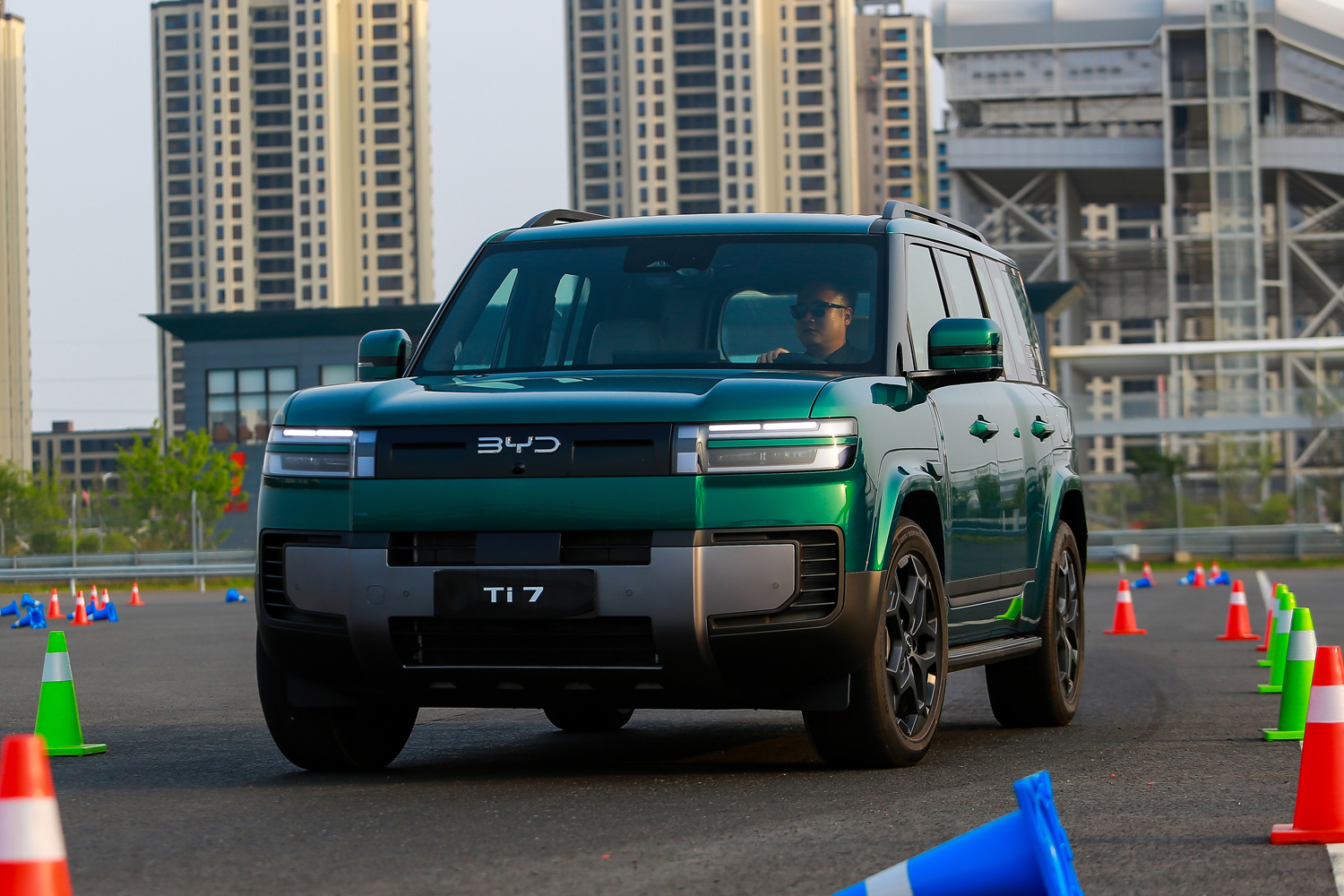
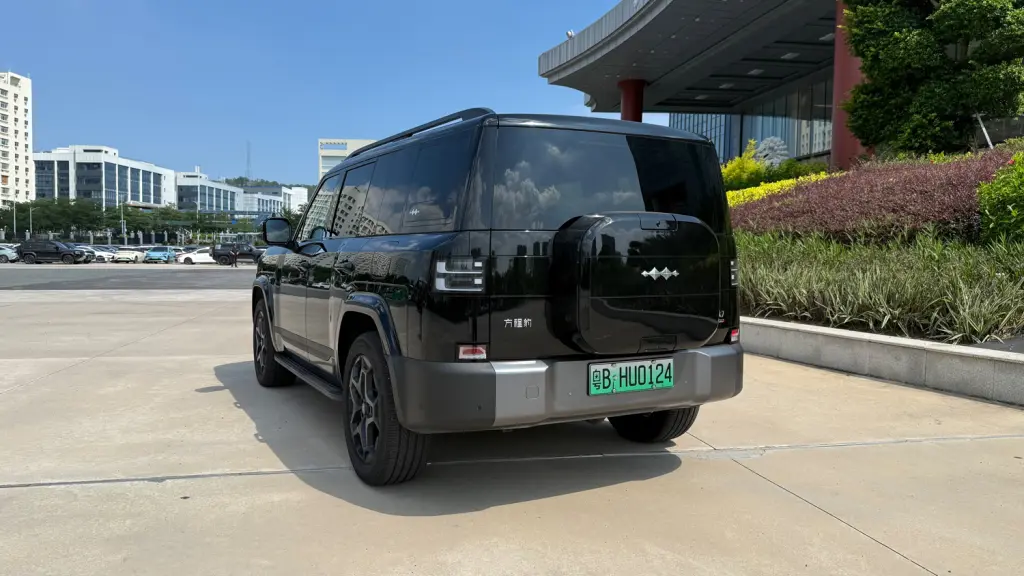
The BYD Ti7 is a bold-looking thing, with an imposing stance that offers distinct Land Rover Defender looks on the outside. My test car featured FangChengBao badging, so the look will be slightly different when it arrives in the UK as part of the BYD portfolio.
The design is strong enough to stand on its own merits, with lots of everyday touches that will make it a very practical option for folks with kids, pets and other stuff to lug around. It’s high off the ground, there are darkened windows, roof rails and a side-opening tailgate that will be perfect for sliding boxes, bikes and tip-trip detritus into. I also really liked the view delivered by the generously-sized door mirrors.
While the outside is dominated by lots of angular panel work, it’s the interior of the BYD Ti7 that really adds extra appeal. My test car came packing an orange-hued leathery style trim, which, against the dark exterior, worked to brilliant effect. BYD designers have chosen to temper this with a solid smattering of brushed chrome effect trim fittings, which alongside a minimalist overall approach works to great effect. Being Chinese, the BYD Ti7 has most of its controls located within the touchscreen and, in this example, the overall effect feels like a success.
The other priority of a vehicle like this is space and I found the BYD Ti7 to be great on that, both in the front and the back. Up in the cockpit, the seats were really comfortable and offered all manner of electric adjustment. Meanwhile, the back row in my five-seat example, was very good too and, surprisingly, these seats were electric as well. The design further back looked like it would be able to accommodate the third row without too much fuss. That would still leave a solid square boot opening for everyday essentials. Overall, I thought the interior of the BYD Ti7 was a definite highlight.
The drive
Considering I didn’t get to drive the BYD Ti7 on anything other than flat roads, it was easy to see the potential. There were lots of options for setting the car up to my liking and specific driving situations too. The UK-specification model will come armed with a 1.5-litre turbo petrol engine augmented by front and rear electric motors offering drive to all four wheels. Judging by the multiple options for tweaking the settings inside the touchscreen, I reckon the BYD Ti7 should be pretty capable off-road or when driven in ever-changing weather conditions.
Everyday driving, however, was about as easy as it gets especially thanks to the EV part of the equation. There’s a column drive shifter, with a purposeful Normal drive mode being ideally suited to the smooth roads I was on. However, this is supplemented by Eco, Sport and a Snow options too, meaning there should be something to assist with any kind of driving scenario. The off-road appeal of the BYD Ti7 was further endorsed by a crop of beefier options that tempted me to try them. Sadly, I didn’t get to sample Mud, Sand or Mountain moments but am certainly looking forward to experiencing them.
I had a bit of a play with the options in the screen too, adjusting brake regen and dipping into Sport when space allowed me to get up more speed. Interestingly, there was even a Sport+ mode nestling in the menu options, and while I engaged it only briefly, the near five-metre long Ti7 felt plenty lively. Ordinarily though, I thought the powertrain felt perfectly solid doing around town-style speeds and it boasted a keen turning circle too, which would add extra appeal for townies. Noise levels were low too, helped I thought by the pretty sumptuous interior and its resulting sound deadening.
The technology
One of the most appealing aspects of the BYD Ti7 is in the tech department. I found plenty to get stuck into, aside from more obvious features such as twin 50-watt wireless charging pads between the front seats and plenty of ports for passengers. Another boon for family-focused buyers will be the box in the centre console that offers heating and refrigeration as required, so could prove perfect for dispensing chilled drinks to irritated offspring in traffic jams. A nice and thoroughly practical touch, I thought.
The sizable central touchscreen was where most of the action was offered. BYD has a practical approach when it comes to usability, so while there were myriad options within the screen menus, I was very keen on quick access tabs along the foot of the display. This meant I could make adjustments on the go without hassle. Plus, there were even some proper physical buttons, with obvious essentials like volume control and dedicated EV mode options being the sort of thing that I’d find it hard to live without during daily use.
Right in front of the driver sits a fairly minimal display that delivered essential information well enough. I was quite keen on the layout of the steering wheel too, which had nicely arranged control buttons each side of the central boss. Over time, I felt that this route would be a great way to make decisions on everyday options, plus there was also the ability to benefit from augmented directions via a head-up display that, while not much use to me on my short route, felt undeniably useful for flustered parents trying to find their next holiday location.
I was also impressed by the audio system, that although appeared to be generic, was more than capable with headrest speakers adding an extra edge to proceedings. Naturally, there were lots of options for fine-tuning its credentials within the infotainment settings.
BYD Ti7 verdict

I really enjoyed my taster session with the BYD Ti7. It packs an awful lot of appeal, especially for people who are keen on generous levels of space, a premium level of trim and all the tech goodies anyone could ask for. While I’ve yet to test the BYD Ti7 on anything other than flat roads, its all-terrain appeal looks to be very solid too with my car boasting seemingly endless suspension setup options within the touchscreen.
Plus, with up to 79 miles of EV-only range, the plug-in model set for the UK market will work brilliantly where the school run, sports activities and shopping close to home are key activities. Anyone with a home or work charger should find the BYD Ti7 spot-on and, hopefully, all for a fraction of the cost of a Land Rover Defender.
BYD Ti7 technical specifications
Scroll to see more →
| Specifications | BYD Ti7 |
|---|---|
| Powertrain | Petrol engine and permanent magnet electric motor |
| Battery | 35.6kWh |
| Power | 646bhp (combined) |
| Torque | 623lb-ft |
| 0-62 mph | 4.5sec |
| Top speed | 118mph |
| Range | 79 miles (EV only) |
| Charge rate | Not stated |
| Cargo volume | Not stated |




Read the full article here


