







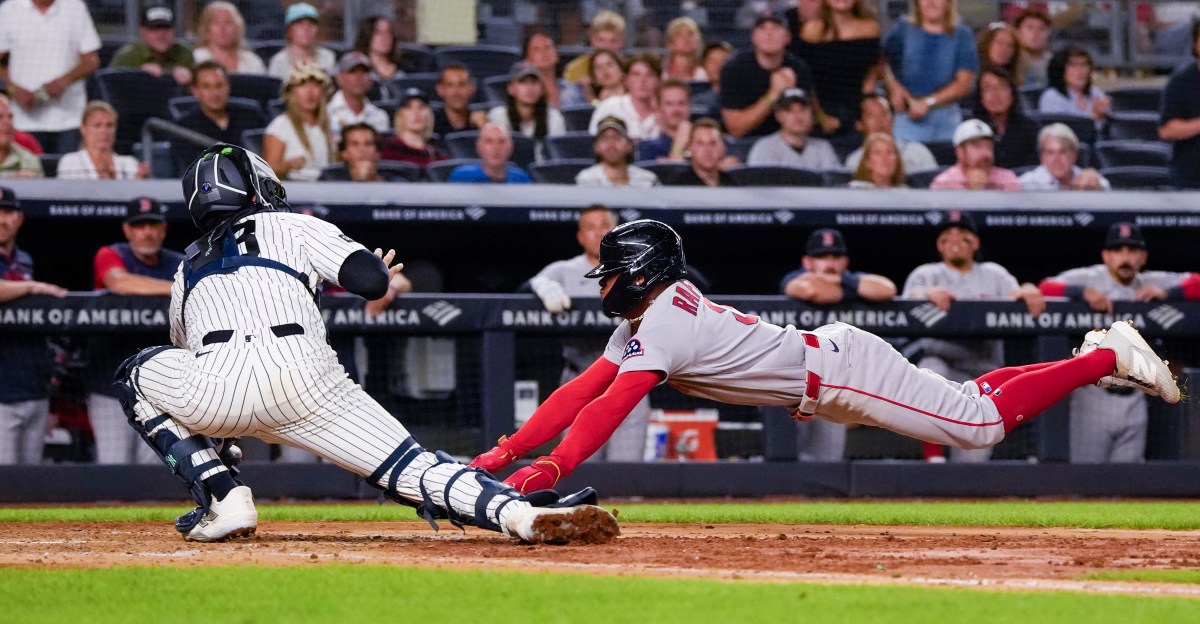
This weekend, I strapped on an Apple Vision Pro to watch a baseball game in immersive virtual reality for the first time. It was technically impressive, visually pretty remarkable, and also didn’t make that much sense.
Apple and Major League Baseball chose a classic match-up of the Boston Red Sox and the New York Yankees for the first of its series of four games streamed on the device. I do not review tech for The Verge, but I do watch a lot of baseball — if there’s a game on and I’m at home, it’s likely on my television. If this is the future of sports, live events, and wearable technology in general, I’d like to see what all the fuss is about.
The first thing to know about baseball is that it is long: in season, in game time, and in the arc of history. Right off the bat, this reality makes having a screen strapped to your face a hard sell. It’s not just the physical burden — like many others, I find the Vision Pro heavy and cumbersome — but also because it’s a time honored tradition to get up and go do something else for a moment while the game is on. It’s America’s pastime for a reason: the slowness, the buildup, the culmination of a long, sticky season where teams slump and get hot. Some nights are duds and others are classics; you are playing (and watching) the long game. Even at the ballpark, you might get up to grab food or another beer, and the seventh inning stretch is built right into live play to give fans a break. With an immersive environment, I struggled with whiplash; coming in and out of the headset’s reality, going from zero to one hundred and back again anytime I wanted to grab a drink, walk around, or eat dinner.
That said, the first time I put on the Vision Pro to watch the pre-game show, I screamed — it’s surreal to see the players so close, from a new, intimate angle and proximity. It was arresting, surprising, and a little scary. As Yankees starting pitcher Cam Schlittler was warming up in the bullpen, all I could think was, “He really is so tall.” A pre-game interview with Jazz Chisholm Jr. made me feel like I was standing uncomfortably close to him. The broadcast on Apple Vision Pro was clearly tailored to an audience who might not be as familiar with MLB or baseball in general: There was a lot of explaining how to watch the game, and many shout outs to the Vision Pro viewers, of course.
The feeling of being terrifyingly close didn’t last very long, though. On Vision Pro, you watch the game primarily from two angles, next to each team’s dugout when that team is batting (you’re stuck there, you don’t get to move around as you please). I liked this angle for certain batters, because you can see the vertical movement of pitches come in without anything blocking them. But for say, a righty batter whose team is watching from the third base dugout (or a lefty whose team is watching from the first base side), their body partially obstructs the view. The immersive view also doesn’t track the action in the outfield — your perspective is frozen next to the dugout. As a result, I felt both in the thick of it and at a strange remove; even ground balls and infield plays feel a bit far away, especially if you’re watching from the third base side and there’s traffic on first and second base.
The immersive broadcast includes a floating jumbotron-style screen that shows a more traditional TV broadcast, along with player stats. I often found my attention drifting up to the standard broadcast, because once the ball leaves the vicinity of the batter, it’s quite hard to track what’s actually going on. The immersive replays from new vantage points like the outfield or closer to first base helped to bridge the feeling of being at a distance. But the Vision Pro’s view isn’t very reactive to what’s happening in real time. When Red Sox second baseman Nick Sogard hit a fly ball early in the game, it almost was a home run — but the immersive view was not very compelling. Baseball is full of weird moments, and it made me wonder how well those would be captured on the Vision Pro. What would the benches clearing in a heated moment look like, given the dugout is blacked out during innings? (For this iconic Red Sox-Yankees brawl, the dugout angle might actually be perfect.) How well could you follow the extremely rare and weird occurrences — like a ball getting wedged between the padding of a wall and the ground — that randomly become extremely important and that most people have never seen happen before? The Red Sox fly ball was caught up against the wall by Yankees centerfielder Trent Grisham in a hopping catch, but the immersive view alone wouldn’t be enough to follow the play closely. You need the TV broadcast screen to supplement the hyperreality.
It all made me wonder who or what watching a game on Vision Pro is for
There were a few moments that really did feel like a new way to experience a very old game. The brief look into the team dugouts, for example, offered views you don’t often get: the screens tucked away with a live feed of the bullpens, or the sunflower seeds flying into the dirt. The on-deck circle, where players do their ritual preparations before it’s their turn up to bat, is visible only occasionally on a broadcast but is in full view on the Vision Pro. After Schlittler was pulled from the game in the sixth inning, the immersive view showed him in the dugout, shaking his head in frustration and heading into the clubhouse, head in hands. You probably wouldn’t get these details in a typical broadcast, at least not up close like this.
On Saturday, I had a game on the TV while I made dinner for a friend, and on Sunday, a group of us caught the last Red Sox-Yankees game, live at Yankee Stadium, where the Yankees crushed the Sox 16-1. It all made me wonder who or what watching a game on Vision Pro is for. It’s remarkable technology that felt weirdly sterile and isolating as I sat on my couch, my friends watching me watch something alone.
All of the most memorable baseball-related moments I’ve experienced happened in the company of others, and none of them depended on how good my view was or how close I was to the players. Immersive viewing might be a fun way for a casual fan or a tech-y person to engage with the game in a low stakes, convenient way. But if baseball is part of the rhythm of your day, or your summer, or your year, it’s hard to imagine regularly choosing the headset over just about any other way to follow the sport. I’d venture that for many baseball fans, the Vision Pro experience optimizes for the wrong thing. It’s novel and undoubtedly exciting — at least until you realize this isn’t what you came for to begin with.
Read the full article here


