

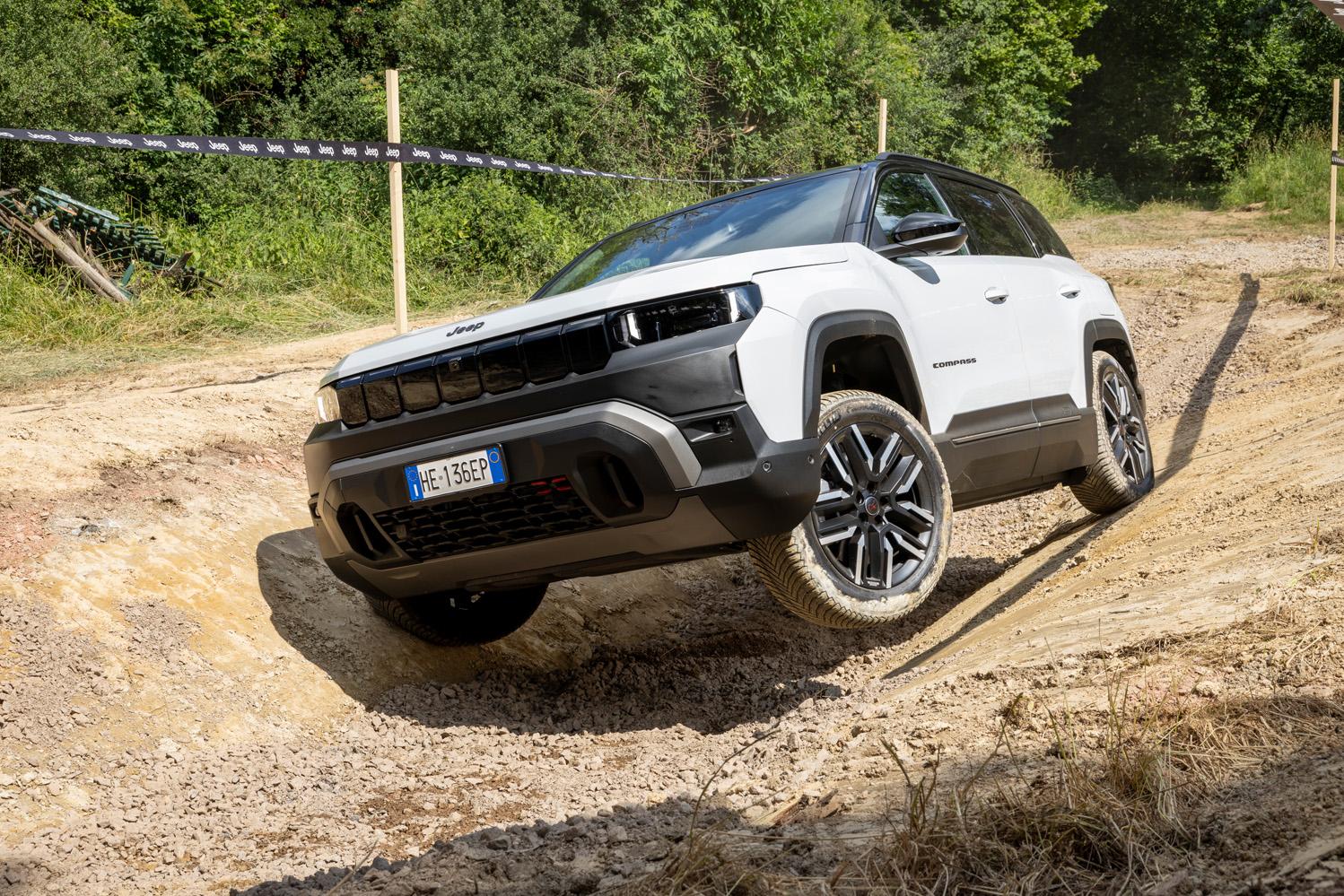
Jeep has been busy boosting its range, with updates to both the Avenger and this, the Jeep Compass.
I loved the Avenger when I drove it a few years ago and now there’s an 85th Anniversary Edition model that tops off a selection including e-Hybrid, full electric and 4XE powertrain variants. There’s even a manual petrol Turbo 100 option for good measure. It’s a compact and very decent on and off-road option.
Focusing on the latter, though, there are a couple of key additions to the Compass line-up. The dual motor, all-wheel drive Compass 4XE is capable of over 370 miles on a charge, while the 231bhp BEV Long Range, can deliver up to 418 miles. The Compass looks and feels bigger and bulkier, which means there’s more space inside and the rugged interior is perfect for anyone with kids and pets to haul.
Crucially, having just driven both vehicles on a mix of roads including some very challenging off-road sections, the Jeep Compass felt like the better bet for anyone who spends more time off-road than on. Granted, that might be a reasonably niche group of folks but, given just how good the Compass was on tough terrain, if I had one, I’d be less worried about going a bit off the beaten track. With the summer holidays knocking, the Compass offers real go-anywhere freedom.
The styling
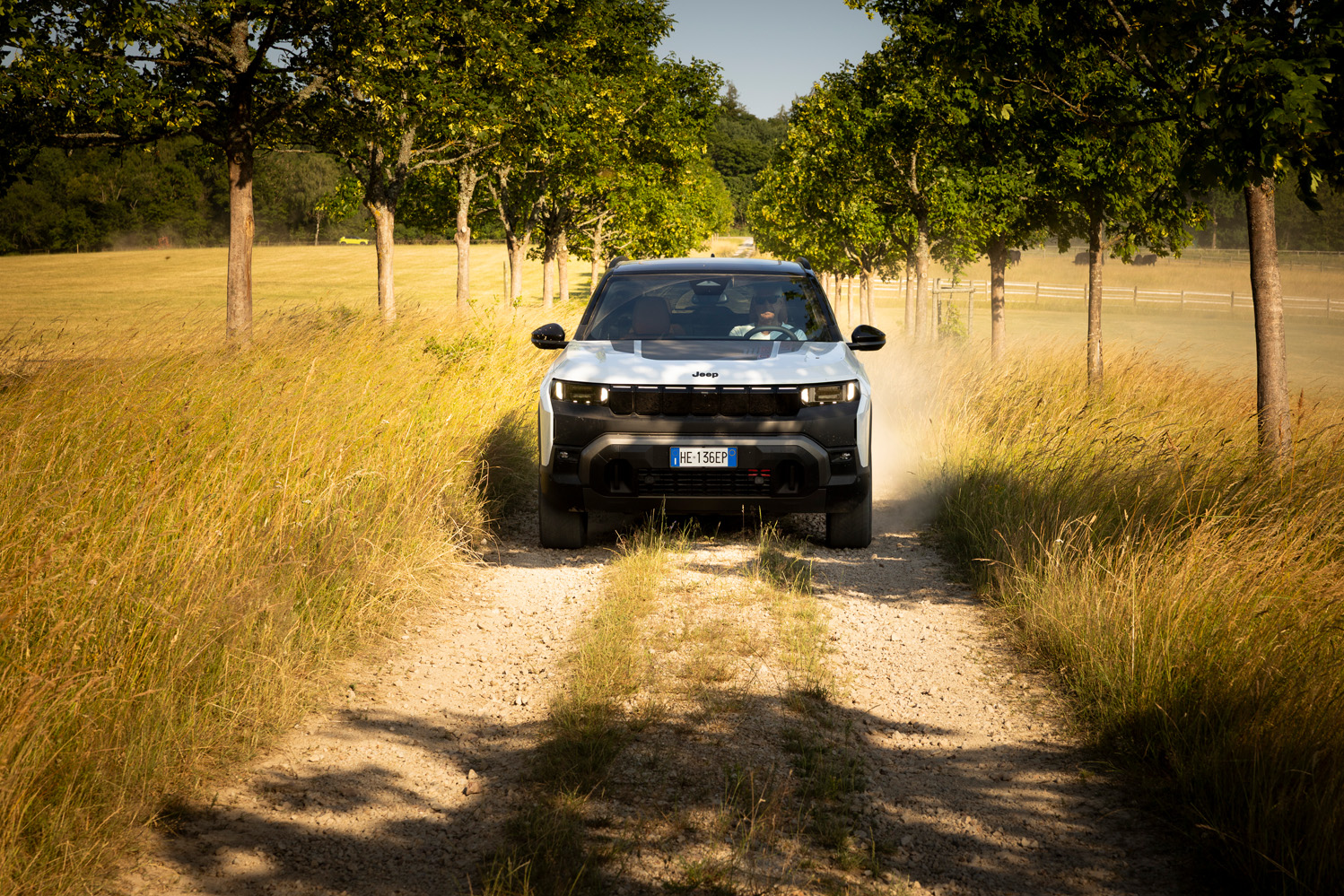
Jeep has fine-tuned the trims for the latest incarnation and the Compass 4XE now comes as an Upland edition, complete with 19in wheels, a rear tow hook, front fog lights and roof rails. There’s also the Overland, which looks slightly zingier thanks to posher diamond cut alloys, a backlit 7-slot grille and matrix LED headlights plus privacy glass and hardier upholstery on the inside.
Some of the cosmetic tweaks have helped its overall off-road appeal too, with sharper front and rear ends meaning better clearance over tricky terrain. The matt black nose section looked like it would be good at fending off sticks, stones and general crud over time too. More black plastic dominates over the distinctive angular wheel arches and along the sills as well, which combined with the blacked-out privacy glass gave my car quite a brooding look. A rear end with cool taillights and an illuminated Jeep logo topped it off.
My only worry about the overall off-road appeal of the Compass 4XE were the alloy wheels. While they looked really good, I think I’d probably be happier with a set of plain and simple steelies. Nevertheless, the dazzling rims lifted the mood of the Compass 4XE. Besides, in reality I doubt many Compass owners will be doing too many off-the-beaten-track manoeuvres anyway.
The drive
Having previously driven the e-Hybrid plug-in, e-Hybrid and BEV variants of the Compass, I knew what to expect from this all-wheel drive C-SUV model. The Jeep Compass 4XE benefits from 10mm higher suspension, which combined with the more acute styling at the front means there’s a 28-degree approach angle, 17-degree breakover angle and 31-degree departure angle. All this makes it better than ever for tricky terrain. It can handle water depths of up to 480mm too.
Prior to taking my Compass 4XE off-road, I tried it on a mix of standard surfaces. While it still sits on the Stellantis STLA Medium platform, the setup has been improved thanks to new springs, dampers and an antiroll bar. As a result, the Compass 4XE feels dependable enough, with the dual motor, all-wheel drive powertrain helping to keep the C-SUV on the straight and narrow. Despite the suspension tweaks, I did think there was some noticeable roll in tight bends, but I could easily live with that.
The power delivery felt nicely balanced too, with 157kW from available from the motor at the front and 132kW from the rear. This dual motor setup also meant that the 4XE had beefy torque on tap, up to 310Nm at the rear wheels thanks to Stellantis engineers hooking up a 14:1 reductor thereby making it well suited to steep inclines. This was also compounded by Jeep’s Selec-Terrain system, which offered me five driving modes including Auto, Sport, Snow, Sand/Mud and a 4WD Lock option that only comes on the 4XE model.
Those latter-mentioned modes gave the Jeep Compass 4XE a real edge once I got to take it off the beaten track. The Sand/Mud option, engaged using a nifty new rubber shifter, allowed me to access genuine potential that had previously felt missing on the road sections I’d driven. And, compared to the Jeep Avenger, which felt a bit overwhelmed by harsher terrain, the Compass 4XE dealt with dirt tracks brilliantly. Its high-riding profile and ability to deliver power very dynamically made it a hugely entertaining thing to drive. If I bought one, I’d be looking for dirt wherever I went, just to give it a go.
The technology
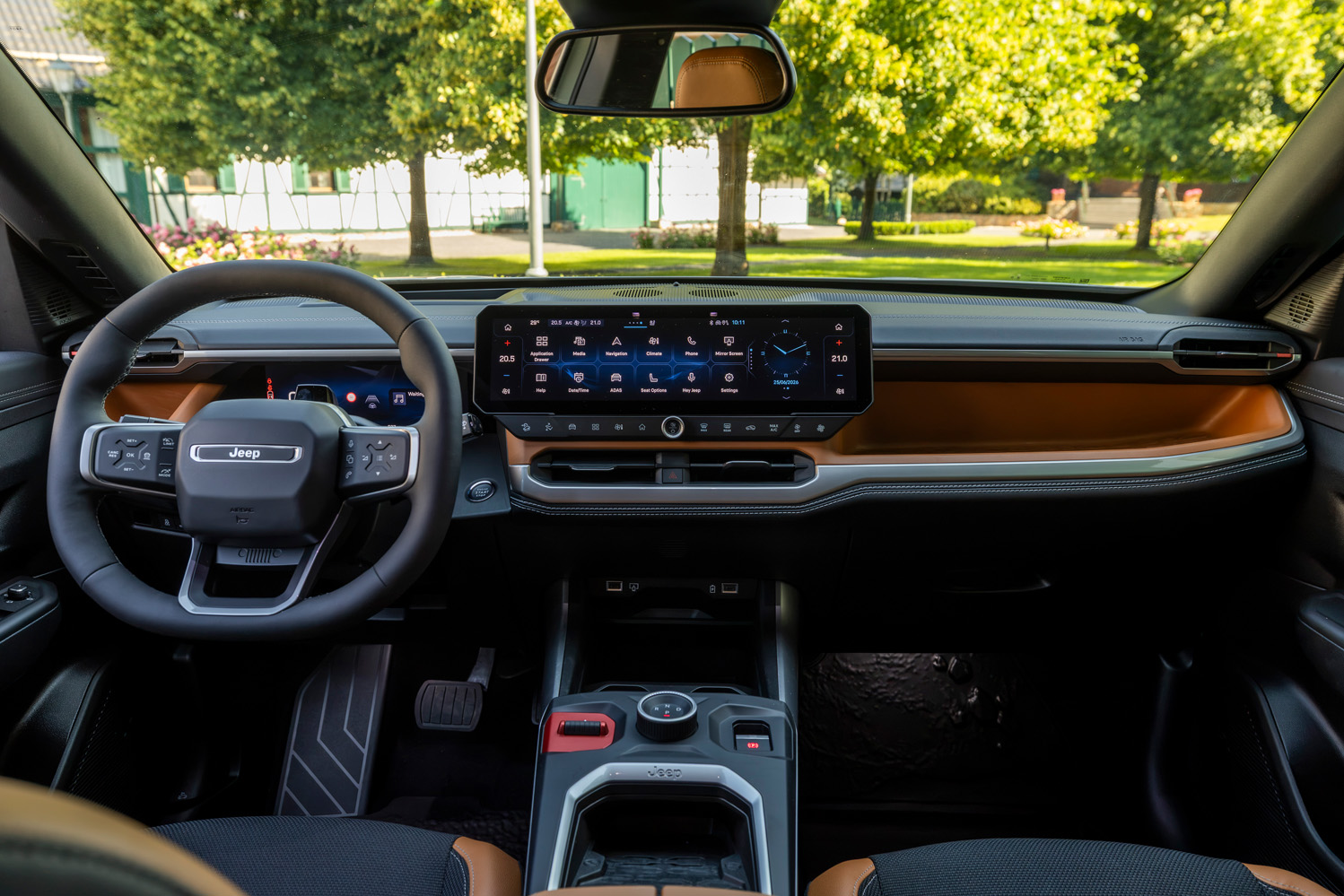
While the cockpit of the Jeep Compass 4XE is undeniably practical, it has also been kitted out with some decent tech. There’s a 10.25in digital instrument cluster complimented by a 16in landscape-oriented infotainment screen that looked much more impressive than the smaller one found in the Avenger. The graphics, as I’d anticipated, were nicely slewed towards chunky fonts, bold colours and a real outdoorsy feel. Usefully, Jeep has retained some physical controls, both along the bottom of the infotainment screen and topping that off with capacitive controls on the steering wheel.
I quite liked the user-friendliness of the infotainment screen. It’s been divided up into chunks, with a middle section that is home to easy-access icons that go straight to core functions. This included the music playing option, which was supplemented by a fairly basic sounding Focal Premium audio system. Then, at either end, there were quick touch controls for controlling climate as well as a ‘Home’ button that would take me back to the home page if I got muddled on the move.
Down on the central console, the Compass 4XE is notable for its bright red Selec-Terrain shifter for choosing drive modes. It was a hard-to-resist feature that really did encourage me to pick through the options, especially as it stood out so much against the fairly stark and decidedly dark interior finishings. I was pleased to see drive could be engaged using a round dial shifter too, instead of that confounded shifter component I seem to see in every other Stellantis group product.
Elsewhere, the levels of tech were solid in my test car, with the likes of wireless Apple CarPlay and Android Auto, wireless phone charging and 360-degree camera all adding value. There is also the option on higher trims to go for a more premium seating setup, that delivers electrically adjustable seats complete with heating and massaging functionality.
Jeep Compass 4XE verdict
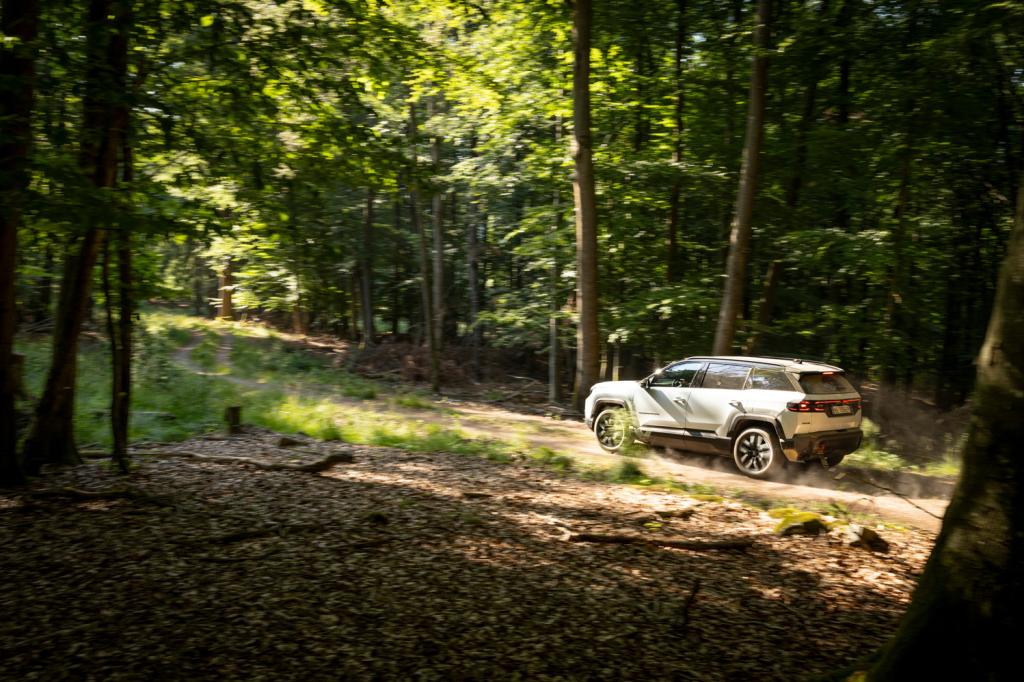
The Jeep Compass 4XE feels most at home out in the sticks when it’s being driven enthusiastically on dirt tracks and across muddy fields. The road-going vibes aren’t quite as impressive, but the combination of the two skill sets make the Compass my choice over the less rugged Avenger. The bonus part is the larger quota of space that comes with the Compass 4XE, even though the bulkier feel of the bruising body style makes it slightly less handy around town.
Add on the range capability of the bigger battery model and this is an option with true go-anywhere appeal.
Scroll to see more →
| Specifications | Jeep Compass 4XE |
|---|---|
| Powertrain | Permanent magnet electric motor |
| Battery | 96.1kWh |
| Power | 375bhp |
| Torque | 426lb-ft |
| 0-62mph | 5.4 sec |
| Top speed | 112mph |
| Range | 370 miles |
| Maximum charge rate | 160kWh |
| Cargo volume | 550 litres |


Read the full article here
