

H. Moser & Cie. has made a digital watch. It has Bluetooth and connects to your smartphone. But don’t call it a smartwatch.
The Swiss brand, known for stripping mechanical watches back to basics, has turned that same philosophy on wearable tech. The result is called the Off-Grid, designed to sit in between a smartwatch and a mechanical watch. It’s the missing link.
I’ve been wearing one for the past week. It’s the most premium digital watch I’ve ever worn, and you can really feel it. In fact, it’s the first digital watch I’ve properly fallen for.
Off-Grid origins
The Off-Grid didn’t come out of nowhere. Its roots trace back to Moser’s partnership with Alpine in Formula 1 (a partnership I’ve seen first hand at the Silverstone Grand Prix).
Last year, that collaboration produced the Streamliner Alpine Drivers and Mechanics Editions, a pair of watches sold together for 59,000 CHF, limited to just 200 pieces. The Drivers Edition was a skeletonised mechanical chronograph built for the drivers. The Mechanics Edition was its digital counterpart, built for the unsung heroes in the pit lane – the pit crew and mechanics.
The Off-Grid is essentially descended from that Mechanics Edition. It also explains the name. It’s “off-grid” in the sense of disconnecting from the noise of always-on tech, but it’s also a nod to being off the F1 grid. A neat little double meaning.
Off-Grid design
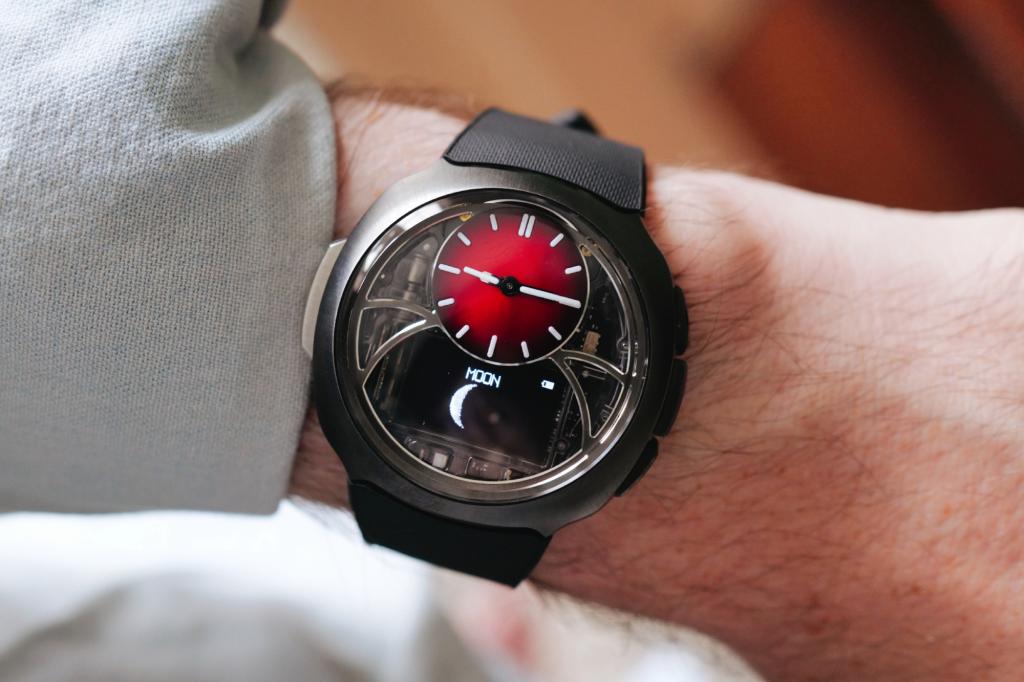
The Off-Grid, from a distance, looks just like an H. Moser Streamliner. It thin, beautifully made, and the rubber strap is one of the comfiest I’ve tried.
The case measures 42.6mm across and 14.4mm thick, but it wears more compact than the numbers suggest.
There are two colourways are on offer. The first, reference 6DI0-1202, pairs blue PVD-treated steel with a Blackor fumé dial and an integrated white rubber strap. It’s the sportier of the two.
The second, reference 6DI0-1205, is darker and more moody. Black PVD-treated steel is matched with a red fumé dial and an integrated black rubber strap. The red dial against all that black is really striking, and it’s my favourite of the two.
The small domed sub-dial sits at 12 o’clock and carries the H. Moser & Cie. logo in transparent lacquer.
I love love love the exposed circuit boards and batteries peeking through the skeletonised dial. That kind of design is really up my street, marrying my love of technology and mechanical watchmaking.
I wore it to an industry event last week, admittedly one full of watch journalists, and it got a lot of attention. As mentioned before, from a distance, it could easily be mistaken for a mechanical Streamliner, which says a lot about how well Moser has folded this into its existing design language.
My only real gripe is the screen integration. When it’s off, it’s just a black rectangle sitting in the middle of the dial, which feels a little jarring next to all that careful mechanical detailing.
Off-Grid functionality
As mentioned before, Moser is pitching the Off-Grid as a missing link between a smartwatch and a mechanical watch. The skeletonised dial hides a digital display underneath. There’s Bluetooth, iOS and Android compatibility, and a companion app. But there’s no fitness tracking, no heart rate monitor, and definitely no endless stream of notifications.
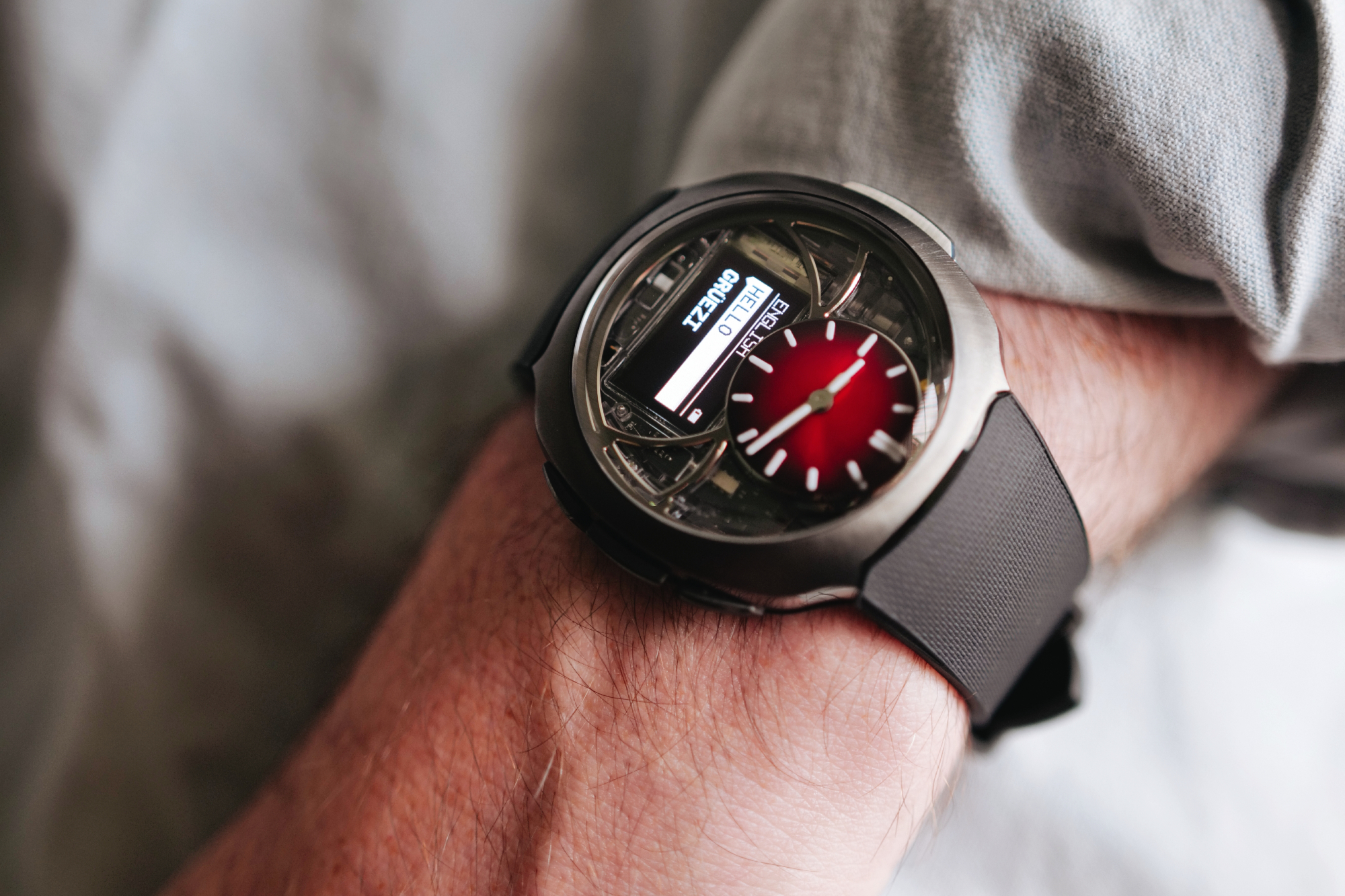
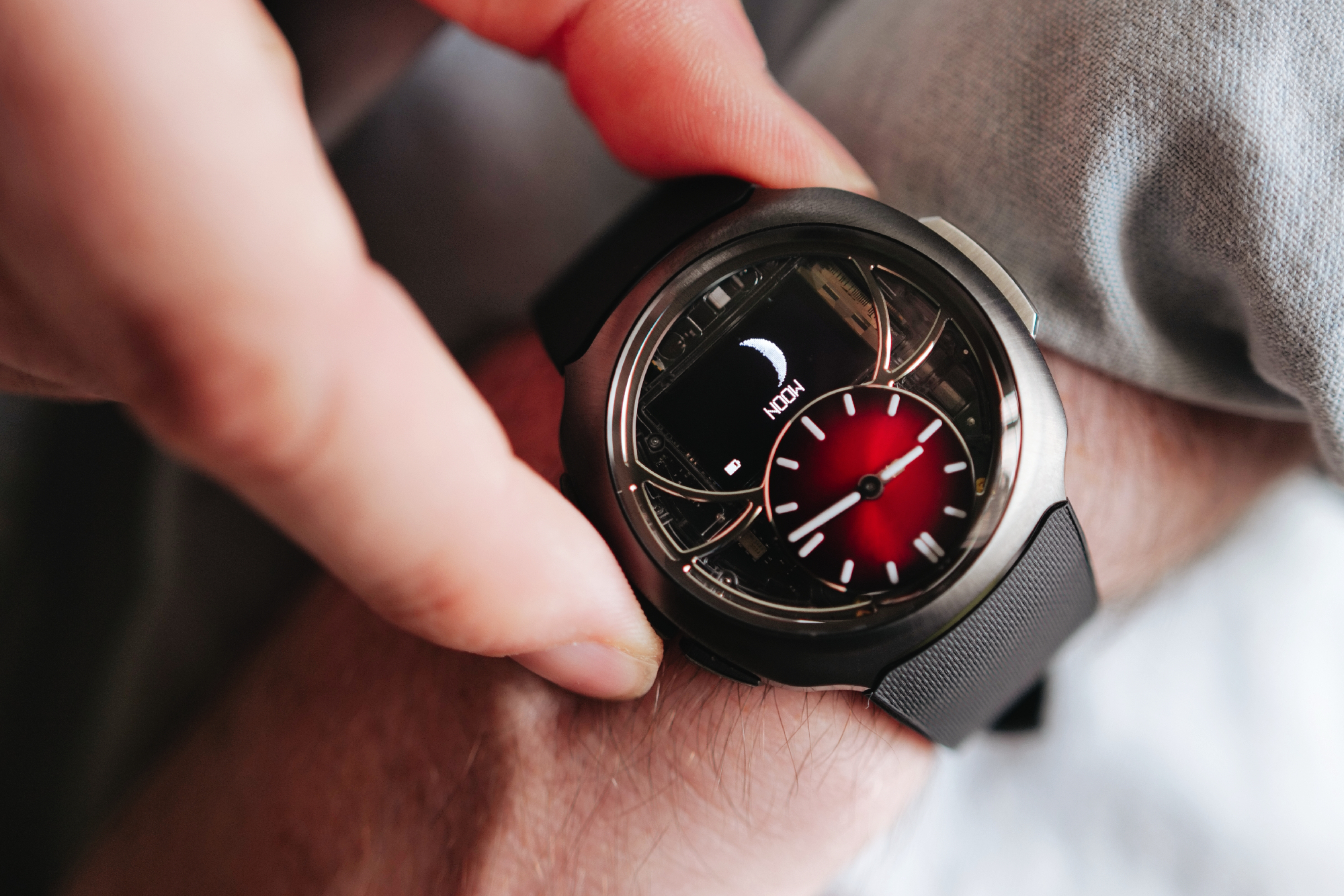
Instead, you get a GMT function with a country selector, a split-seconds chronograph, a perpetual calendar, and a perpetual moon phase that’s programmed a full century ahead. There’s also a vibrating alarm and a timer.
It’s basically a grand complication in digital form.
I used the timer a lot during the week. My son, meanwhile, was obsessed with the moonphase animation.
The quirkiest touch is the “Off-Grid” mode itself. Press the pusher at 9 o’clock and it pulls up a quick country selector along with a built-in dictionary of ten words/phrases, translated into 21 languages. It’s a fun idea for travellers, equal parts handy phrasebook for a trip and fidget toy for a long-haul flight.
It’s easy to live with once you get the hang of the pushers. I like this ‘paired down’ approach a lot – I’m not the biggest fan of attention-grabbing smartwatches, Moser’s pitch, that intelligence sometimes means knowing when to stop, is a refreshing one. Also, I get my fitness tracking from smart rings now, so I’m not missing out there.
Off-Grid specs
Under the skeletonised dial sits the Calibre D10, developed with Sequent. It’s made up of 186 components and runs at 32,768 vibrations per second, with an accuracy of ±0.3 seconds per day.
Battery life depends on how hard you push it. Left purely as a timekeeper, it’ll run for over 12 months. Add GMT display and 30 days of alarm use, and you’re looking at 6 months plus. Push it further with GMT, 30 days of alarm use and 4 hours of chronograph use, and it drops to 3 months plus.
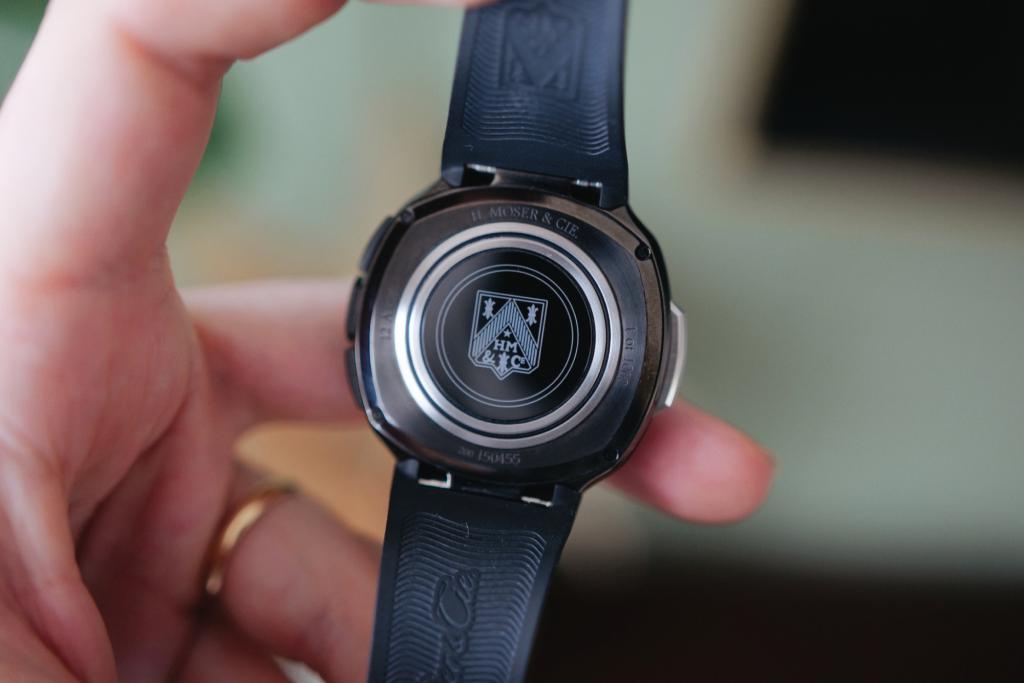
The watch is water-resistant to 12 ATM, and the sapphire case-back shows off the Moser emblem.
Is it worth it?
Am I advocating for this to be someone’s only watch? No. But as part of a wider watch collection, it’s a brilliant set-and-forget option. Think of it a bit like a G-Shock (although nowhere near as rugged). It’s always telling the right time, and when you’re a little bleary eyed and can’t be bothered working out where the hands are pointing (which, let’s be honest) we’ve all been there, you can just glance at the digital display instead.
It’s worth being honest about the downside too, though. Unlike a beautiful Streamliner Perpetual Calendar, which will happily outlive all of us, this is still a digital, hybrid smart watch. It has a shelf life. The battery, the module, the Bluetooth chip, all of it will eventually become obsolete in a way a mechanical movement never does.
Price and availability
I loved my week with the Off-Grid, and am seriously considered buying one. It’ll set you back 3900 CHF plus tax, which feels like a lot for what is, on paper, a digital watch, but it’s also the cheapest way into H. Moser & Cie. ownership, and likely will be for a long time.
Both colourways are limited to 1000 pieces each.
Existing Moser clients get first access through boutiques and H. Moser’s website from 21 to 24 September. It then opens up to the wider audience from 24 September 1PM (CET), with the window closing on 4 October.
Liked this? Buying your first mechanical watch? Here’s everything you need to know before spending a penny


Read the full article here
