




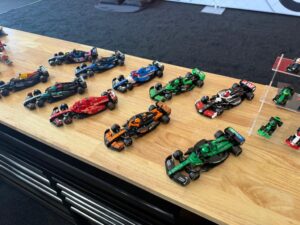


Two years ago, Lego and F1 shook hands on what looked like a fairly standard licensing deal. It’s since turned into one of the most successful partnerships in motorsport (up there with Rust-eze and Lightning McQueen).
It started with some Speed Champions sets and a bit of cross-promotion. Job done, right? Instead it’s turned into something far bigger – drivable life-sized cars, a race-ready F1 Academy livery, and helmets so detailed that drivers turned up to the track with them.
I’ve been watching F1 since Jenson Button won the title with Brawn GP, and I’ve been playing with Lego for about as long as I can remember – so this is about as close to a dream beat as journalism gets for me.
Having covered most of this from the inside, I thought it was worth pulling the whole story together – here’s how Lego and F1 became the perfect pit-lane partnership.
How much is the deal actually worth?
Neither side has put a figure on it, which is fairly normal for this sort of tie-up. Lego and F1 announced their “global multi-year strategic partnership” in September 2024, with product launches confirmed to run at least through the following seasons, but no contract length or fee has ever been made public.
For context, F1 teams collectively pulled in around $2 billion in sponsorship revenue last year.
Lego’s arrangement sits outside F1’s official “Partner” portfolio entirely (it isn’t listed among F1’s headline sponsors like LVMH, whose 10-year deal is reportedly worth $1.1 billion), which suggests a more product-and-activation-led structure than a straightforward billboard deal.
Whatever the number, it’s clearly enough to justify building ten roadworthy 1500kg cars and, this year, twenty-two individual go-karts.
Who does this benefit more?
The pairing makes sense from both sides of the table. For Lego, a licensing deal like this taps directly into a F1 fanbase that already loves spending on branded gear – replica kit, team merch, and now, the chance to own your favourite team’s car in brick form.
For F1, Lego offers something the sport has always found tricky: a way to make a fairly serious, grown-up sport feel playful and accessible to children without diluting the racing itself.
The activations, such as the Miami and Silverstone drivers parades (more on those later) get amplified across national news, social media, by the drivers (who, unlike with most sponsor commitments, seem to genuinely enjoy taking part), and by fans.
November 2024: the announcement that started it all

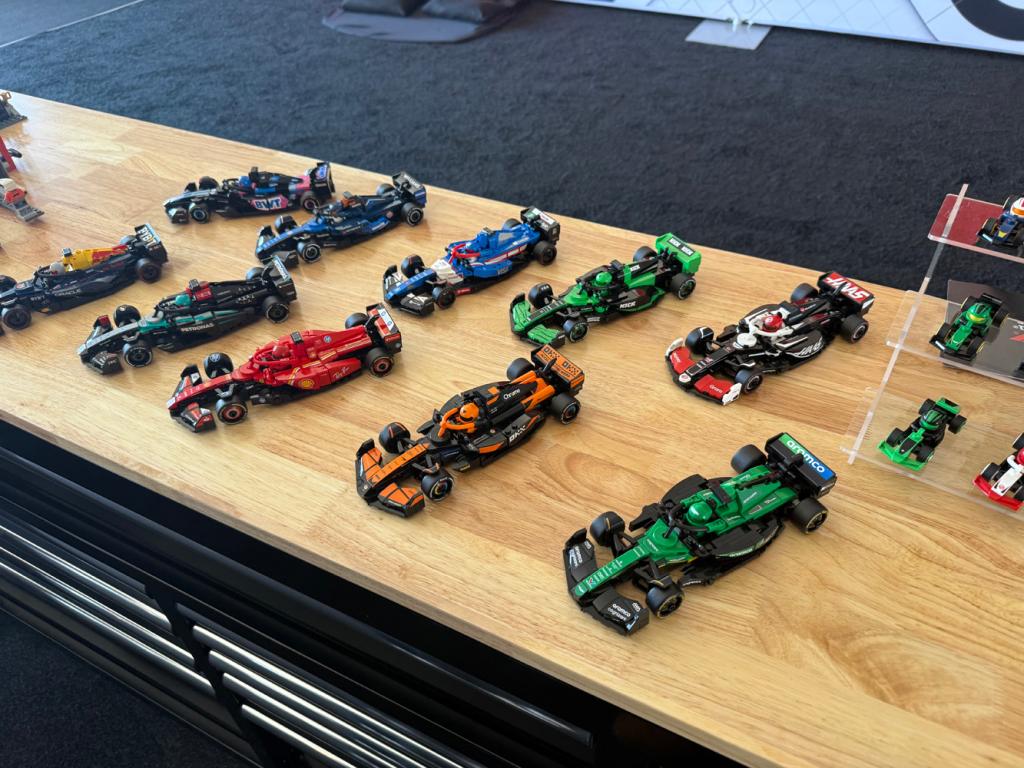
My colleague Dan Grabham was in Las Vegas when Lego officially confirmed what had been rumoured for months: a proper, all-team partnership with Formula 1. Every one of the ten grid teams signed up for its own Speed Champions car, which is no small feat, given how notoriously reluctant F1 teams are to cooperate on anything.
Lego’s creative lead Dan Meehan called it the product of 18 months’ work, and said seeing all ten liveries together as a collection was what really got him.
Beyond the headline cars, the launch spanned pretty much every corner of Lego’s catalogue – Technic sets for Red Bull and Ferrari, an Icons homage to Nigel Mansell’s Williams FW14B, City playsets, collectible blind-bag minicars, and even a Duplo range for toddlers.
May 2025: things get life-sized in Miami
Things got really serious a few months later, when I went behind the scenes at Lego’s big project for the Miami Grand Prix. Twenty-six designers and engineers had spent close to a year building ten fully drivable, 5.5-metre Lego F1 cars – one per team, each around 400,000 bricks and 1500kg, with real F1 rims and tyres bolted onto a custom Lego frame.

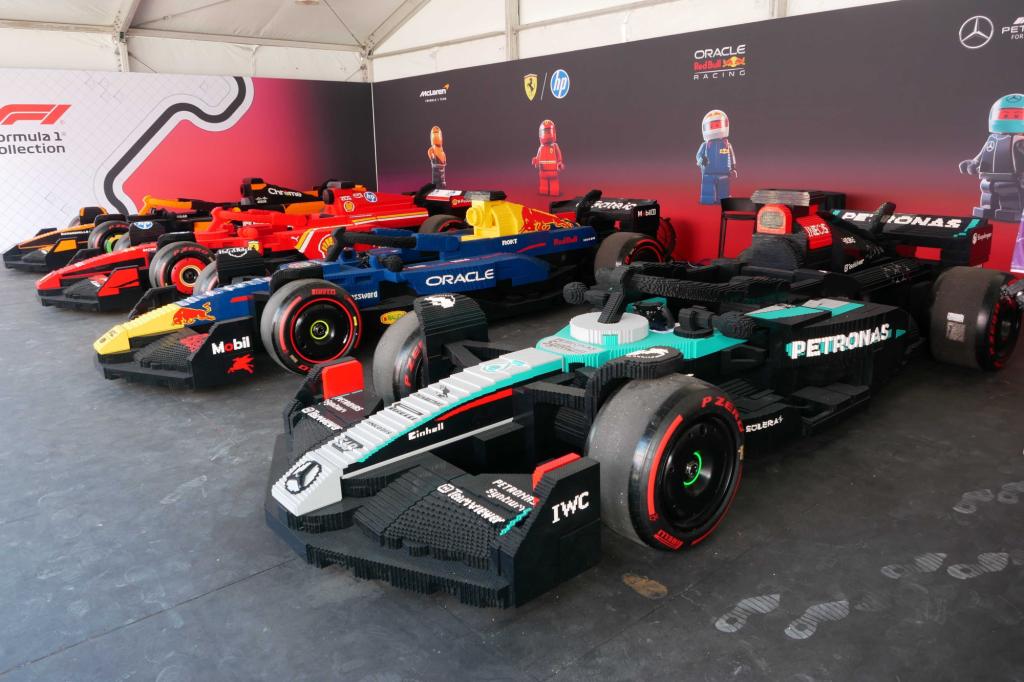
Lead engineer Martin Šmida talked me through the metal understructure, the electric motor and the racing brakes; his colleague Marcel Šťastný admitted the drivetrain could go faster than its 20km/h limiter allowed, but that wasn’t really the point. “They’re about the moment, the joy, the surprise,” he told me.
All twenty drivers took to the Miami track in the cars for the parade lap, and, inevitably, some gentle bumper-car chaos followed.
November 2025: Lego goes racing for real
By the time the paddock reached Las Vegas again, the partnership had evolved from novelty into something with actual sporting intent.
My colleague Tom Morgan was there as Lego and F1 Academy director Susie Wolff revealed a genuine Lego-branded entry for the 2026 F1 Academy season, to be driven by Dutch racer Esmee Kosterman under car number 32 – a nod to the year Lego’s creator started making toys.

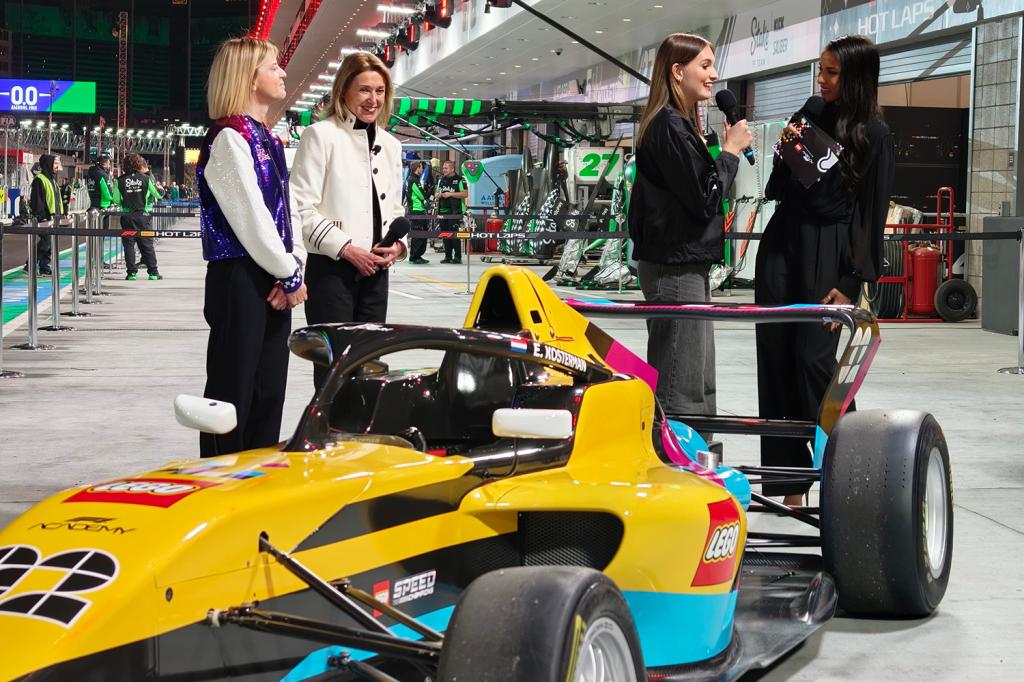
The matching 201-piece Speed Champions set and the real car shared the same livery, designed in-house by Lego’s team.
Wolff called it a “pinch me moment” for girls seeing themselves represented in motorsport. It was a genuine widening of what the partnership was for – not just merchandise inspired by F1, but F1 built, in part, by Lego.
March 2026: the helmets arrive
The 2026 season proper kicked off with a shift in focus from cars to drivers. In Melbourne, I covered the launch of the first two Lego helmet sets, celebrating Ferrari’s Charles Leclerc and Lewis Hamilton.
Both drivers carried life-sized brick-built replicas of their own helmets – over 3500 bricks each, built by Lego Certified Professional Ryan McNaught’s team over 60 hours apiece – into the paddock to mark the occasion.
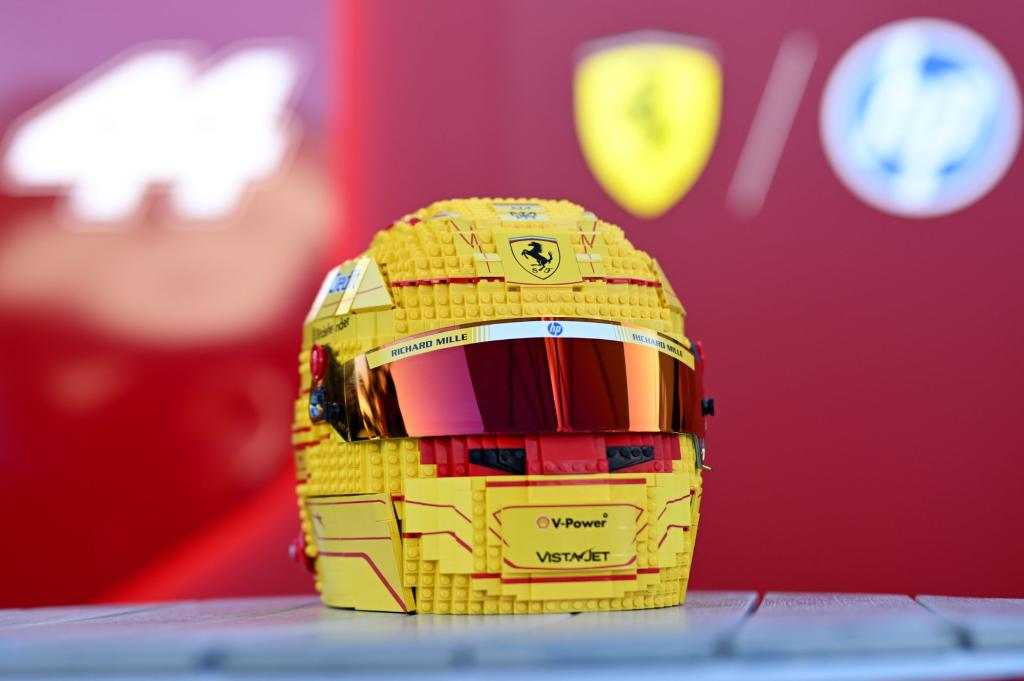
The 885-piece display sets that followed included each driver’s first-ever minifigure appearance, plus details like Leclerc’s tributes to his late father and to Jules Bianchi.
As someone who’s been to the Miami parade and is a longtime Hamilton fan, I said at the time I’d be first in the queue – and the model now sits on my desk.
June 2026: McLaren’s 1000th race, and a very last-minute rewrite
The helmet models returned for McLaren’s 1000th Grand Prix in Monaco, this time with Lando Norris and Oscar Piastri. I covered the launch, and the backstory turned out to be the best part: the sets had been in development for two years, designed in tandem with the real helmets Norris and Piastri wore on track that weekend – the toy inspiring the real thing, rather than the other way round.
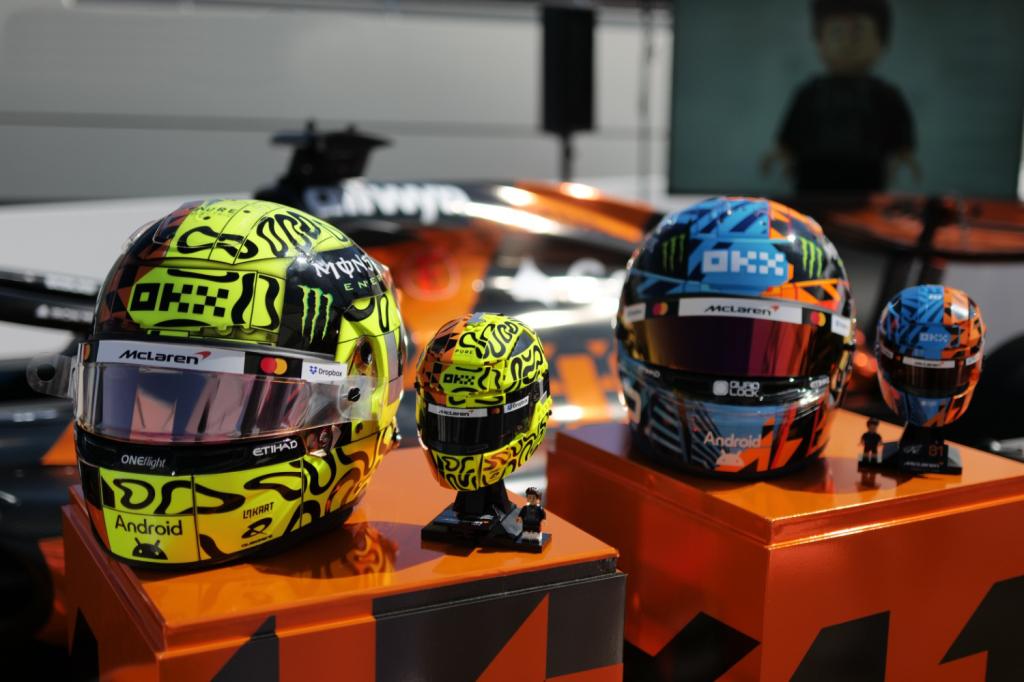
Then Norris won the 2025 World Championship and switched from car number 4 to number 1, forcing Meehan’s team into a late scramble to redesign the helmet, the minifigure and even the Easter eggs. “We’re not recreating an object from the past,” Meehan told me. “We’re co-creating a real life thing.” The finished set still hides a spare tile bearing the number 4 in its parts bag – what would have been, had Norris not gone and won the title.
Getting the minifigures right took plenty of negotiation. Piastri wanted flip-flops and anatomically correct Lego kangaroos on his casual fit; Norris’s minifigure hair proved so hard to match that he ended up getting a real haircut to solve it.
July 2026: Silverstone doubles down
Ahead of the British Grand Prix, Dan Grabham reported on the next escalation: rather than ten shared team cars, all 22 drivers would get their own individual drivable Lego kart, built on a go-kart chassis with a 28,000-piece Lego body layered on top. L
ego’s Julia Goldin said fans and drivers alike had wanted “more” after Miami’s chaos.
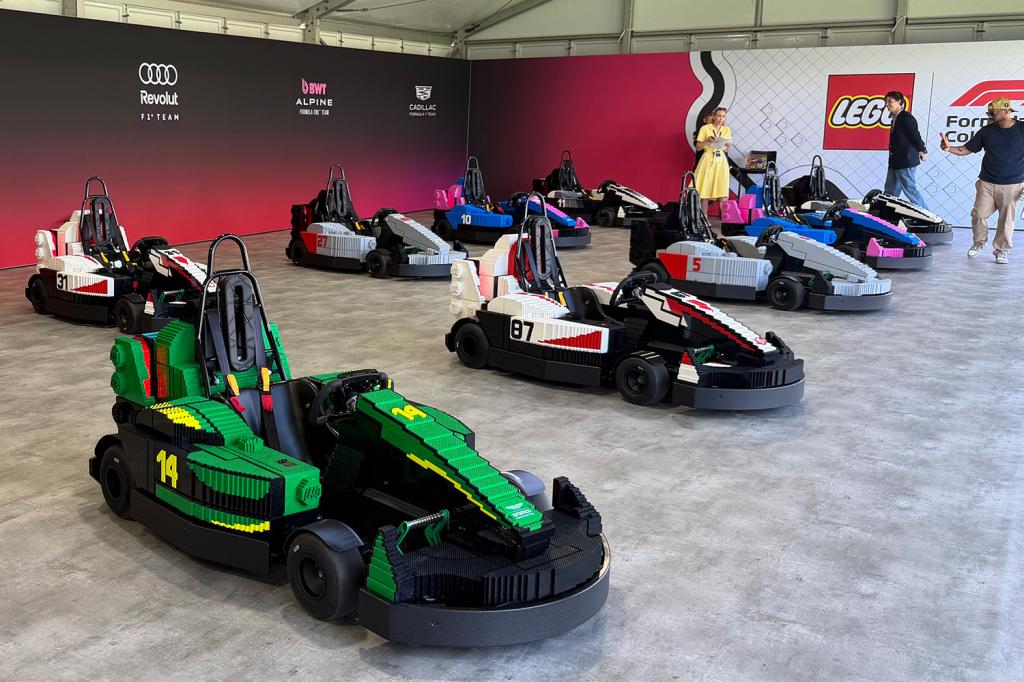
This time there was less exposed brickwork and proper bumpers – a response to the minor prangs of the year before.
The race parade was exactly as chaotic as you’d expect, with several drivers (and FIA President Mohammed Ben Sulayem) ending up beached in the gravel.
What’s next?
Two years in, the partnership shows no sign of running out of racetrack. What started as a set of Speed Champions cars has become a genuine creative partnership between a toy company and the fastest sport on the planet.
Lego and F1 are locked into a multi-year deal, and if the past two seasons are anything to go by, I can’t wait to see what they have coming up next.
Liked this? Does investing in Lego make more sense than stocks and shares? We’ve crunched the numbers, the answer may surprise you




Read the full article here


