







Introduction
Can you really have too much of a good thing? Acer’s new gaming laptop is about to test the theory. The Predator Helios 18 AI has hardware usually reserved for enterprise-grade equipment, not an RGB-infused desktop replacement notebook.
On top of Intel’s latest “Arrow Lake Refresh” processor and range-topping GeForce RTX 5090 graphics there’s a ridiculous 96GB of memory on board – right while we’re in the middle of an AI-inflicted component cost crisis. Terabytes of speedy SSD storage and a blindingly bright mini-LED display just ramp things up further.
The one small snafu that’ll stop most gamers in their tracks? The five thousand pound asking price. It’s so OTT that Acer’s North American arm has actually reigned in its version, capping out at 32GB of RAM and a 1TB SSD – though that’ll still set US shoppers back an eye-watering $4499. At that point, is the Predator really a workstation wearing esports cosplay?
What has changed between Helios 18 generations?
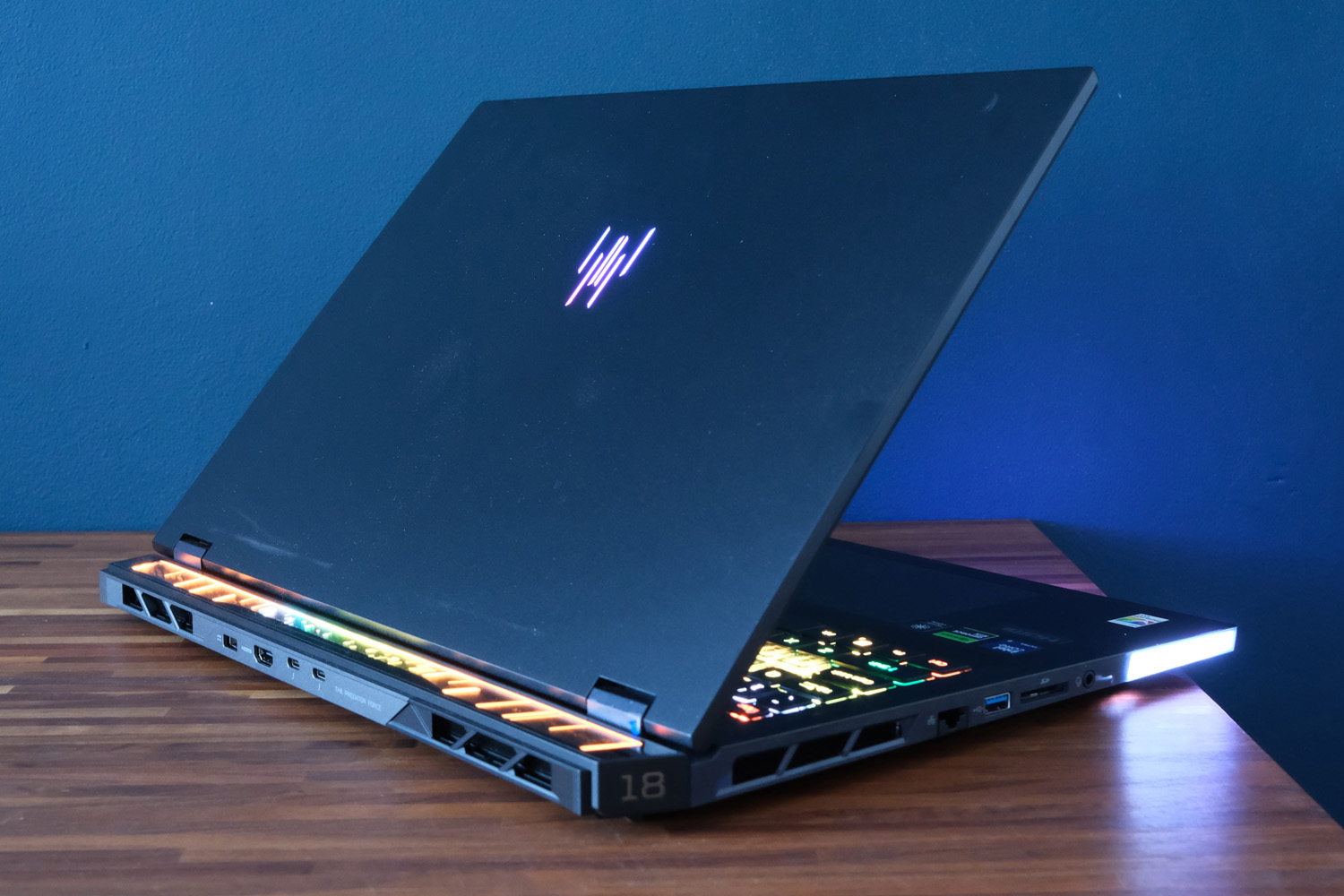
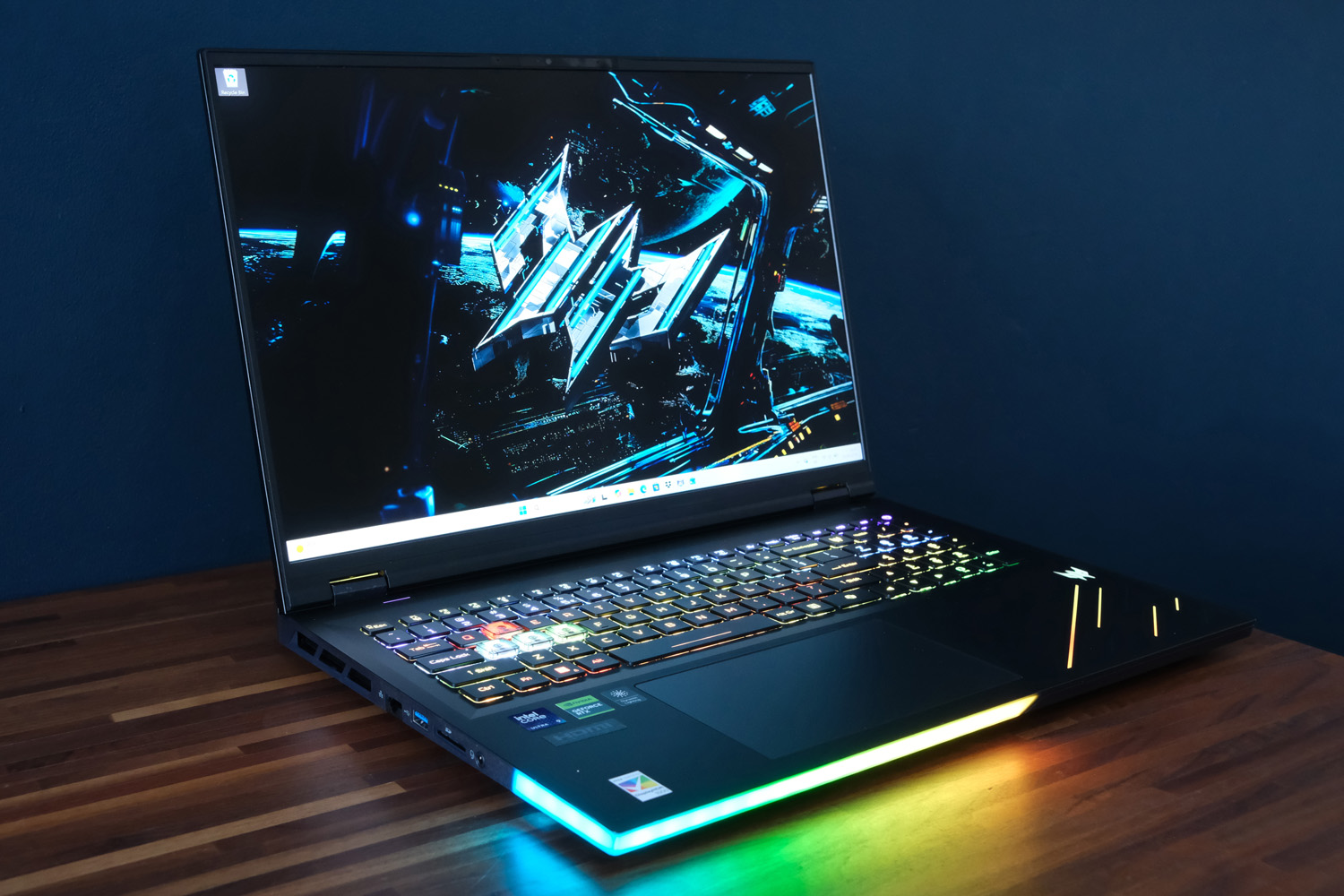
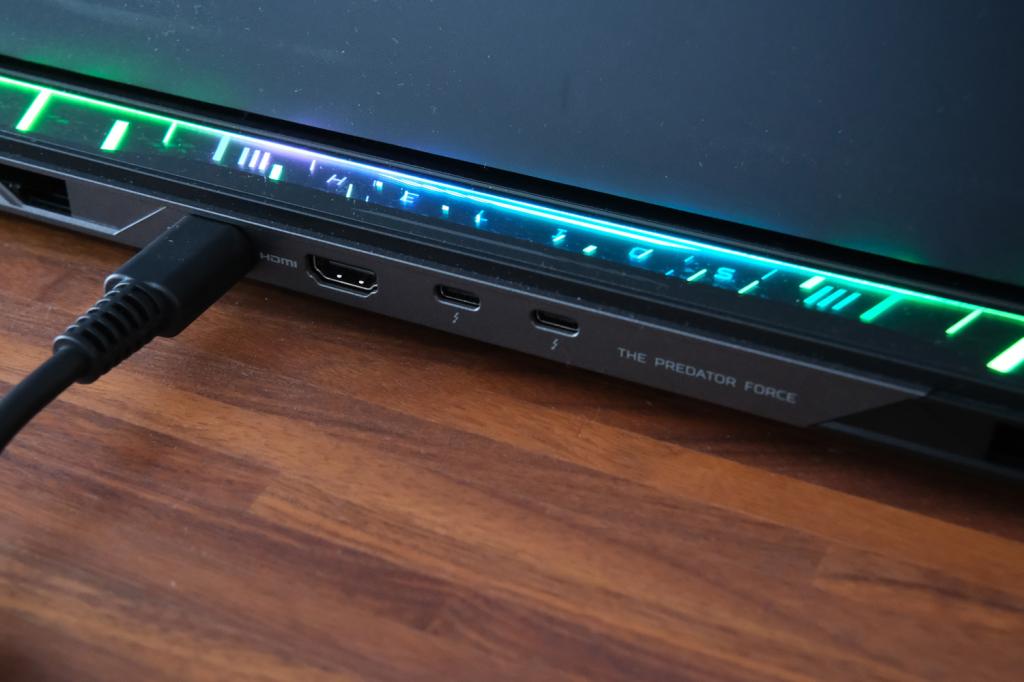
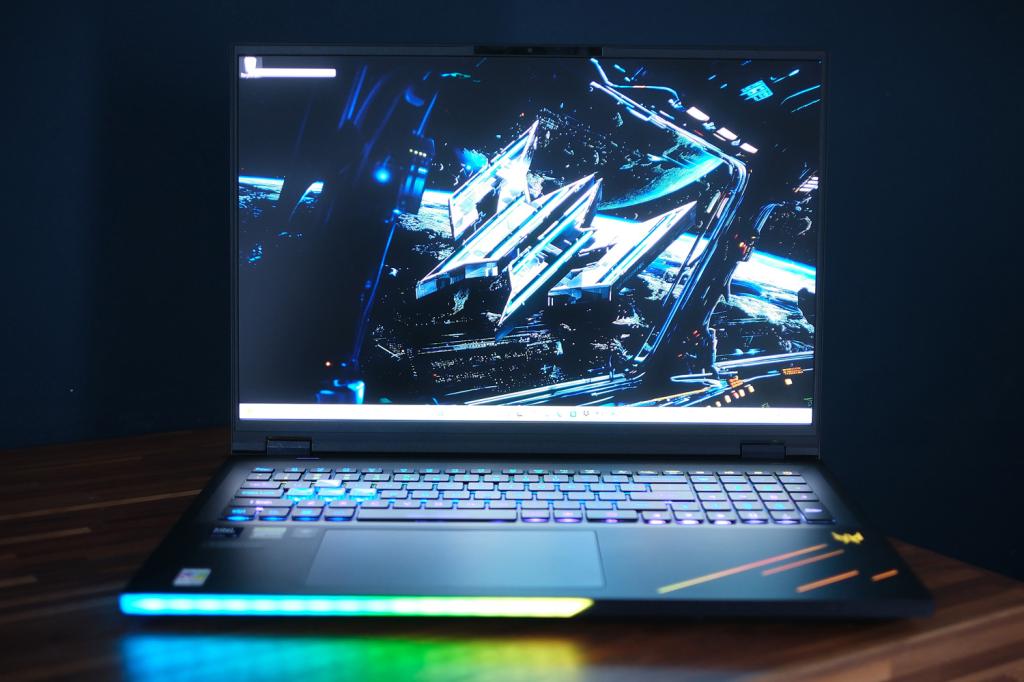
Physically, not a whole lot. This new Predator uses the same chassis as the 2025 version, complete with RGB lighting scattered throughout the chassis. The logo on the lid, the entire keyboard tray, the wrist rest and even the front lip of the laptop all glow rainbow hues the second you power it up – as does the now-familiar ‘chin’ at the rear which makes room for the sort of cooling kit needed to tame desktop-class components.
Turn off the lights and the all-black chassis looks rather minimal, albeit rather massive. This 18in brute weighs in at 3.5kg and has a considerable desktop footprint. It’s not something I’d want to carry around on the regular – especially as the 400W power supply needs to come along for the ride – though it still has a desktop PC licked for portability. Thickness is a hair under 30mm, which is respectable for a laptop meant to take up near-permanent residence on your desk.
While the lid is made from metal, everything else feels like polycarbonate – but not the kind that feels cheap. There’s little flex and no rattles, so it feels like money well spent once it’s on your hands. It comfortably has the edge over Medion’s Beast 18.
Connectivity is also superb, with HDMI 2.1 and twin Thunderbolt 5 type-C ports at the rear; one USB3 Type-A, a 3.5mm headphone port, Ethernet port and an SD card reader on the left; and two further USB3 Type-As at the right.
What are the Predator Helios 18 AI’s keyboard and touchpad like to use?
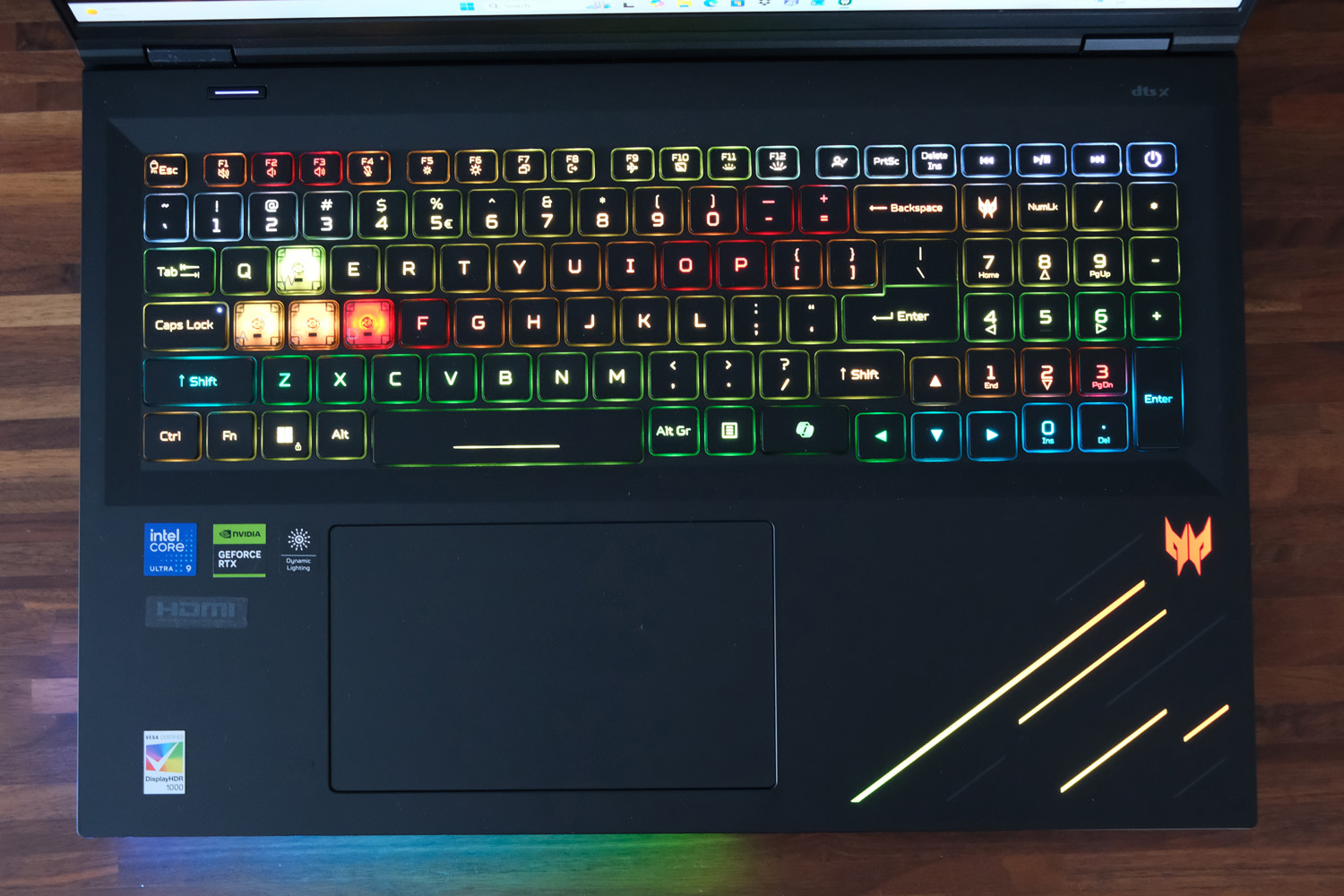
I wasn’t shocked to see both a full-size QWERTY ‘board and a numerical keypad when I opened the Predator’s lid. There’s even room at the sides, so you don’t feel at all cramped while typing. Only the function row (which is also stuffed with multimedia shortcuts ) is half-height, with every other key being full size.
Keys have a good amount of bounce and plenty of travel. They’re not overly loud and you’ve got plenty of room to rest your wrists either side of the expansive glass touchpad. I was quickly up to my usual typing speed.
The WASD and arrow keys go further, with swappable translucent switch/key cap combos that better show off the underlying per-key RGB included in the box. They’ve got a lower 0.7mm actuation point and a satisfying clicky, mechanical action that I loved for gaming. Installation is fiddly, though – I spent a good ten minutes searching my office floor for a spring I’d managed to dislodge – and you’re not getting the adjustable actuation seen many modern gaming keyboards.
I found the touchpad more of a mixed bag. It would often swallow my inputs, either ignoring clicks or making me swipe multiple times to move the cursor where I wanted it. There’s ample room for multi-touch gestures but the physical click feels just a little old school now that haptic ‘pads are a thing. Then again it’s unlikely to see a whole lot of use, given the Predator will spend most of its life at a desk and hooked up to a gaming mouse.
Is the Predator Helios 18 AI’s screen a class-leader?
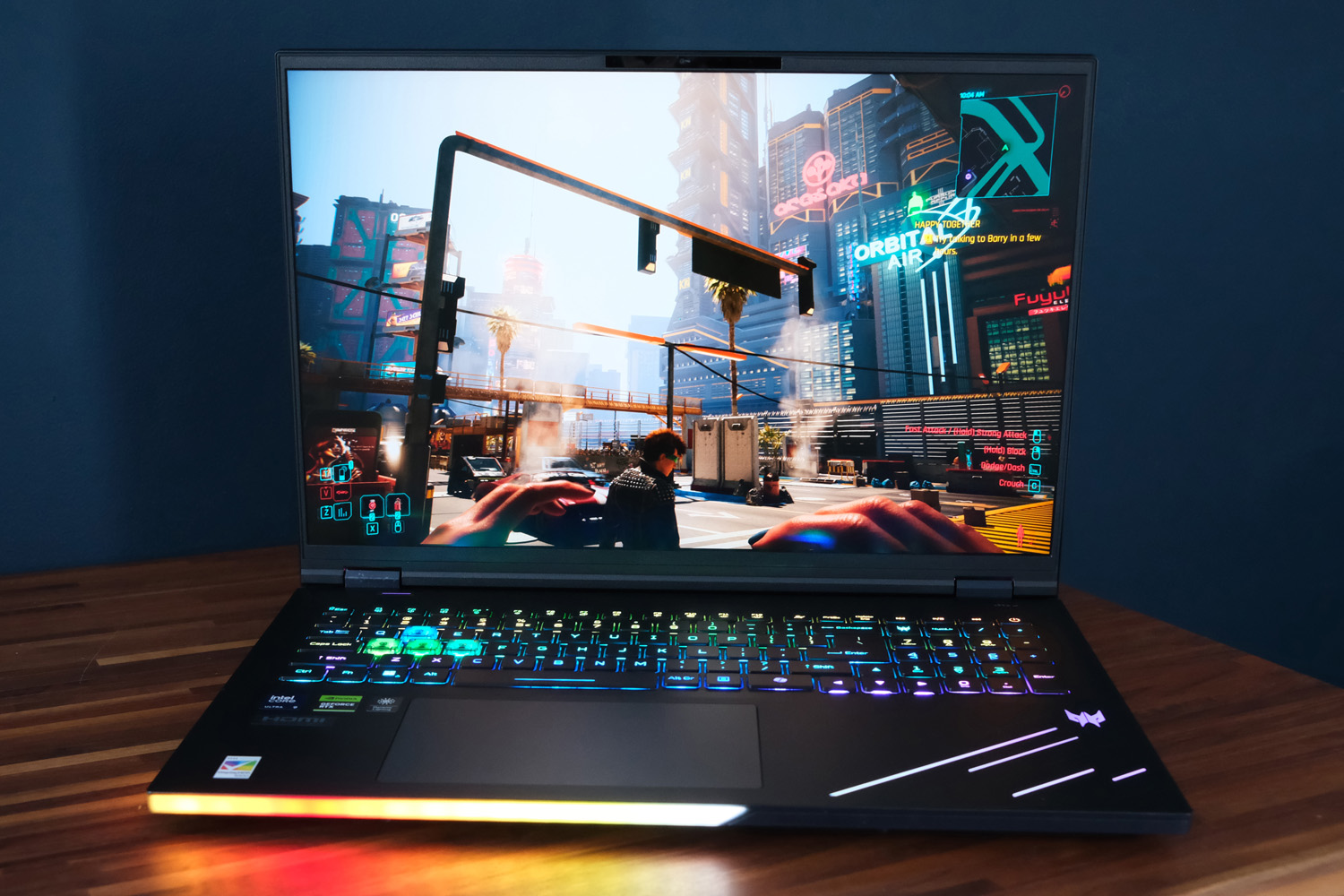
There’s no doubt Acer wins out for sheer brightness; the Predator Helios 18 AI can hit a blinding 1000 nits peak for HDR content, and isn’t that far behind for standard dynamic range. Even if your desk is right next to a window, you’ll have no trouble seeing what’s on this laptop’s screen.
It’s a mini LED panel, which is increasingly rare in a sea of OLEDs. While not immune from the halo effect when showing highlights against areas of deep shadow, it still puts in a strong showing in dark scenes with properly deep blacks. The matte finish works against it when having to deal with light reflections, but contrast is rather grand in a dark room. Games and films had real punch. Colour coverage is top tier, making it ideal for colour-precise creative work.
Obviously it’s huge at 18in, with a pixel count to match. Everything looks incredibly detailed at 3840×2400, even if it’s asking a lot from the GPU to run games at this resolution natively. Doubly so if you want to hit the 120Hz maximum refresh rate, which is admittedly a bit on the small side for a modern gaming laptop. A dual-mode display option lets you step up to 240Hz, but only by dipping the resolution down to Full HD; smaller rivals can manage 2560×1600 at the same refresh rate. Nvidia G-Sync eradicates any screen tearing when the GPU can’t quite manage a smooth 60fps, though.
I thought the six-speaker audio system was a decent match to the screen, with plenty of volume and a clear mid-range. It doesn’t have a huge amount of bass though, so I still reached for my headphones for any gaming.
Does the Predator Helios 18 AI’s performance live up to the specs?
The outgoing Helios was hardly wanting for power, but this new one steps up to another level courtesy of Intel’s Core Ultra 9 290HX plus. While based on the same architecture as the 275HX seen previously, Intel has eked some extra multi-threaded performance fro its eight performance and 16 efficiency cores – handy for gaming – without needing much extra power.
And yet it’s the amount of memory that’ll turn more heads right now. At a time when AI data centres have driven RAM prices through the roof, Acer has slapped a humungous 96GB of the stuff inside this laptop. 32GB is very much still the norm for gaming notebooks, with 64GB being ‘nice to have’ – 96GB feels like overkill. Unless, that is, you’re running massive local language models (LLMs) on-device, or are comparing with the outgoing model; Acer sold a version of that with a ridiculous 192GB of RAM and 5TB of storage for a wallet-busting £6800.
Here the combo delivers performance that absolutely smokes the Core Ultra 9 386H powering Razer’s recently refreshed Blade 16. The higher 5.5GHz peak clock speed gave it the single-core edge, while the extra cores turned in significantly higher multi-threaded results. It’s also noticeably quicker than the Core Ultra 9 275HX powering Medion’s Beast 18, with multi-core and AI-based tasks some 40% improved. The extra memory is really coming into its own here.
| Acer Predator Helios 18 AI productivity benchmarks | |
| Geekbench 6 single-core | 2524 |
| Geekbench 6 multi-core | 22741 |
| Geekbench AI | 9791 |
| Speedometer 3.1 | 43.2 |
Real-world capability is equally rapid, with every bit of software I tried running nigh-on flawlessly. The extra memory really only comes into its own when working with AI, editing 8K video footage, processing absolutely massive datasets, or rendering 3D graphics in real-time; most gamers simply won’t benefit from it.
Case in point: the Nvidia GeForce RTX 5090 is an absolute monster of a GPU, with 24GB of dedicated video memory, but when set to the same display resolution as the Razer Blade 16 (which only has 32GB of RAM), frame rates in Cyberpunk 2077 were basically on par. You’re still having to reach for DLSS upscaling when activating path-traced lighting in the newest, most demanding titles.
The Acer saw more of a lead in older games, with Shadow of the Tomb Raider and Gears Tactics each gaining some 15-30fps – though that could also be because the faster CPU isn’t bottlenecking performance, or the larger Predator’s dual AeroBlade 3D fans, heatpipe cooling system and liquid metal thermal grease are able to tame temperatures better than the slimline Razer.
| Acer Predator Helios 18 AI gaming benchmarks | Native rendering (3840×2800) | 2560×1600 | DLSS Upscaling |
| 3DMark Steel Nomad | 6085 | N/A | N/A |
| Gears Tactics | 95.9fps | 174.5fps | N/A |
| Shadow of the Tomb Raider (RT off) | 98fps | 180fps | 158fps |
| Shadow of the Tomb Raider (RT on) | 66fps | 128fps | 119fps |
| Cyberpunk 2077 (Ultra, RT off) | 42.26fps | 91.72fps | 196.3fps |
| Cyberpunk 2077 (RT Overdrive) | 10.2fps | 22.8fps | 166.7fps |
Of course the Blade maxes out at 2560×1600, but the Acer has almost a third more pixels to play with. Cyberpunk 2077 at native resolution is simply asking too much, even before turning on ray tracing; 42fps is playable, but not what I’d be happy with after spending five grand on a laptop. DLSS helps out massively, with Ray Reconstruction and frame generation able to boost the RT Overdrive preset to a fantastic 166fps.
You’ll be able to game on the Predator Helios 18 AI for a long while to come – perhaps long enough for that extra memory to make a bigger difference to frame rates – but right now it doesn’t have such a monumental lead that gamers will be able to fully justify the expense.
I can’t ignore how loud it got while playing, either. The Turbo preset kicks the fans into high gear, at which point you’ll absolutely want to wear headphones.
What’s the Predator Helios 18 AI’s battery life like?

Acer has crammed in the biggest battery a laptop can have and still be allowed in your hand baggage on planes, but the 99Whr cell has a job on its hands keeping the Intel CPU and 18in display juiced for any serious stretch of time.
While I managed to eke just over four hours of streaming video with the screen set to 50% brightness and the RGB lighting disabled, any more demanding workloads will see it drain faster. Think of it as emergency backup power, rather than something that’ll get you through a working day away from the mains.
Should you buy the Acer Predator Helios 18 AI in 2026?
Don’t let those RGB effects fool you: with such a colossal amount of memory, this latest Predator is a desktop replacement laptop chasing coders and AI obsessives rather than gamers. The RTX 5090 GPU may deliver outstanding frame rates at the Acer’s native resolution – helped by Intel’s potent new silicon – but they aren’t significantly higher than what 16in rivals with more mainstream CPUs and RAM can manage at 1600p. Unless you’re sat millimetres from the screen, the resolution difference won’t be all that noticeable in games.
While it may future-proof you for a while, anyone wanting true long-term ownership will still be better off with a similarly-priced desktop PC. Though not as transportable and needing a separate screen, mouse and keyboard, a desktop-class 5090 would be another step up from the laptop chip inside the Acer.
That said, if you’re determined to get a laptop with desktop-grade number crunching ability, the Predator is cheaper than Alienware’s Area-51 18 by some margin – while also having a third more RAM.
What are the Acer Predator Helios 18 AI’s technical specifications?
Scroll to see more →
| Specifications | Acer Predator Helios 18 AI |
|---|---|
| Screen | 18in, 3840×2400, 120Hz mini-LED |
| Processor | Intel Core Ultra 9 290HX plus |
| Memory | 96GB RAM |
| Graphics | Nvidia GeForce RTX 5090 |
| Storage | 2TB |
| Operating system | Windows 11 |
| Connectivity | 3x USB3 Type-A, 2x Thunderbolt 5 Type-C, HDMI 2.1, 3.5mm headphone port, Ethernet, SD card reader |
| Battery | 99Whr |
| Dimensions | 401x308x29.6mm, 3.5kg |




Read the full article here


