







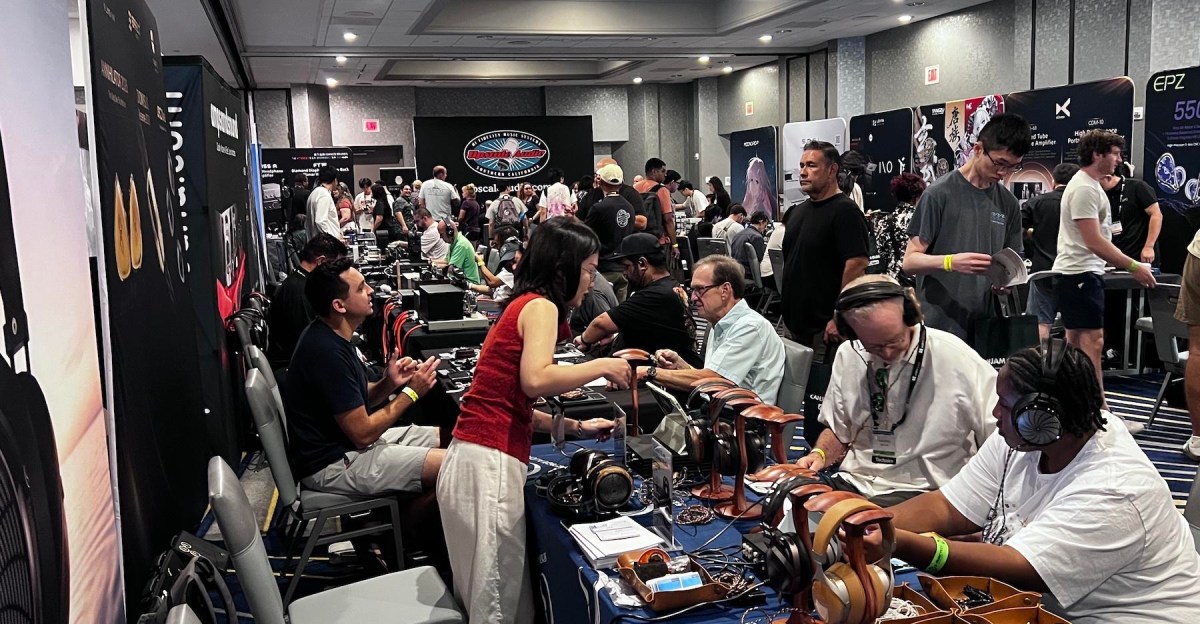
I’ve been reviewing headphones for a long time, and I’ve listened to everything from the barely serviceable to multi-thousand-dollar open-back headphones. But recently I’ve been uninspired by the state of mainstream options. Most are perfectly good — great, even — but they lack a distinct character. Something to remind me why I fell in love with headphones to begin with, landing me in this crazy career. I needed some revitalization. I needed to see something cool. I needed to be around other people with an emotional connection to headphones. I needed to go to CanJam.
CanJam is a small audio show produced by Head-Fi.org, the largest audio-focused online forum, with multiple events a year at different places around the world, including London, Shanghai, New York City, Dubai, and Southern California. It’s where mainly boutique manufacturers exhibit their latest headphones and related gear to enthusiasts constantly searching for the most accurate and engaging audio experience they can find. You won’t find Bose or Apple here — although Sony’s Pro division was there, as were some familiar names like Sennheiser and Audeze.
In all my years covering A/V gear, I’ve never actually made it to a CanJam. Either it wasn’t an interest for the outlets I was writing for, or personal obligations kept me from going. But this year, my first at The Verge, felt like the right time. So on August 29th, I braved the 405 from Los Angeles down to Irvine, California.
CanJam SoCal 2026 was in a convention space at the Irvine Marriott. Most exhibitors — including larger audio names like Sennheiser, Focal, and HiFiMan as well as niche brands like Astell&Kern and Noble Audio — had booths in the biggest room. Many set up listening stations with tablets running Qobuz (the streaming service of choice for audiophiles because of its hi-res lossless audio) to demonstrate their headphones, DACs, amps, media players, and even cables. Others were in quieter rooms off the main hallway, more conducive to listening. And crowding into those rooms and booths were a couple thousand audio enthusiasts.
My first stop was the Campfire Audio booth. Campfire Audio builds earbuds in Portland, Oregon; I’ve listened to its $1,500 Solaris and $300 IO in-ear monitors in the past. Today, though, was for an in-ear monitor that debuted at CanJam Singapore in May: the Campfire Audio Chimera. Most mainstream earbuds and headphones have a single driver per ear that has to reproduce every frequency from the lowest bass to the highest treble. Two if you’re lucky. The Chimeras have nine. It’s a “quad-brid” design, meaning they use four different types of audio delivery in a single IEM: a dynamic driver for bass and lower mids; a dual-diaphragm balanced armature (BA) for midrange clarity and two more for the high end; four electrostatic tweeters to add high-end air and spaciousness; and bone conduction for extra bass.
Because of the number of drivers, the Chimera are chonky: about the size of a piece of Bubblicious bubble gum. It took some finagling to get them comfortably in place. Once I did, though, I was immediately impressed. The low end was nice and full, without getting muddy or overpowering the frequencies above. An open high end gave space to allow cymbals to shimmer and decay while avoiding any abrasiveness. The real star, though, was the midrange. Both the quiet, conversational passages of Tracy Chapman and passionate wailing of Janis Joplin sounded as if they were right there in front of me. Even though I was listening while standing in a conference hall, the Chimera delivered one of the most detailed and enjoyable listening sessions I’ve had in a long time. But they’re also $7,500.
That pricing isn’t unheard of in the audiophile world — boutique, hand-built audio gear is always more expensive — but the Chimera are at another level, even compared to the rest of Campfire’s lineup. In addition to the design and engineering necessary to create a small(ish) in-ear with nine drivers all working together, much of that price is also because of materials and manufacturing. They have a carbon fiber and brass Damascus construction, with folded layers that create a topographical map design. And because of that process, the slight variations in finish make each Chimera unique. They also have a six-conductor cable that by itself is more expensive than most people’s earbuds, and include a microfiber cloth, IEM cleaning tool, and nine different tip options.

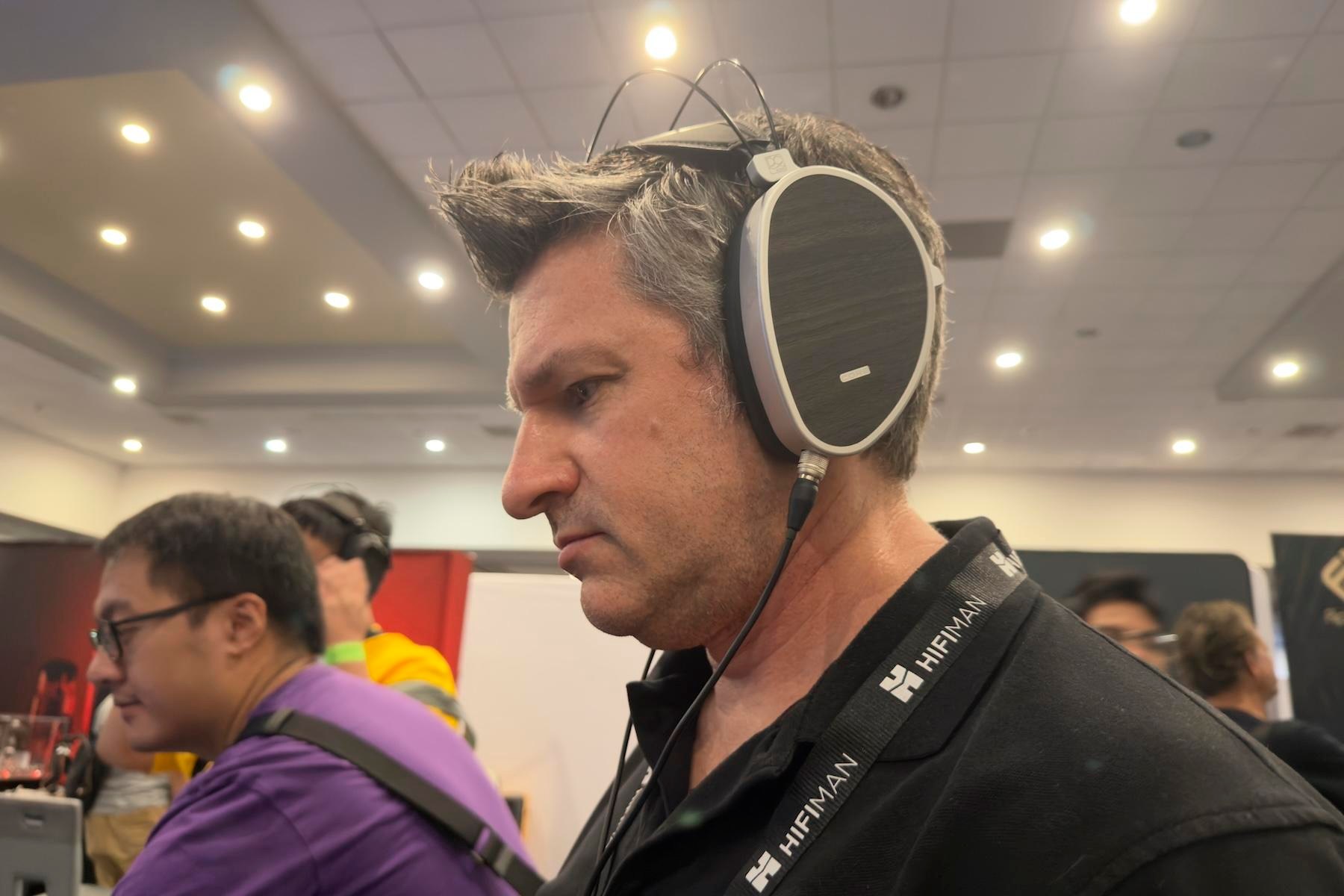
Not every product at CanJam is that far out of reach, though. Fosi Audio had wired in-ears for under $150 that sounded good for the price, plus an interesting portable CD player. The Dan Clark Audio Aeon Core planar magnetic headphones — which aren’t cheap at $900, but still more accessible than the Chimera — had a nice, wide soundstage, where the background vocals in the Black Crowes’ “Remedy” wrapped around to sing from my left and right, with Chris Robinson in front. Snare hits snapped and cymbals sizzled, although on “Fast Car” by Tracy Chapman the snare verged on being too much. I’ve been a fan of Dan Clark Audio headphones since the company was MrSpeakers, and I could easily envision myself relaxing on the couch with the Aeon Core.
The Aeon Core are closed-back headphones, so it was easy to concentrate on the music even with the bustle around me. But many audiophile headphones are open-back, and a busy show floor is not an ideal space for getting a good impression. I tried a pair of $1,449 HiFiMan Arya headphones with an onboard Wi-Fi receiver. Wi-Fi is still rare in headphones (although the recently announced Sonos Ace Ultras have it); it’s better at streaming lossless audio over longer ranges than Bluetooth. They sounded good, but with their open-back planar design it’s difficult to get a strong opinion.
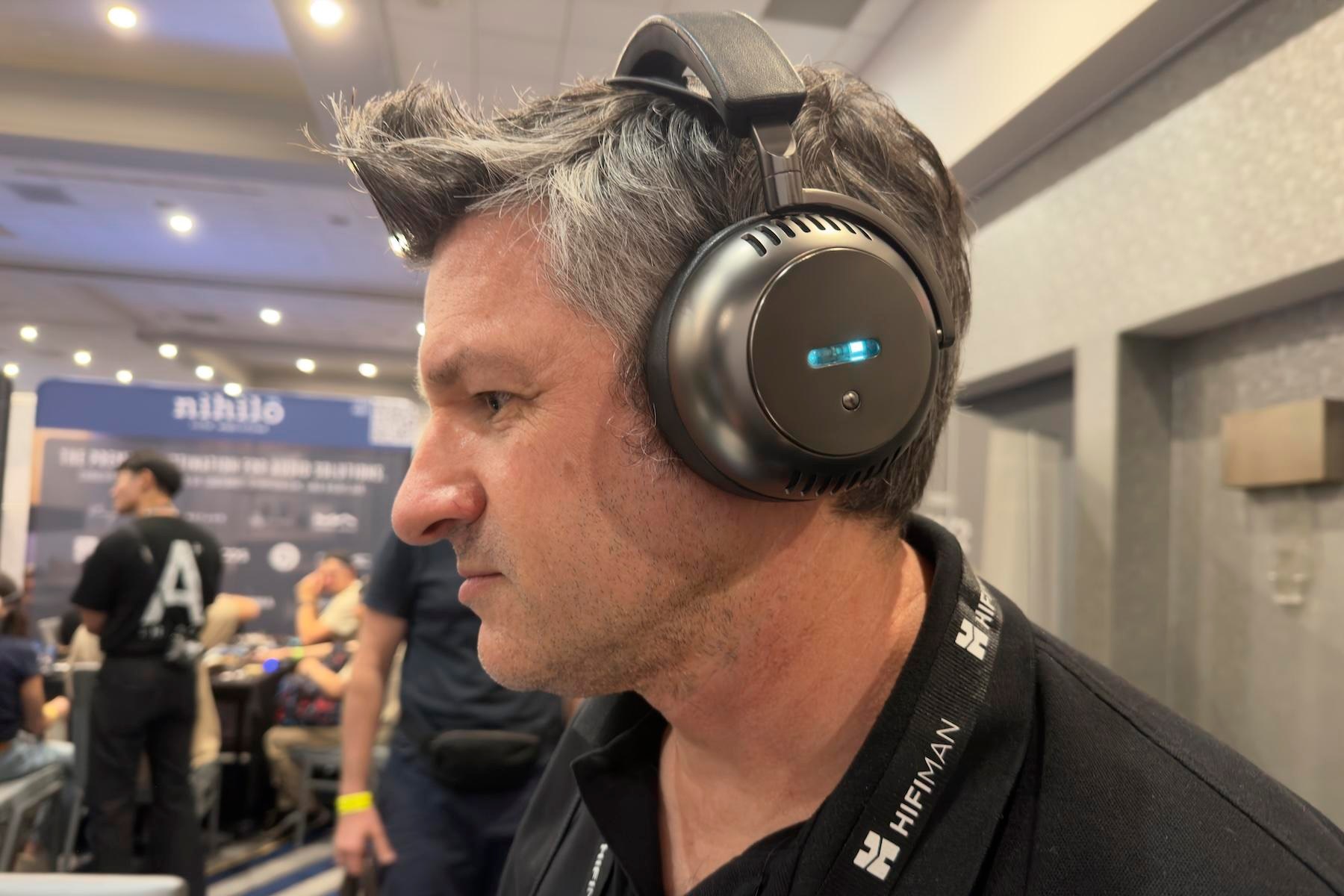
On my last loop of the show floor to see if there was anything I missed, a glowing ear cup caught my eye. It was a vacuum tube. In a pair of headphones! The Écoute TH2, which were funded on Kickstarter last March, are supposed to replicate a high-end two-channel audio system, all in the headphones themselves. They have a built-in vacuum tube preamp with a 6P1 tube and dual-mono amplification (the left and right channels are driven independently from the DAC to each driver). They also have solid ANC (a show floor is great for testing that) and an 8-band EQ, and they’re really comfortable. On a live recording of “A Pirate Looks at Forty” with Dave Matthews, Jack Johnson, and Tim Reynolds, I felt the audience around me as if I was at the show. There’s a lot of high-end detail, but the upper frequencies are boosted too much for my taste (I didn’t get a chance to try and tone it down with the EQ). Still, the TH2 are an incredibly interesting pair of headphones.
And they are what’s great about a show like CanJam. I never would have known about the Écoute otherwise; there are so many headphones out there and only one me. Decades ago, CES used to be more about audio than robots, but there’s no going back where that’s concerned. It’s all the more reason why CanJam and shows like it need to stick around.
Read the full article here


