

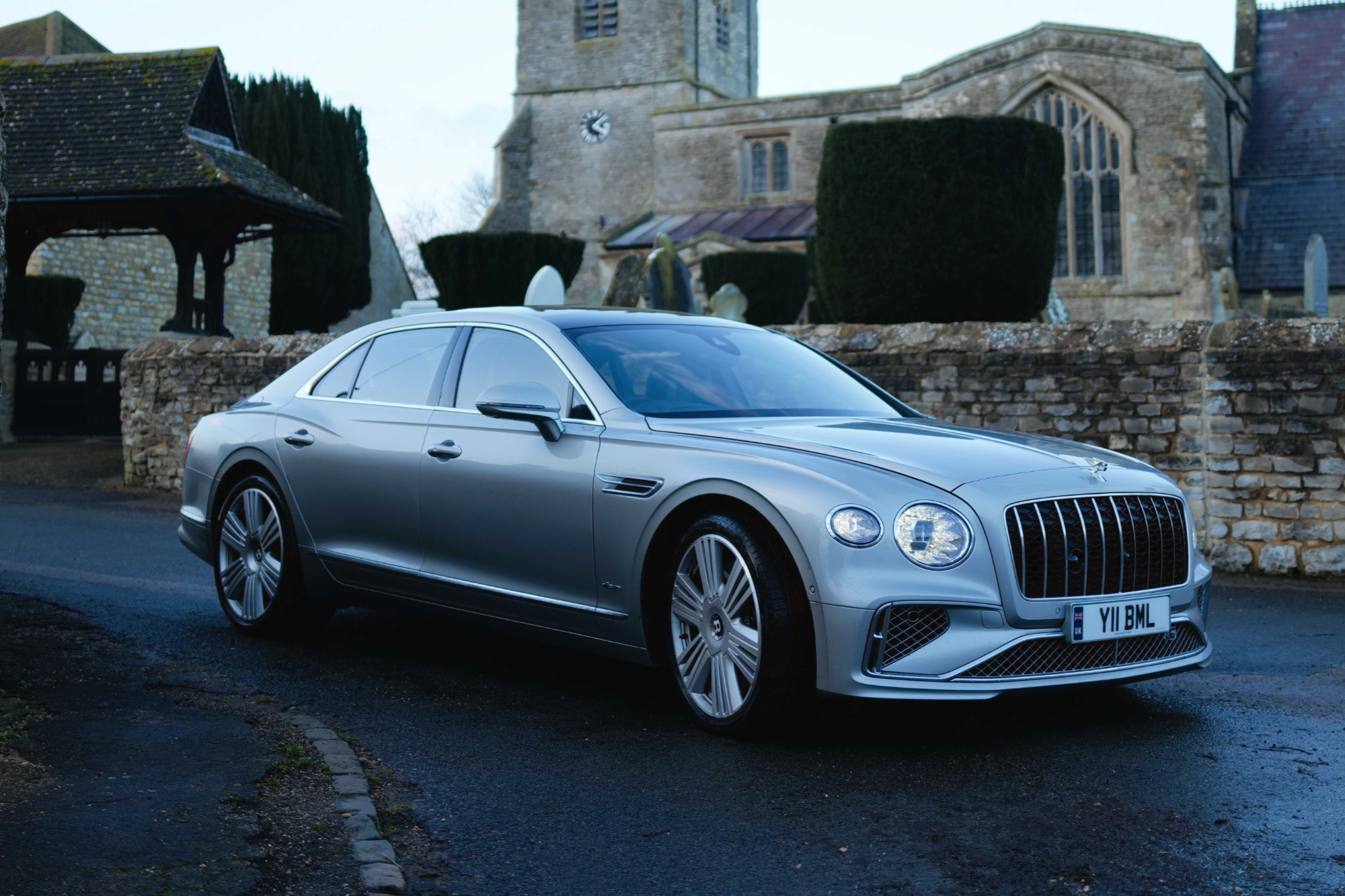
I’ve driven a fair few luxury vehicles over my time as a journalist, and I’ve watched the transition from big V12 and W12 engines to more efficient hybrid and electric powertrains. It’s a trend some traditional petrolhead keyboard warriors bemoan, but after living with the new hybrid Bentley Flying Spur for a week, I’m fully on board.
Pull away from a standstill in near-total silence, gliding through little villages on electric power alone, then drive 900 miles to the South of France without stopping – it’s the epitome of luxury.
Bentley calls the fourth-generation Flying Spur its first four-door supercar, which sounds like marketing, so I’ve spent a week with the car to test how it holds up.
The powertrain changes everything
Bentley’s new Ultra Performance Hybrid system pairs a 600 PS twin-turbo V8 with a 190 PS electric motor integrated into the eight-speed dual-clutch gearbox. Combined output is 782 PS and 1000 Nm of torque.
The 0-60 mph sprint takes 3.3 seconds, which is half a second quicker than the W12-powered car it replaces (which itself was never slow).
But the headline number is 47 miles of pure electric range. That covers the average commute, the pre-school run, a trip to the shops, all without burning a drop of fuel. And crucially, full electric mode is available at speeds up to 87 mph, which means it’s genuinely usable on A-roads and dual carriageways, not just crawling through car parks.
The transition between modes is seamless, too, making it very difficult to notice when you switch from pure EV mode to Hybrid. One moment the V8 is doing its characterful, cross-plane-crank thing, and the next, silence.
I drove the Rolls-Royce Cullinan recently. It’s a remarkable vehicle – serene, imperious, opulent, but climbing out of it, one thought kept nagging: this car really could use a hybrid powertrain.
Living with it
Day-to-day, the Flying Spur is remarkably easy to operate. The 25.9 kWh battery replenishes in under three hours on an 11 kW charger, so an overnight top-up is all you need.
The connected car features are all up there with the most high-tech vehicles – you get remote cabin pre-conditioning, remote charging monitoring, even the ability to summon the car from your phone.
Of course it has Apple CarPlay and Android Auto, viewing on the James Bond-esque rotating central screen (which still might be my favourite option in any car, ever).
The air ionisation system keeps the cabin smelling fresh, and the Wellness Seating, with its automatic postural adjustment and Seat Auto Climate, means long journeys genuinely don’t fatigue you the way they do in cheaper cars.
Comfort mode is noticeably better than the previous generation, too. The new twin-valve dampers allow the suspension to be properly compliant without sacrificing the body control in Sport. There are no compromises here.
The only thing I couldn’t get used to was parking a car this size (just over 5.3 metres long) in a car parking spot… best to get your chauffeur to do that for you.
A final word on the numbers
The previous Flying Spur Speed, powered by Bentley’s legendary W12, produced 900 Nm and 659 PS. The new hybrid car produces more torque, more power, accelerates quicker, and emits 90-percent less CO₂.
Total range between fuel stops stretches to 515 miles.
For a four-door car that weighs over two tonnes and hits 60 mph in 3.3 seconds, those numbers are genuinely startling.
The Ultra Performance Hybrid makes the Flying Spur better in every measurable sense. It’s quicker, cleaner, more refined, more capable in traffic, and arguably more fun to drive because the electric motor fills in the torque curve the moment you ask for it.
The Bentley Flying Spur Speed is proof that hybrid power is perfect for a luxury car.
Liked this? Driving the Aston Martin DBX S on a stormy night showed me why so many people like SUVs

Read the full article here
