

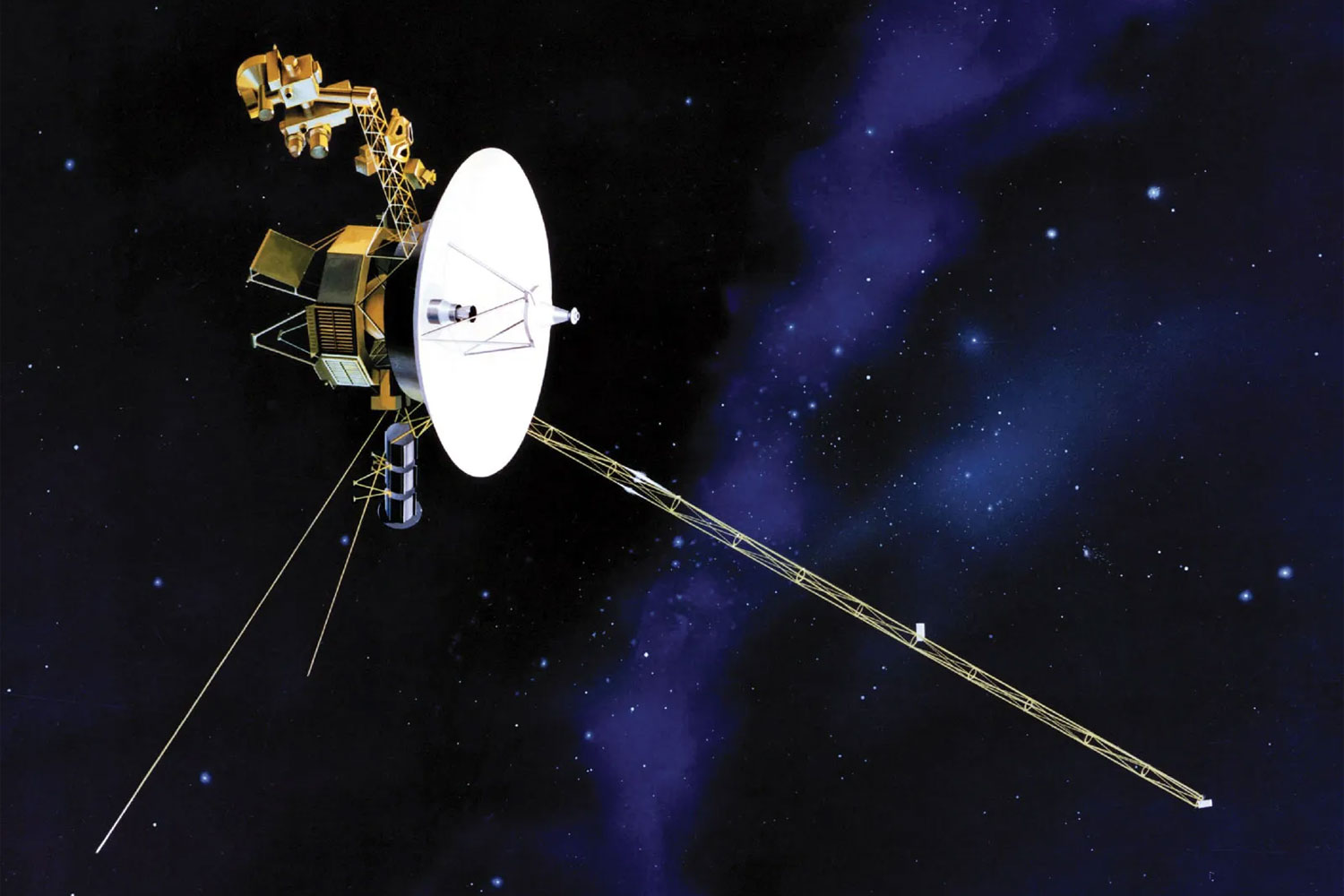
We’re huge fans of the latest and greatest tech here at Stuff. But there’s something about older tech from bygone eras that have a charm that modern glass slabs like smartphones simply can’t match. Take NASA’s Voyager 1 and Voyager 2 probes, for example.
Launched back in 1977 (when disco was still alive, and Star Wars had only just landed in cinemas), most modern smartphones would look like alien technology to the engineers who built them. But nearly 50 years later, both spacecraft are somehow still operational. It’s deeply impressive, and increasingly complicated.
A new deep-dive report (via Space Daily) has explored the strange reality of keeping the Voyager probes alive in 2026 – and it turns out the internet’s favourite version of the story isn’t entirely accurate.
You’ve probably seen the headline before – NASA is relying on a handful of octogenarian engineers to maintain the probes’ ancient software written in a programming language nobody understands anymore. That’s not completely true, but the actual situation might be even stranger.
The onboard systems don’t actually run on Fortran – the world’s first widely used high-level programming language developed in the 50s – as the simplified version of the story often claims. According to the report, the probes instead run assembly language written for purpose-built General Electric processors designed in the early 1970s.
The real issue isn’t necessarily the programming language itself though – it’s the vanishing knowledge surrounding it. Over nearly five decades, documentation has been lost, fragmented, or left sitting in paper archives as teams and offices changed over time. Some of the original engineers are no longer alive, while others retired years ago. Larry Zottarelli – the last original Voyager engineer still actively working on the mission – retired back in 2016 at the age of 80.
Today’s Voyager team is much younger overall, but NASA still occasionally relies on retired specialists for emergency support because the expertise involved is so niche.
And the hardware itself is primitive by modern standards. Across the Voyager computer systems, the total memory is often described as roughly 64KB to 70KB – less than a tiny image file on your phone. Voyager project manager Suzanne Dodd has previously compared operating the spacecraft to flying an Apple II through interstellar space.
That limitation became very visible during Voyager 1’s communications failure between late 2023 and early 2024, when engineers spent months trying to diagnose corrupted data coming from one of the spacecraft’s computer systems. The incident highlighted just how difficult it can be to troubleshoot ageing systems built using decades-old hardware and fragmented documentation.
At this point, though, the bigger challenge may simply be time. The spacecraft are powered by radioisotope generators that lose roughly four watts of power output every year, forcing NASA to slowly shut down instruments to keep the probes operational for as long as possible.
NASA currently believes that the probes could potentially remain contactable until around 2036. After that, the Voyagers will continue drifting silently through interstellar space – still carrying humanity’s messages into the unknown nearly 60 years after launch. I don’t know about you, but I think there’s something rather eerily beautiful about that.

Read the full article here
