

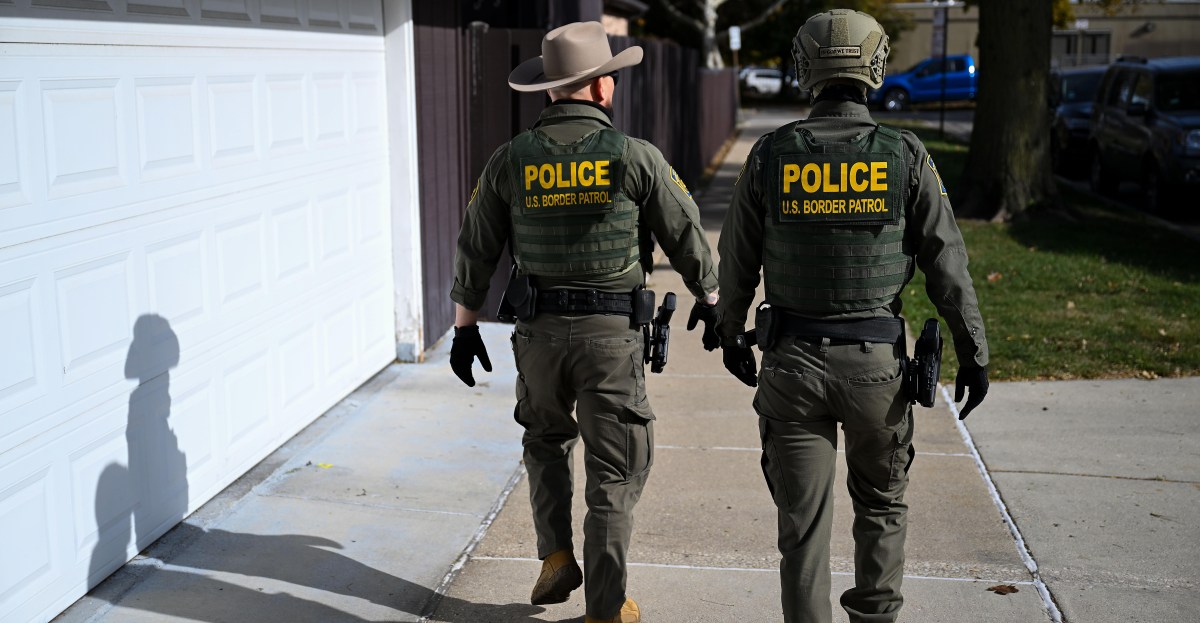
Border security czar Tom Homan keeps threatening to “flood” New York City with ICE agents. But a new investigation shows that ICE has been quietly ramping up arrests in the New York area already — and disproportionately targeting Latino neighborhoods. The City, a local nonprofit news organization, found 430 street arrests in the metropolitan area between October 2025 and mid-March. Of these, 93 percent involved Latinos, even though they only make up 66 percent of the local undocumented population. More telling: Many of those arrested weren’t the intended targets at all. Agents grabbed them while looking for other people, according to court records, and detained them because they supposedly looked sort of like the person they were after. ICE is ramping up enforcement in cities where there haven’t been reports of high-profile raids — and agents seemingly have carte blanche to arrest people based on the color of their skin.
After widespread backlash to ICE’s Operation Metro Surge in Minnesota, where a federal judge recently ruled that agents made warrantless arrests largely based on race, Homan said ICE is now using “smarter enforcement” in the Twin Cities and elsewhere. ICE has reportedly shifted to “targeted” arrests — but The City’s reporting shows that agents will eagerly arrest anyone they come across while looking for their targets. Though ICE has plenty of surveillance tools at its disposal it can use to track people down, this equipment is apparently far less effective than racial profiling. And even if other judges rule against ICE’s racist practices in the future, there may be little recourse. The Supreme Court recently ruled that racial profiling is permissible when it comes to immigration enforcement.
Court records obtained by The City documenting more than 1,200 arrests in the New York City area between October 2025 and mid-March show a troubling pattern of discrimination. Time and time again, agents will arrest a person they claim looks like their actual target, even when there’s little resemblance beyond skin color or accent. One man claims agents called him a “maldito Mexicano,” or a “fucking Mexican,” while arresting him. In several instances, ICE agents apprehended people they claimed looked like their targets and detained them even after it was evident they had gotten the wrong person. On one February afternoon, ICE agents circled the same Staten Island block multiple times in search of a 25-year-old Mexican man named Julio. They first detained a 36-year-old Guatemalan man named Isaias, then a 21-year-old Guatemalan man named Juan, both of whom they described as “a male who was believed to be the intended target.” The agents then arrested a third person, a 47-year-old man named Alejandro, because he left the building the agents had been monitoring. All three were taken into custody; the first two left the country after being detained.
Nationwide, ICE carried out more than 400,000 arrests in the first 14 months of Donald Trump’s second term, according to the NAACP Legal Defense Fund. A growing number of these apprehensions involve Latinos with no criminal past or outstanding deportation orders, suggesting that agents are illegally profiling people on the street, a Cato Institute analysis found. Multiple people detained by ICE have filed lawsuits alleging they were targeted not because of their legal status but because of their race — but the Supreme Court effectively allowed racial profiling in a 6-3 decision last September, ruling that ICE agents can stop people based on their “apparent race or ethnicity,” language, or accent.
ICE isn’t the only form of law enforcement roving the streets in search of immigrants. Just as Trump has ordered many agencies — including the FBI and Homeland Security Investigations, a division within ICE that typically investigates child exploitation and drug trafficking — to prioritize immigration arrests, so too have local police departments and sheriff’s offices taken on work on behalf of ICE. Under Trump, there has been a surge in 287(g) agreements, a Clinton-era program that deputizes police for immigration enforcement. On his first day back in office, Trump issued an executive order requiring the DHS secretary to maximize these agreements. By February, there were 1,412 active 287(g) partnerships across the country, according to NPR, nearly all of which were signed in 2025.
There are three types of 287(g) arrangements: The jail enforcement and warrant service officer models involve transferring people from local jails to ICE custody, while a third, the task force model, lets officers stop people for suspected immigration violations. The Obama administration suspended the task force model in 2012 amid rampant allegations of racial profiling and civil rights violations in some communities — most infamously Maricopa County, Arizona, where then-Sheriff Joe Arpaio, an early adopter of the 287(g) program, implemented an aggressive, nakedly racist enforcement regime. But Trump brought back that task force model, which makes up the majority of new agreements. A DHS spokesperson told NPR that police officers and sheriff’s deputies who sign up for the task force model receive 40 hours of training on topics including immigration and civil rights law, along with ICE’s Use of Force policy. Under previous administrations, 287(g) training took about a month.
Texas and Florida lead the pack. Both states have passed legislation requiring local law enforcement to cooperate with DHS, and in Florida, even Fish and Wildlife Conservation Commission officers are now scanning Flock cameras to assist ICE. The Trump administration is seeking to expand 287(g) everywhere, not just in states with high Latino populations. There has been an explosion in 287(g) agreements across the Midwest, and DHS has even begun offering financial incentives for officers who participate in 287(g) programs, including monthly bonuses up to $1,000. In other words, DHS is providing financial incentives for racial profiling. One critic, Nayna Gupta of the American Immigration Council, told KCUR that the bonus “is essentially a bounty” for immigrants.
Even when arrests don’t lead to immediate deportations, they funnel immigrants out of their communities and into remote detention centers, isolating them from legal support. To get out of ICE detention, a person needs to file a habeas corpus petition. Crucially, the habeas petition has to be filed in the jurisdiction where the person is detained, meaning someone arrested in New York — where federal courts are typically friendlier to immigrants — and transferred in Louisiana has a brief window of time to ask for release. Nothing about this process is clear or obvious. In its review of 1,200 habeas petitions filed between October 2025 and March of this year, The City found a troubling rise in street arrests, many of which followed a similar pattern of racial profiling.
Reports suggest that ICE is shifting its tactics without actually reducing enforcement. DHS Secretary Markwayne Mullin, who took over the department after Kristi Noem’s ouster, has said he wants to keep ICE out of the news and has signaled that the agency will take a more targeted, less bombastic approach to enforcement. But ICE hasn’t stopped roving the streets — agents have just begun doing their work more quietly. In New York, the shift to street enforcement may actually be an attempt to fly under the radar. Earlier in Trump’s second term, ICE agents were arresting people in federal courthouses, during or after their immigration hearings. These arrests were met with outcry from legal observers and advocates and were easily documented by journalists.
On the crowded streets of New York City, street arrests are less likely to draw attention — at least for now. In February, after agents were spotted in the predominantly Latino Brooklyn neighborhood of Bushwick, volunteers surrounded them and started blowing their whistles as the agents arrested someone. They pounded on the agents’ car windows and even managed to get the man’s contact information before he was taken away. According to The City’s reporting, the volunteers connected the man with a lawyer who helped him get out of ICE detention. But the fear persists. The randomness of the arrests means that anyone could be a target. But it won’t be just anyone: ICE is arresting people based on the color of their skin. Racial profiling is the only way DHS can fulfill Trump’s promise of mass deportations.
Read the full article here
